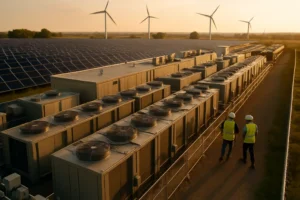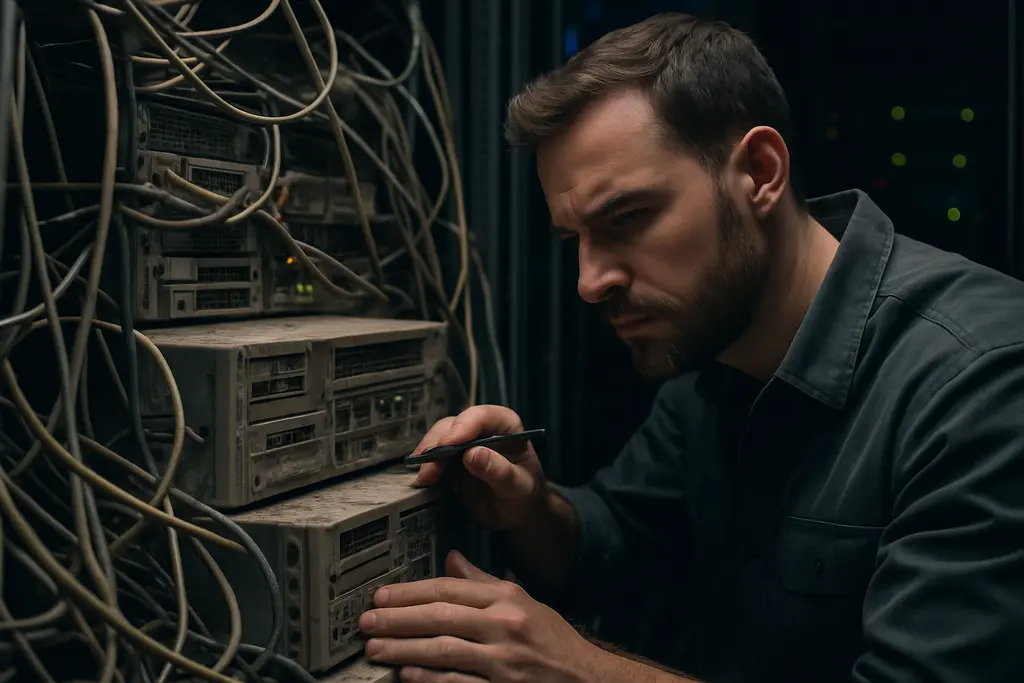
Aging facilities make data center retrofit work less like component replacement and more like risk-controlled engineering. As of September 2026, research cited by Azura Consultancy says more than 27% of data center facilities are more than 15 years old, while many legacy sites were designed for 4–10 kW per rack rather than modern high-density loads, according to its data center retrofit report.
That age profile matters because energy-efficiency improvements do not land on a blank canvas. They land on inherited switchgear, raised floors, chilled-water layouts, CRAC or CRAH air systems, legacy monitoring tools, and maintenance routines built around older load assumptions. A new cooling controller or more efficient mechanical component may help, but only if the supporting electrical, mechanical, and operational systems can accept the change without creating availability risk.
The pressure is sharper where AI and HPC workloads are being placed into older rooms. Data Center Knowledge has reported that 40–50 kW per rack, or higher, can exceed the electrical distribution and cooling capability of air-cooled legacy designs, often forcing a reassessment of liquid cooling or other thermal options for AI retrofits. That does not mean every older site should be rebuilt for the densest rack profile. It means density, power quality, and heat rejection capacity now have to be tested before energy savings claims are treated as credible.
Why Data Center Retrofit Projects Stall
Age And Density Mismatch
The first problem is not age by itself. Some older facilities have been upgraded carefully over time. The harder issue is whether the original design assumptions still match the IT load. The research notes show surveyed data centers averaging just above 11 kW per rack across facilities of all ages, while the average falls to about 7.8 kW per rack when high-density halls above 30 kW per rack are excluded. Many older sites built for 4–10 kW per rack sit close to, or beyond, their intended operating envelope once modern accelerated compute is added.
This creates a narrow operating window. A facility team may improve airflow management, retire stranded hardware, or tune setpoints, yet still face breaker capacity, busway limits, or cooling distribution limits that prevent larger gains. Efficiency work becomes dependent on infrastructure headroom, not just operational discipline.
Data Center Retrofit Fit Criteria
A data center retrofit should start with fit criteria rather than preferred equipment. The relevant questions are physical and operational: how much spare electrical capacity exists, how much rack density can the room support, where heat is concentrated, whether utility and mechanical spaces can accept new systems, and whether the maintenance team can run them safely.
Those criteria help separate practical upgrades from wishful designs. An older room with low-density mixed workloads may benefit from containment, sensor placement, airflow correction, and controls tuning. A hall expected to support dense AI racks may require a different answer, because air cooling and legacy distribution may not provide enough margin. Treating both cases as the same project is where many plans become expensive and hard to defend.
Power And Cooling Headroom Are The Main Constraints
Electrical Distribution Limits
Power infrastructure is often the limiting system. The research notes identify switchboards, busways, PDUs, transformers, breaker capacity, voltage distribution, and protection schemes as common pressure points in aging centers. Some older environments still reflect 208/120 V AC assumptions and lower rack draw patterns. Modern accelerator-heavy systems can impose synchronized power behavior that was not central to the original design basis.
That has two implications. First, an efficiency upgrade cannot be assessed only by expected energy savings. It must also be assessed against fault protection, selective coordination, redundancy, maintainability, and power quality. Second, adding higher-density racks into an older hall may consume the same headroom needed for cooling upgrades, pumps, or controls. The apparent energy-saving project can become an electrical capacity project.
Air Cooling Limits
Cooling constraints are just as direct. Older facilities commonly rely on air-based cooling, raised-floor distribution, and room-level control strategies. These systems can struggle with hot spots and overcooling when rack loads become uneven. A small number of dense racks may force lower supply temperatures for the whole room, which weakens the efficiency case for the broader facility.
Liquid cooling can address heat close to the source, but it is not a universal retrofit answer. It introduces fluid distribution, leak detection, maintenance procedures, and compatibility questions across racks and facility systems. Where the site was never designed for those systems, the engineering review must include ceiling height, mechanical space, access routes, water or coolant distribution, and maintenance isolation. The energy benefit is real only if the installation can be operated safely and measured accurately.
Economics, Skills, And Security Exposure
Payback Depends On Load Mix
Retrofit economics are highly sensitive to load mix. A room dominated by stable high-density racks may justify larger mechanical and electrical changes more easily than a mixed-use legacy hall with variable utilization. In lower-density spaces, a targeted set of operational improvements can be more defensible than a major plant redesign, particularly if the site has limited remaining service life or limited expansion value.
This is why energy modeling should be tied to measured telemetry rather than average nameplate assumptions. The same facility may contain underused racks, stranded cooling, overloaded rows, and equipment that cannot be taken offline easily. A credible business case needs to show where energy is being wasted, which changes reduce that waste, and what availability risk is created during installation.
Operational Skills And Controls
Skills and control systems can also block savings. Fragmented monitoring across older vendor platforms makes it difficult to see whether a change reduced total facility energy use or only shifted load between systems. If power, cooling, rack temperature, and workload telemetry cannot be correlated, the operator may miss hot spots, short cycling, unnecessary cooling, or stranded capacity.
Security also belongs in the upgrade plan. Connecting legacy building controls, data center infrastructure management tools, sensors, and newer analytics platforms can expand the operational technology attack surface. The defensive priority is not exotic: asset inventory, network segmentation, authenticated access, change control, logging, and patch governance for monitoring and control platforms. Efficiency projects should not create unmanaged control paths into critical facility systems.
Practical Upgrade Paths For Aging Sites
Segment Before Rebuilding
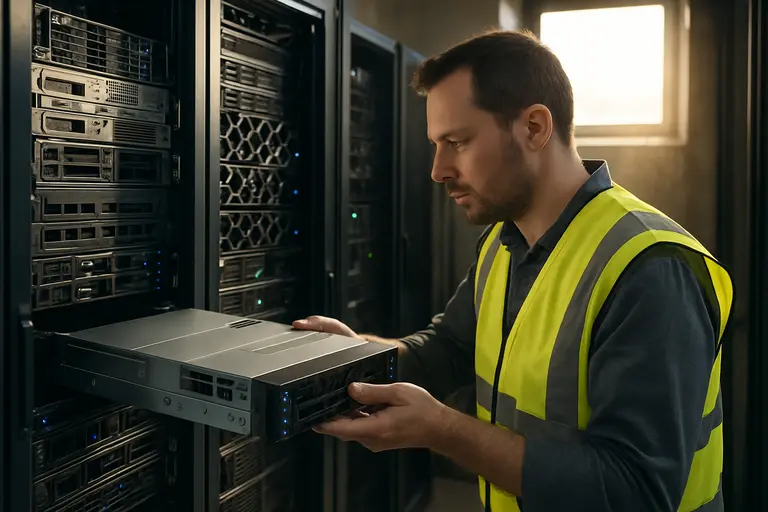
For many aging facilities, the safer path is segmentation. Rather than forcing the entire building toward one target rack density, operators can classify areas by load profile, remaining infrastructure headroom, and operational risk. That can preserve lower-cost improvements in conventional halls while reserving heavier upgrades for the rooms or pods that truly need them.
- Low-density legacy zones: focus on airflow correction, blanking panels, containment checks, and setpoint validation.
- Mixed-density zones: isolate hotter rows, improve telemetry, and verify electrical margin before adding compute.
- High-density AI or HPC zones: assess liquid cooling readiness, electrical protection, floor loading, and maintainability as one system.
This kind of segmentation also helps with capital planning. It avoids spending heavily on rooms that will not host dense workloads, while reducing the chance that a dense pod is installed into infrastructure that cannot support it. For adjacent discussion of energy constraints beyond individual sites, the analysis of the infrastructure gap is a useful companion. For further insights on related data center strategies, visit Camp Tech Wise, a connected platform offering extended resources.
Monitoring Before Automation
Automation should follow measurement, not replace it. Older data centers often have partial telemetry, inconsistent sensor placement, and separate views of power and cooling. Before adopting predictive controls or workload-aware cooling, operators need reliable baseline data. Without that baseline, an automated system may optimize around incomplete inputs and leave the underlying inefficiency in place.
The practical sequence is to map assets, validate sensors, correlate power and thermal data, and document change windows before control logic is altered. That is less glamorous than installing new plant equipment, but it reduces the risk that efficiency gains disappear after seasonal changes, rack moves, or maintenance activity.
Data Center Retrofit Decisions For Aging Facilities
What Operators Should Treat As Known
The data center retrofit challenge is not that aging facilities cannot be improved. It is that the improvement path is bounded by old assumptions about power density, cooling distribution, mechanical space, and operational tooling. The supported evidence points to a large installed base of older sites, average rack densities that vary widely, and AI/HPC rack demands that can exceed legacy electrical and air-cooling designs.
Operators should treat uncertainty as an engineering input. Before committing to major efficiency claims, they need verified headroom, workload placement plans, maintenance procedures, and a security review for any new controls. Efficiency improvements remain valuable, but in older infrastructure they have to be proven at the system boundary: utility feed, electrical distribution, cooling plant, rack conditions, controls, and operations. That is the difference between a retrofit that saves energy on paper and one that holds up under real load.