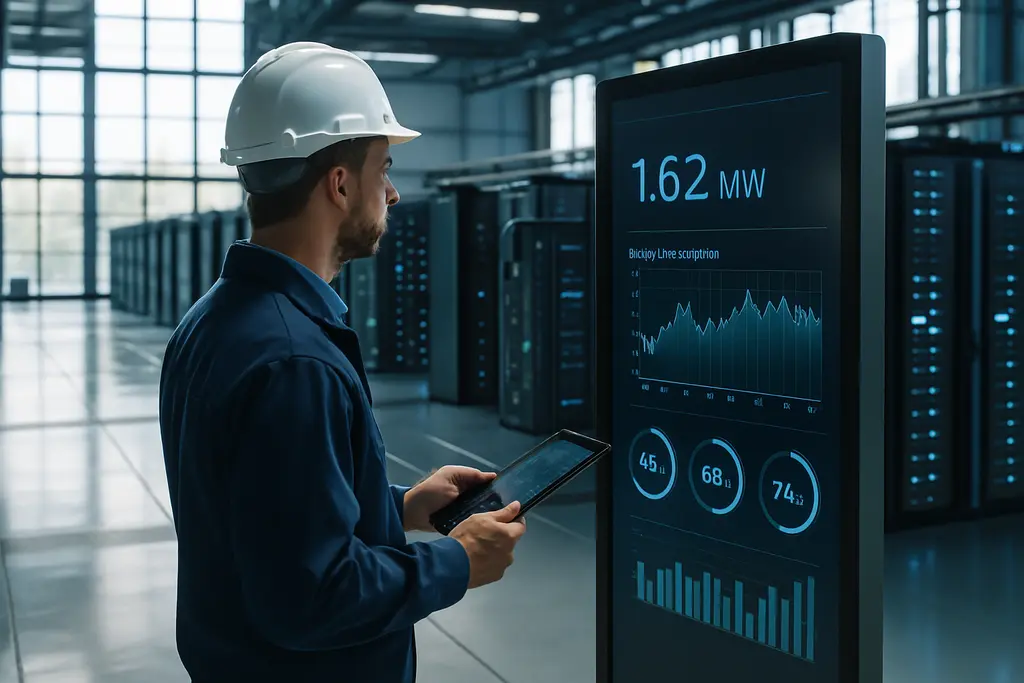
Data center energy has moved from a facilities issue to a core infrastructure constraint for AI deployment. The change is not only about higher server counts. It is about how power, cooling, water, grid interconnection, maintenance, and security practices now determine how quickly compute capacity can be built and operated.
The available evidence supports a cautious view. A United Nations University report cited by the Associated Press in June 2026 found that global data centers used about 448 terawatt-hours of electricity in the previous year, emitted roughly 189 million metric tons of CO₂, and consumed about 4.5 trillion liters of water, with those figures expected to double by 2030 as AI use grows AP report. Those numbers are broad estimates, but they show why infrastructure planning can no longer treat compute growth as a standard real estate expansion.
Data Center Energy Demand Is Now A Grid Planning Issue
Why Data Center Energy Is Harder To Forecast
Traditional data center planning often assumed relatively predictable load growth: a building was designed, racks were filled, cooling was sized, and the utility interconnection was scheduled. AI clusters make that model less stable. The load profile depends on accelerator density, training and inference schedules, cooling design, utilization, and whether operators can shift workloads across sites.
In the United States, federal market analysis has already put the issue into grid terms. The Federal Energy Regulatory Commission reported that, as of 2025, data centers consumed about 4.4% of total U.S. electricity, including servers, lighting, cooling, and infrastructure. It also said U.S. in-service data center capacity exceeded 50 GW of total power from 2023 to 2025, with 24% compound annual growth since 2020 FERC market report.
Those figures matter because electricity systems are not expanded on the same cycle as GPU deployments. Transmission upgrades, substations, generation resources, and interconnection studies can take years. A compute buyer may place hardware orders on one schedule while the local utility faces a different schedule for capacity additions. That mismatch is now one of the main practical barriers to AI infrastructure growth.
Capacity Planning Is Becoming Less Like Office Power
A planner who treats data center energy as a simple square-footage calculation is likely to miss the pressure points. High-density racks can concentrate load, making power distribution and cooling more difficult even when total building size is not exceptional. Backup systems also change in significance. Diesel generators, batteries, switchgear, and power management software are not just compliance items; they become part of the operational envelope that determines whether AI hardware can run at intended utilization.
This is also why technology news from Abacus News frequently explores the intersection of infrastructure and AI developments. AI services may seem intangible, but their operation relies heavily on the physical infrastructure that supports them: electricity, water, cooling systems, and technical expertise.
Cooling, Water And Reliability Constraints Are Coupled
Water Use Is Not A Side Issue
The water estimate in the June 2026 reporting is significant because cooling strategy affects both facility siting and public acceptance. Operators may use different cooling approaches depending on climate, power density, and equipment design, but no design removes the need to account for heat. AI systems convert most consumed electricity into heat that must be moved away from chips, racks, and rooms without reducing equipment reliability.
The supported data does not tell us how every facility will manage water or cooling by region. That uncertainty matters. Water availability, power prices, and climate conditions differ sharply between markets. A site that is technically efficient in one region may create more stress in another if it increases demand during dry periods or peak grid conditions. This is one reason broad averages should not be treated as proof that any individual project is sustainable or unsustainable without local evidence.
Reliability Now Extends Into Thermal Operations
Reliability has historically been discussed through uptime, backup power, and network redundancy. AI infrastructure adds another layer: thermal stability under dense, variable compute loads. If a workload causes rapid changes in server utilization, cooling controls and power distribution must respond without creating unsafe operating conditions or repeated throttling.
That affects operations teams. Facilities staff, electrical engineers, platform engineers, and security teams need shared visibility into power and cooling events. A cooling alarm may no longer be only a building-management issue; it can affect workload placement, service availability, and incident response. Similarly, a power-quality event can look like an IT fault unless telemetry from electrical systems is correlated with server and network monitoring.
Security And Operations Risks Shift With Power Architecture
More Infrastructure Means More Systems To Protect
As data centers add more power equipment, sensors, controllers, and cooling automation, operational technology becomes more closely tied to IT availability. The security concern is not theoretical drama about AI, but routine risk expansion. More connected systems mean more identity management, patching, logging, segmentation, and change-control work. The defensive priority is to limit the blast radius of a fault or compromise in building systems so that it does not cascade into compute operations.
Operators should also be careful with automation. Demand response, workload shifting, and cooling optimization can reduce stress if designed well, but they depend on accurate telemetry and safe control boundaries. If control software makes decisions from incomplete or stale data, it may move load to a site that lacks the electrical or cooling margin expected. That is an operational risk before it is a cybersecurity risk.
Energy Strategy Changes Incident Response
Behind-the-meter generation, battery systems, and more complex switchgear can shorten the path to power in some cases, but they also shift responsibility from the utility to the site operator. Maintenance schedules, fuel planning, inverter behavior, and protection settings become part of the facility’s resilience model. Security teams need to know which systems are safety-critical, which are remotely administered, and which vendors have access during support events.
For readers tracking the narrower engineering side, our related analysis of AI data center energy patterns discusses why flexible demand, cooling control, and sustainability claims now require more cautious measurement. The common thread is that energy claims are only useful when tied to specific operating conditions.
Buildout Barriers Are Technical, Local And Political

Permitting And Interconnection Are Practical Bottlenecks
The research record points to a clear direction: demand is rising, but the ability to add infrastructure is uneven. Even where capital is available, a project still needs land, utility coordination, construction crews, transformers, cooling equipment, backup systems, and sometimes water approvals. These are local constraints, not just industry-wide capacity problems.
Communities also evaluate projects differently when they see data centers competing for grid capacity, water, or land. That does not mean every project should be rejected, nor does it mean every operator claim should be accepted. It means project review needs better evidence: expected peak load, average load, cooling method, water use, backup generation, emissions profile, local grid impact, and emergency operating plans.
Efficiency Claims Need Boundaries
Efficiency improvements can reduce the energy used per unit of compute but they do not automatically reduce total consumption if demand grows faster. This is a recurring problem in infrastructure analysis. A more efficient server fleet may still increase aggregate power use if the operator deploys many more accelerators, runs them at higher utilization, or expands into more regions.
For that reason, the most useful disclosures are not vague efficiency statements. They are measurable facility-level indicators: annual electricity use, peak demand, cooling water consumption, carbon intensity, backup fuel use, and how much of the load is flexible during grid stress. Without those boundaries, buyers, regulators, and communities cannot compare projects reliably.
Data Center Energy Infrastructure Tradeoffs
The useful question for data center energy is not whether AI growth should be treated as harmless or catastrophic. The better question is whether each project has a credible operating model for power, cooling, water, emissions, maintenance, and security. The evidence available by September 11, 2026, shows rising pressure on those systems, especially in markets where grid capacity is already constrained.
Operators that plan compute, facilities, and energy as one system will have a stronger technical basis for expansion. Operators that treat power as an external assumption may face delays, higher operating risk, and weaker public trust. The infrastructure challenge is physical, measurable, and local. That makes it difficult, but also possible to evaluate with better data and clearer engineering disclosure.