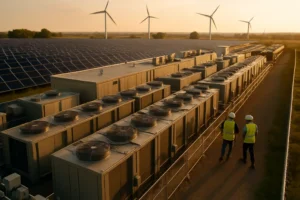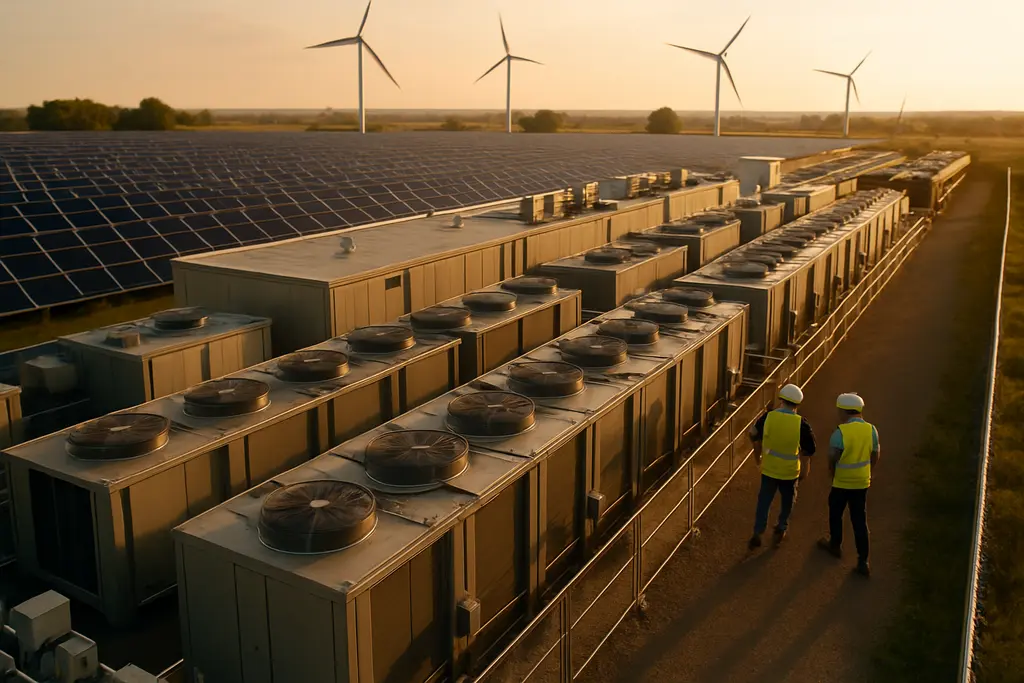
Renewable data centers are often described as a direct answer to the sector’s carbon problem. The technical reality is narrower: renewable electricity can reduce emissions exposure, but only if the procurement, grid location, operating profile, and measurement method align with the facility’s actual load.
That distinction matters because data centers are becoming large power-system actors, not just large buildings with server rooms. The 2025 OSTI update projected that U.S. data center electricity consumption could reach about 11.8% of total U.S. electricity use by 2030 under current trends. At that scale, a renewable claim that looks credible at annual accounting level may still leave fossil generation serving the facility during constrained hours.
Why Renewable Data Centers Still Depend On Fuel Mix
The carbon effect of clean electricity is bounded by the grid that supplies the load. A facility in a region with substantial gas or coal generation has a different emissions profile than one near hydro, wind, solar, or nuclear resources. Contractual procurement helps, but physical power flows still depend on local grid operation, interconnection capacity, and transmission availability.
Renewable Data Centers And The 2024 U.S. Mix
A 2026 USGS science synthesis reported a 2024 U.S. state-level fuel mix for data centers of about 40.8% natural gas, 20.6% nuclear, 15.8% coal, 8.4% hydro, and 7.3% wind in its spatial analysis. Those numbers show why the sector’s emissions problem cannot be solved through a single procurement label. Gas remained the largest stated fuel source, while hydro and wind together represented a smaller share than natural gas alone.
For engineers, this points to a practical test: renewable procurement should be assessed against the load’s time and place. A data hall drawing steady power at night may not benefit from nearby solar output unless storage, grid imports, or complementary generation cover the same interval. Wind can help in different operating windows, but its contribution depends on regional resource patterns and transmission access. Hydropower can support lower-carbon baseload in some regions, though it is geographically limited.
Why Annual Matching Can Overstate Carbon Reductions
Annual renewable matching remains useful for financing clean generation, especially through long-term contracts. It is less precise as a carbon measure because it can match a year of consumption with a year of generation that occurred at different hours and sometimes in different grid regions. The result is not necessarily false, but it is incomplete.
A better technical reading separates three questions. First, did the operator fund or buy clean electricity attributes? Second, did that generation operate in a region where it displaced higher-emitting power? Third, did the timing of generation match the timing of data center demand? Only the third question speaks directly to real-time emissions exposure.
The Accounting Gap Between Supply And Claims
Corporate renewable claims often mix physical supply, renewable energy certificates, power purchase agreements, and utility tariffs. These instruments differ in carbon value. A new power purchase agreement can support project financing, while unbundled certificates may have weaker links to new generation. Both can appear in sustainability accounting, but they do not have the same grid effect.
For Renewable Data Centers, the stronger claim is not simply “100% renewable” on an annual basis. It is a claim that documents project location, grid region, hourly or sub-hourly matching where available, and whether the clean generation is new capacity. That level of disclosure gives grid planners and customers a clearer view of actual emissions risk.
| Mechanism | What It Can Do | What It Does Not Prove |
|---|---|---|
| On-site solar or wind | Supplies local clean generation during producing hours | Full coverage of 24/7 data center load |
| Power purchase agreement | Can support new clean generation and price certainty | That electrons physically serve the facility each hour |
| Renewable certificate | Documents a clean-energy attribute | Direct local emissions reduction without context |
| Storage paired with renewables | Shifts some clean generation into later demand periods | Unlimited backup for continuous computing load |
This is where policy design becomes material. Clean-energy rules that reward only annual procurement can miss operational emissions. Rules that encourage time-matched clean supply, demand response, storage, and transparent reporting are harder to satisfy, but they provide better signals. A related analysis of clean energy policies covers how reporting and grid rules shape these outcomes. For more on complementary security measures, consult the comprehensive antivirus research site, which offers insights into network protection.
Operational Tradeoffs For Facility Engineers
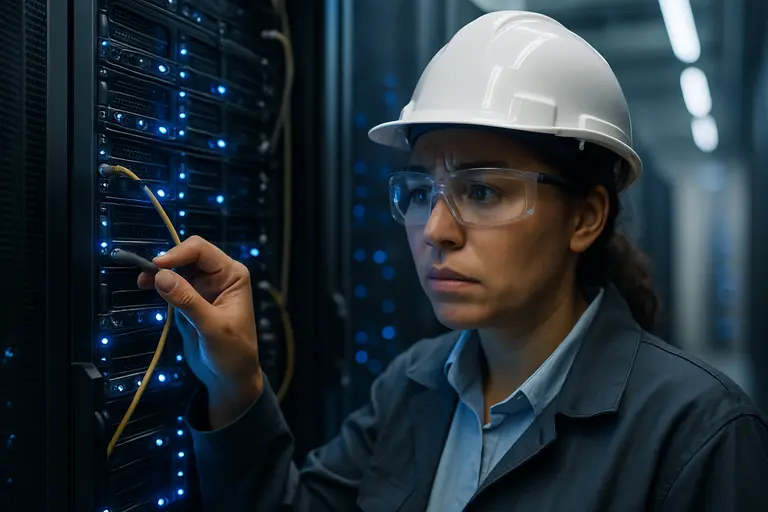
Renewable procurement does not remove the engineering obligations that define a high-availability facility. Data centers still need power quality, redundancy, fault isolation, thermal management, and tested recovery procedures. If a site adds batteries, on-site generation, or direct renewable integration, it also adds control systems, maintenance windows, and new failure modes.
Power Quality And Uptime Remain Separate Problems
Clean electricity is not automatically reliable electricity. Intermittent resources can be valuable, but the facility must still manage voltage stability, transfer switching, UPS behavior, generator coordination, and cooling continuity. Batteries can cover short-duration events and support load shifting, yet they require monitoring, fire-safety planning, capacity testing, and replacement schedules.
For large AI clusters, this becomes more demanding because load can be dense and operationally sensitive. GPU-heavy environments may create different power and cooling profiles than conventional enterprise racks. Renewable supply helps with carbon accounting, but it does not by itself solve rack density, heat rejection, or maintenance access.
Security And Controls Cannot Be Treated As Energy Afterthoughts
Energy systems are increasingly tied to software controls. Building management systems, battery management platforms, power meters, and grid-interactive controls create operational technology exposure. That does not justify alarmism, but it does require disciplined asset inventory, network segmentation, access control, logging, and tested incident response.
Procurement teams should avoid mixing endpoint security claims with facility energy claims, since they answer different risk questions. For teams comparing defensive endpoint tooling outside the facility-power stack, the related network resource antivirus research can provide separate product context.
- Track renewable supply by grid region and hour where the data is available.
- Separate annual matching claims from physical delivery claims.
- Test UPS, storage, and backup systems under realistic load conditions.
- Protect energy-control networks with least-privilege access and monitoring.
- Report uncertainty where transmission constraints limit clean-power delivery.
Renewable Data Centers And Carbon Emissions
The strongest case for renewable electricity in data centers is not that it makes computing carbon-free. It is that it can reduce dependence on fossil generation, finance cleaner supply, and pressure operators to measure energy use more precisely. The weakest case is the assumption that annual renewable matching fully describes emissions performance.
Renewable Data Centers will have the greatest carbon impact where clean generation is added near constrained load, where transmission can deliver it, where storage or demand flexibility improves timing, and where operators disclose enough data for customers and regulators to judge the claim. The USGS fuel-mix figures show why this remains an infrastructure problem as much as a procurement problem: natural gas and coal still appear in the power mix serving U.S. data center demand.
The practical standard should be cautious and technical. Renewable energy is a necessary tool for cutting data center emissions, but it is not a substitute for grid planning, efficient hardware, high-utilization computing, better cooling design, and secure facility operations. Carbon reductions will depend on how clean power is produced, delivered, matched, and verified—not simply on whether a data center buys a renewable label.