AI data center power architecture is entering a redesign phase because the rack is becoming too dense for yesterday’s electrical assumptions. The industry has spent years talking about GPUs and cooling, but the next hardware fight may sit inside power conversion, voltage levels, transformers, and the copper that carries current across the rack.
That is exactly the kind of hidden hardware layer that determines whether AI infrastructure can keep scaling. The same pressure behind Nvidia Blackwell GPUs is now forcing engineers to rethink how electricity moves from the facility entrance to the processor core.
AI Data Center Power Architecture Is Hitting 48V Limits
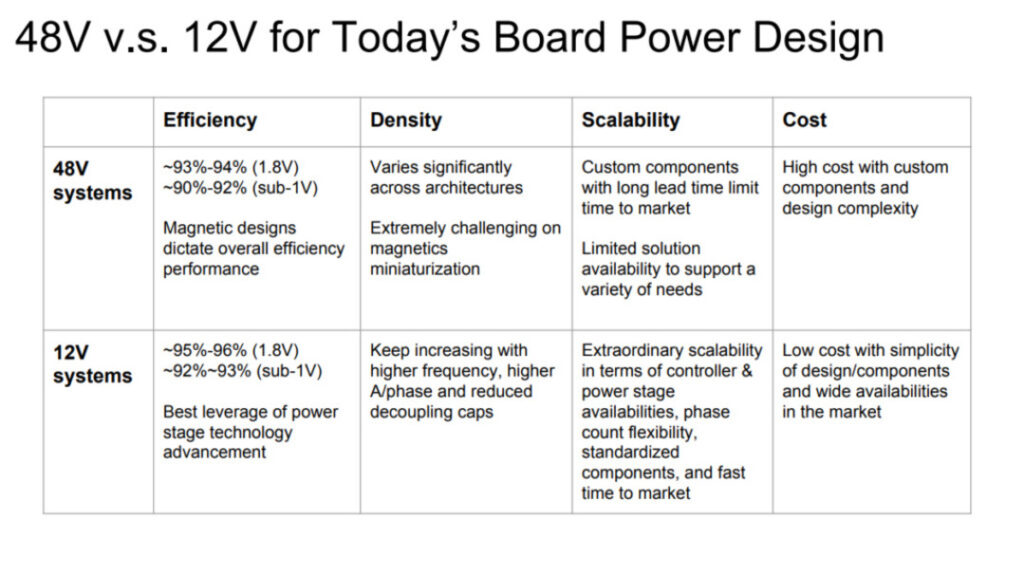
A recent technical paper argues that rapid AI workload growth is driving higher power demand, current transients, and thermal stress, exposing limits in traditional 48V rack architectures, low-voltage AC distribution, and line-frequency transformer interfaces. It points toward high-voltage conversion-ratio DC/DC converters, facility-level low-voltage DC distribution, and medium-voltage solid-state transformers as key building blocks for next-generation power delivery.
The core problem is physics. As rack power rises, delivering large amounts of energy at lower voltage requires higher current. Higher current means more losses, thicker conductors, more heat, more copper, and more complicated power distribution.
That is why the 48V rack is under pressure. It has served modern server infrastructure well, but AI racks are moving toward power densities that make old assumptions harder to defend.
The next bottleneck may not be the accelerator. It may be the power path beneath it.
Why AI Racks Are Electrically Different
Traditional data center racks were dense, but AI racks are different because accelerators concentrate power into systems designed for training and inference at massive scale. GPU clusters also create dynamic loads, with power changing rapidly as workloads start, stop, shift, or synchronize.
Those transients matter. A power architecture must not only deliver enough electricity on average. It must maintain voltage stability and reliability when AI workloads change quickly.
This is where older distribution chains become inefficient. Multiple conversion steps can compound losses. Transformers and UPS systems take space. Low-voltage distribution can create current and thermal challenges.
The industry can add more infrastructure around the problem, but that increases cost and complexity. The more durable answer may be changing the architecture itself.
800VDC Is Becoming a Serious Candidate
One reason 800VDC is getting attention is that higher voltage can reduce current for the same power level. Lower current can reduce conductor losses and ease some copper and thermal pressure.
A separate study on an SST-driven 800VDC data center architecture modeled a system converting medium-voltage AC to an 800V low-voltage DC bus and evaluated it against a UPS-based supply chain using real-world operating profiles. The paper found that the approach maintained tight DC-bus voltage regulation and reduced input-side energy consumption compared with the UPS baseline through an 800VDC data center simulation.
That does not mean every facility will jump to 800VDC immediately. Data centers are conservative for good reasons. Uptime matters. Safety matters. Standards matter. Maintenance teams need training. Protection systems must handle faults. Equipment ecosystems must mature.
But the direction is clear: AI racks are pushing power designers toward higher-voltage, more efficient architectures.
The New Power Stack Is More Than One Upgrade
| Power Layer | Traditional Pressure | Emerging Direction |
|---|---|---|
| Rack distribution | 48V current rises with rack density | Higher-voltage intermediate buses |
| Facility distribution | Multiple AC conversion stages add losses | Low-voltage DC distribution options |
| Transformers | Line-frequency equipment uses space and weight | Medium-voltage solid-state transformers |
| Backup systems | UPS chains add conversion complexity | DC-coupled backup and storage designs |
| Fault protection | DC systems need fast isolation | Solid-state protection and controls |
The table shows why AI data center power architecture is not a single component swap. It is a system redesign.
The Benefits Are Real, but So Are the Risks
Higher-voltage architectures can reduce losses, improve density, and free space for compute. They may also make it easier to integrate batteries, renewable power, and advanced controls.
But high-voltage DC distribution creates its own difficulties. DC faults behave differently from AC faults. Protection must be fast and coordinated. Equipment must be safe to operate and maintain. Standards need to catch up. Supply chains must support new converter designs at data center scale.
Solid-state transformers are promising because they can combine voltage conversion, control, and power-quality functions in more compact and flexible ways. Yet they also bring questions around cost, reliability, heat, and long-term field performance.
This is why the move away from conventional architecture will be gradual. The industry will not redesign every facility overnight. It will likely start with the densest AI campuses, where old designs impose the highest cost.
The practical challenge is efficiency without fragility.
The Next Signals Are Standards, Vendors, and Rack Density
The first signal is vendor alignment. If major GPU, server, power electronics, and facility-equipment companies converge around similar voltage architectures, adoption becomes easier.
The second signal is rack density. As more roadmaps point toward extremely high-power racks, operators will have less room to keep traditional distribution untouched.
The third signal is standards and safety. New voltage architectures need protection rules, maintenance practices, certification paths, and training before they can become mainstream.
The fourth signal is retrofitting. New facilities can be designed around different power systems. Existing data centers will face harder questions about whether upgrades are possible or economically justified.
The fifth signal is data. Operators will want proof that new architectures lower energy use, improve reliability, and reduce total cost of ownership under real AI workloads, not only in technical models.
Power Design Is Becoming AI Strategy
The AI race has made every hidden infrastructure layer visible. First it was GPUs. Then memory. Then cooling. Then grid access. Now AI data center power architecture is moving into the same spotlight because racks cannot keep getting denser without better ways to deliver electricity.
The 48V era is not ending tomorrow. It will remain part of many designs, especially inside intermediate conversion stages. But the idea that conventional rack power can absorb every next-generation AI workload is getting harder to defend.
AI data center power architecture will matter more over the next week and far beyond it because the future of AI hardware depends on power delivery as much as compute. If electricity cannot move efficiently from grid to chip, the smartest accelerator in the world becomes a thermal and electrical problem waiting to happen.