Artificial intelligence is reshaping nearly every major industry, from healthcare and finance to logistics and entertainment. As organizations adopt increasingly sophisticated AI models, the demand for powerful computing infrastructure has surged. Traditional centralized data centers, once sufficient for most enterprise workloads, are now struggling to keep pace with the enormous computational requirements of modern AI systems.
In response, technology companies and cloud providers are shifting toward a new approach: distributed AI data centers powered by advanced graphics processing units (GPUs). Among the most influential developments in this space is the introduction of NVIDIA’s Blackwell GPU architecture, which has rapidly become a cornerstone of next-generation AI infrastructure.
This new model of distributed computing allows organizations to process artificial intelligence workloads closer to users, improve performance, and scale services globally. As demand for AI applications continues to expand, distributed AI infrastructure supported by high-performance hardware like Blackwell GPUs is expected to play a central role in the future of digital computing.
The Growing Need for AI-Focused Infrastructure
Artificial intelligence workloads differ significantly from traditional computing tasks. Training large language models, running generative AI systems, and processing massive datasets require enormous computational power and specialized hardware optimized for parallel processing.
Older server architectures were primarily designed for general-purpose applications. While they could handle databases, websites, and business software efficiently, they were not built for the highly parallel mathematical operations that AI systems rely on.
This gap has driven the rapid expansion of AI-focused infrastructure. Data centers are increasingly built with specialized processors such as GPUs, AI accelerators, and high-speed networking components. These systems are capable of processing billions of calculations simultaneously, allowing AI models to be trained faster and deployed more efficiently.
However, raw computing power alone is not enough. As AI applications become more widely used—particularly in areas like real-time translation, recommendation engines, autonomous systems, and medical diagnostics—latency and scalability have become equally important considerations.
This is where distributed AI data centers come into play.
What Are Distributed AI Data Centers?
A distributed AI data center model spreads computing resources across multiple geographic locations rather than relying on a single massive facility. Instead of processing all AI workloads in one central hub, tasks are distributed among numerous interconnected data centers located closer to end users.
This architecture offers several advantages:
- Reduced latency: AI computations can be performed nearer to where data is generated or requested.
- Improved scalability: Infrastructure can grow by adding additional nodes rather than expanding one central location.
- Greater reliability: Workloads can shift automatically if one data center experiences disruptions.
Distributed infrastructure also supports the growing role of edge computing, where data is processed locally instead of being sent long distances to centralized cloud facilities.
For AI applications that require immediate responses such as voice assistants, autonomous systems, and financial trading platforms this decentralized approach can significantly improve performance and user experience.
NVIDIA Blackwell GPUs and the Evolution of AI Servers
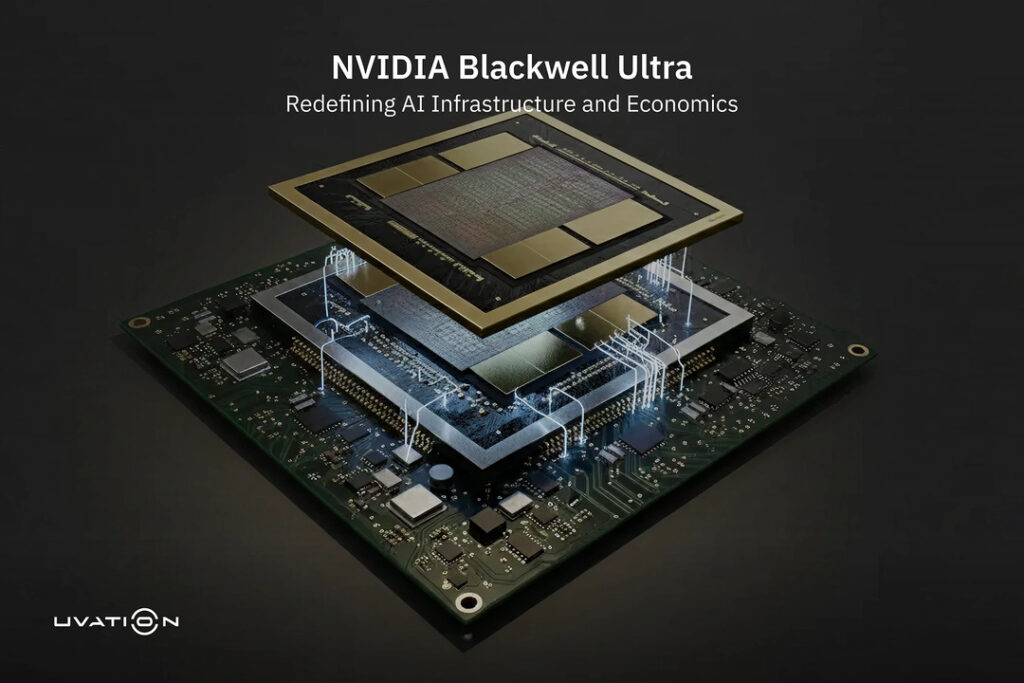
At the heart of many modern AI data centers are specialized GPUs designed specifically for machine learning workloads. NVIDIA’s Blackwell architecture represents one of the latest advancements in this field, delivering major improvements in efficiency, performance, and scalability.
Blackwell GPUs are engineered to handle the massive computational demands of training and running large AI models. These processors support high-speed memory systems, advanced tensor cores, and optimized data pathways that allow AI calculations to be performed far more efficiently than traditional CPUs.
The architecture is particularly suited for large-scale AI models that require enormous parallel processing capacity. Tasks such as deep learning training, generative AI inference, and scientific simulations can be distributed across thousands of GPU cores simultaneously.
This capability has made Blackwell GPUs a key component in modern AI servers deployed by cloud providers, research institutions, and enterprise technology companies.
The integration of these processors into distributed data center networks allows organizations to scale AI workloads across multiple regions without sacrificing computational performance.
AI Inference at Scale
While much attention is often given to training large AI models, running those models in real-world applications known as inference represents an even larger infrastructure challenge.
Inference workloads occur every time an AI system responds to a user query, generates text, analyzes an image, or processes sensor data. With millions of users interacting with AI services simultaneously, these workloads must be handled efficiently and quickly.
Distributed AI data centers equipped with Blackwell GPUs enable organizations to deploy inference workloads closer to end users. Instead of routing requests to a distant central server, AI responses can be generated within nearby data centers.
This localized processing dramatically reduces response times and network congestion while improving overall service reliability.
For example, generative AI tools used for chatbots, automated customer service, or creative content generation rely heavily on high-performance inference systems. By distributing these capabilities across multiple locations, companies can ensure that AI-powered applications remain responsive even during periods of heavy demand.
The Role of Cloud Providers and Hyperscale Infrastructure
Major cloud computing providers are among the primary drivers of distributed AI infrastructure development. Companies operating hyperscale data centers are investing heavily in GPU clusters capable of supporting massive AI workloads.
These facilities often contain tens of thousands of AI accelerators connected through high-speed networking systems. When combined with distributed architecture, they form a global network capable of supporting AI services for millions of users simultaneously.
Cloud platforms increasingly offer AI infrastructure as a service, allowing businesses to access powerful computing resources without building their own data centers. Organizations can deploy AI models on distributed GPU clusters and scale workloads dynamically based on demand.
This model has accelerated the adoption of artificial intelligence across industries, lowering the barriers to entry for companies that want to integrate AI capabilities into their products and services.
Energy and Cooling Challenges in AI Data Centers
The rise of AI-driven infrastructure has also introduced new challenges related to power consumption and cooling requirements. High-performance GPUs consume significantly more energy than traditional processors, particularly when operating at large scale.
A single hyperscale AI data center can require enormous electrical capacity, sometimes equivalent to the energy needs of a small city. As a result, energy efficiency and sustainable infrastructure design have become critical priorities.
Advanced cooling systems, including liquid cooling technologies and immersion cooling methods, are increasingly being used to manage heat generated by large GPU clusters.
Additionally, many technology companies are exploring renewable energy solutions to power AI infrastructure while reducing environmental impact.
The Future of AI Infrastructure
Distributed AI data centers powered by advanced GPUs represent a major shift in how computing infrastructure is designed and deployed. As artificial intelligence becomes more integrated into everyday technology, the need for scalable, efficient, and globally distributed computing resources will only continue to grow.
Future developments may include more specialized AI processors, improved networking technologies, and smarter workload management systems capable of automatically distributing AI tasks across global infrastructure.
Edge computing, where AI processing occurs even closer to devices and sensors, is also expected to play a larger role in this evolving ecosystem.
Together, these innovations will shape the next generation of AI infrastructure, enabling faster applications, more responsive services, and new forms of intelligent technology.
Final Thoughts
The rise of distributed AI data centers marks a significant transformation in the architecture of modern computing. By combining geographically distributed infrastructure with powerful GPU technologies such as NVIDIA’s Blackwell architecture, organizations can deliver high-performance artificial intelligence services at unprecedented scale.
This approach addresses the growing demands of AI workloads while improving latency, scalability, and system resilience. As businesses and cloud providers continue to invest in advanced AI infrastructure, distributed data centers are likely to become the foundation upon which the next era of artificial intelligence innovation is built.
With AI applications expanding across nearly every sector of the global economy, the evolution of data center architecture will remain a crucial factor in determining how quickly and effectively these technologies can continue to advance.