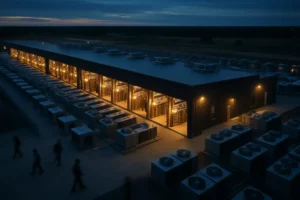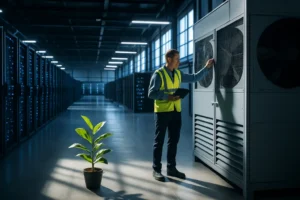
AI power and cooling is becoming the less glamorous but more decisive side of the data center boom. Nvidia may still dominate the headlines, but the companies that move electricity, manage heat, shorten deployment timelines, and keep AI clusters stable are starting to look like the infrastructure winners beneath the chip story.
That shift matters because AI data centers are no longer limited by whether customers want more GPUs. They are increasingly limited by whether the physical site can support the load, a problem already visible in AI rack power architecture as higher-density systems force operators to rethink how electricity reaches the server and how heat leaves the room.
AI Power and Cooling Is Now Part of the Compute Stack
The AI boom has made power equipment and cooling systems strategic. Transformers, switchgear, busbars, coolant distribution units, thermal controls, and microgrid software are no longer back-end facility details. They are part of whether an AI data center can be built on time and operated safely.
That is why suppliers outside the GPU market are gaining attention. Energy-hungry data centers are driving demand for transformers and advanced cooling systems, with Reuters reporting that some leading suppliers have seen surging orders tied to AI infrastructure projects and North American expansion. The broader market is being shaped by a trillion-dollar data center boom.
The lesson is simple: compute does not exist without facilities. A rack of AI accelerators is only useful if the building can feed it stable power, remove heat, protect uptime, and scale repeatedly.
The hidden winner is the infrastructure layer.
Transformers Are Becoming a Deployment Bottleneck
Transformers do not sound like an AI product, but they are now one of the most important pieces of the data center supply chain. They convert high-voltage grid electricity into usable levels for servers, cooling equipment, and power distribution systems.
When transformer lead times stretch, data center timelines stretch. Capacity is booked years ahead, developers with firm supply relationships gain an advantage. When transformer prices rise, the cost of AI compute rises with them.
This is why the power equipment market is suddenly part of AI strategy. It is not enough for a hyperscaler or neocloud provider to secure land and GPUs. The project also needs substations, transformers, medium-voltage equipment, controls, protection systems, and qualified teams to integrate them.
The same issue applies to grid interconnections. Even a well-financed AI campus can sit idle if electrical infrastructure arrives late. That creates an unusual situation: the most advanced chips in the world may wait on industrial equipment that used to attract little public attention.
AI has made slow hardware visible.
Cooling Is Where Density Becomes Reality
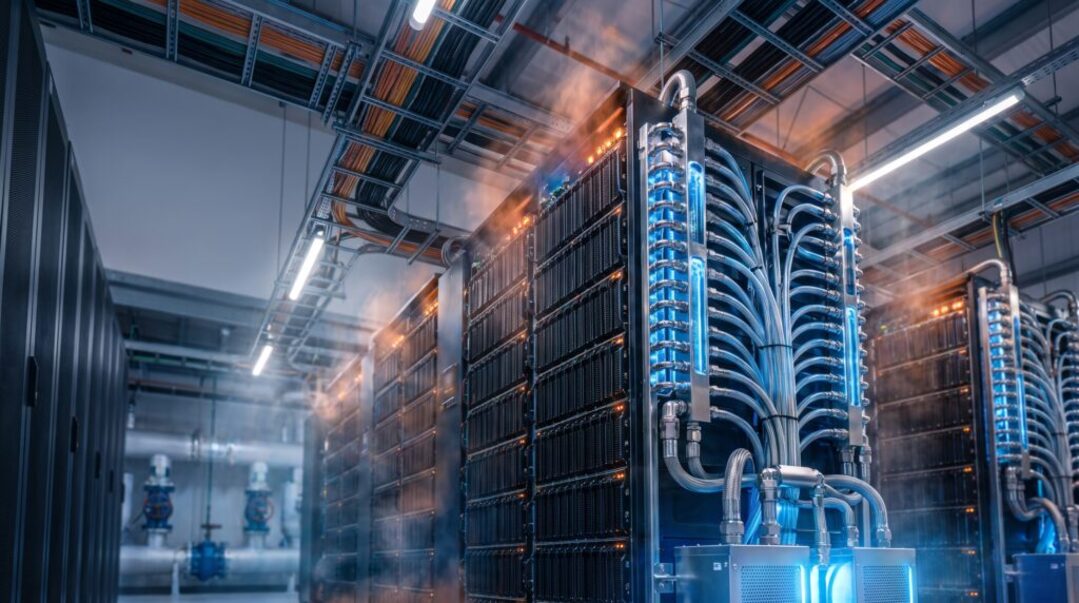
Power creates the second problem: heat. As AI racks become denser, traditional air cooling becomes harder to defend for every workload. Liquid cooling is no longer an exotic option for specialized deployments. It is moving toward the mainstream of high-density AI infrastructure.
Schneider Electric’s latest AI-centric modular data center reference design combines prefabricated power, liquid cooling, air cooling, and IT infrastructure for AI workloads that involve extreme power and thermal management, instantaneous load ramps, complex racks, and scalable deployment through a modular AI reference design.
That kind of integration shows where the market is going. Cooling cannot be bolted on late. It has to be planned with the server platform, rack density, power design, facility water system, and maintenance model.
For operators, liquid cooling offers a path to higher performance density and potentially better efficiency. But it also introduces new operational concerns: leak detection, coolant chemistry, service workflows, staff training, facility retrofits, and vendor dependency.
The cooling race is not just thermal math. It is operational risk management.
The Old Data Center Supply Chain Is Being Repriced
The AI boom is changing which suppliers matter most. A simple comparison makes the shift clear.
| Infrastructure Layer | Old Data Center Role | AI Data Center Role |
|---|---|---|
| Transformers | Utility-side electrical equipment | Critical path for megawatt-scale deployment |
| Switchgear and controls | Facility reliability systems | Real-time power routing and protection layer |
| Air cooling | Default thermal strategy | Limited by extreme rack densities |
| Liquid cooling | Specialized high-performance option | Core requirement for many AI clusters |
| Microgrids | Backup or niche resilience model | Faster path around grid constraints |
| Reference designs | Engineering support material | Repeatable deployment template for AI factories |
The table shows why AI power and cooling companies are not just riding a temporary market wave. They are becoming part of the data center product itself.
As AI campuses grow, the market will reward suppliers that can deliver complete, repeatable systems rather than isolated components.
Integrated Designs Are Becoming the New Advantage
The next competitive edge may come from companies that can combine power and cooling into one coordinated deployment model. AI data centers need speed, but they also need reliability. A faster build that creates electrical or thermal instability is not a victory.
That is why partnerships between power-management and thermal-management companies are so important. Eaton and Trane Technologies recently announced an AI data center reference design built around higher-power architectures, saying the approach can improve energy efficiency by up to 15%, reduce installation costs by up to 30%, and cut copper use by up to 80% compared with conventional low-voltage designs through a coordinated power-cooling design.
The numbers matter, but the structure matters more. AI factories cannot be designed in silos. Electrical systems, cooling loops, controls, and compute platforms have to behave like one operating architecture.
This is where infrastructure companies can win margin and relevance. The supplier that solves coordination becomes more valuable than the supplier that only ships parts.
The prize is repeatable AI deployment.
The Next Pressure Point Is Margin and Delivery
The supplier boom does not mean every power and cooling company will win. Demand is strong, but competition is increasing. Component shortages, platform changes, deployment delays, and customer concentration can pressure margins even when revenue rises.
Investors should watch backlog quality, not just backlog size. A three-year backlog sounds impressive, but it matters whether orders are tied to credible projects, bankable customers, and deliverable equipment. The “ghost demand” problem already haunting some data center power requests can also distort supplier expectations.
Another signal is whether suppliers can adapt to new electrical architectures. Higher-voltage distribution, direct-to-rack DC feeds, solid-state transformers, liquid cooling, and microgrid controls may reshape procurement faster than traditional equipment makers expect.
Data center operators should watch service capacity too. AI facilities need more than products. They need installation, commissioning, monitoring, maintenance, and emergency response teams that understand high-density environments.
The weakest supplier will sell hardware. The strongest one will sell confidence.
AI power and cooling is becoming one of the clearest ways to understand the next phase of the data center boom. The industry may still talk first about GPUs, model size, and cloud demand, but the real constraint is increasingly physical.
The companies that keep AI campuses powered, cooled, and deployable may become the quiet winners of the infrastructure cycle. Nvidia remains central to the story, but the next bottleneck may sit in a transformer yard, a chilled-water loop, a microgrid controller, or a prefabricated power room. The AI boom will not be judged only by how many chips are sold. It will be judged by how many of those chips can actually run.