AI data center security is no longer just about firewalls, identity controls, and locked server cages. The UAE’s reported rethink of a massive AI campus after Iranian drone and missile attacks shows that frontier compute is becoming physical strategic infrastructure something that may need air-defense planning, distributed sites, hardened facilities, and national-security-grade resilience.
That is a major shift for the AI infrastructure race. The same pressure that made AI data center scale a global competition is now forcing governments and operators to ask a more uncomfortable question: what happens when the data center is not merely a commercial asset, but a target?
AI Data Center Security Has Entered the Geopolitical Layer
The UAE is reportedly revising plans for a 5GW AI data center project after regional attacks exposed the vulnerability of U.S.-linked technology infrastructure in the Gulf. The original concept was a 10-square-mile campus in Abu Dhabi, but the project may shift toward a network of data centers spread across the country, with officials considering protections such as air defenses and underground construction through the latest project revision report.
That is not a minor design adjustment. It changes the meaning of AI infrastructure.
For years, the dominant constraints were chips, power, cooling, land, water, and interconnection. Those remain critical. But the UAE case adds another layer: physical survivability in a region where military risk is not hypothetical.
If the next generation of AI models depends on giant compute campuses, then those campuses start to resemble strategic energy assets, communications nodes, or defense infrastructure. They hold economic value, sovereign data value, and geopolitical value at the same time.
The new question is compute under attack.
Stargate UAE Was Built as a Sovereign Compute Signal
Stargate UAE was announced as the first major international deployment of OpenAI’s broader Stargate infrastructure vision. The partnership includes G42, OpenAI, Oracle, Nvidia, Cisco, and SoftBank, with a 1GW compute cluster planned inside the larger UAE–US AI Campus in Abu Dhabi.
The official launch framed the site as a 5GW AI infrastructure campus designed to provide regional compute capacity, low-latency inferencing, sovereign infrastructure, and access to advanced AI systems. The first 200MW cluster was expected to go live in 2026, with the full campus powered by nuclear, solar, and natural gas through the announced UAE-US AI Campus.
That ambition explains why the project matters. The UAE is not trying to host a routine colocation facility. It wants to become a global AI hub with the compute capacity to serve government, finance, healthcare, energy, education, and regional commercial demand.
But sovereign compute cuts both ways. The more important the site becomes to national AI strategy, the more valuable it becomes to adversaries.
A data center that can serve national agencies and major AI workloads is not only an economic engine. It is also a strategic dependency.
One Giant Campus Creates a Different Target Profile
The original logic of a giant AI campus is easy to understand. Large sites can concentrate power, cooling, fiber, security teams, operations staff, and construction planning. They can also give partners a clear symbol of national ambition.
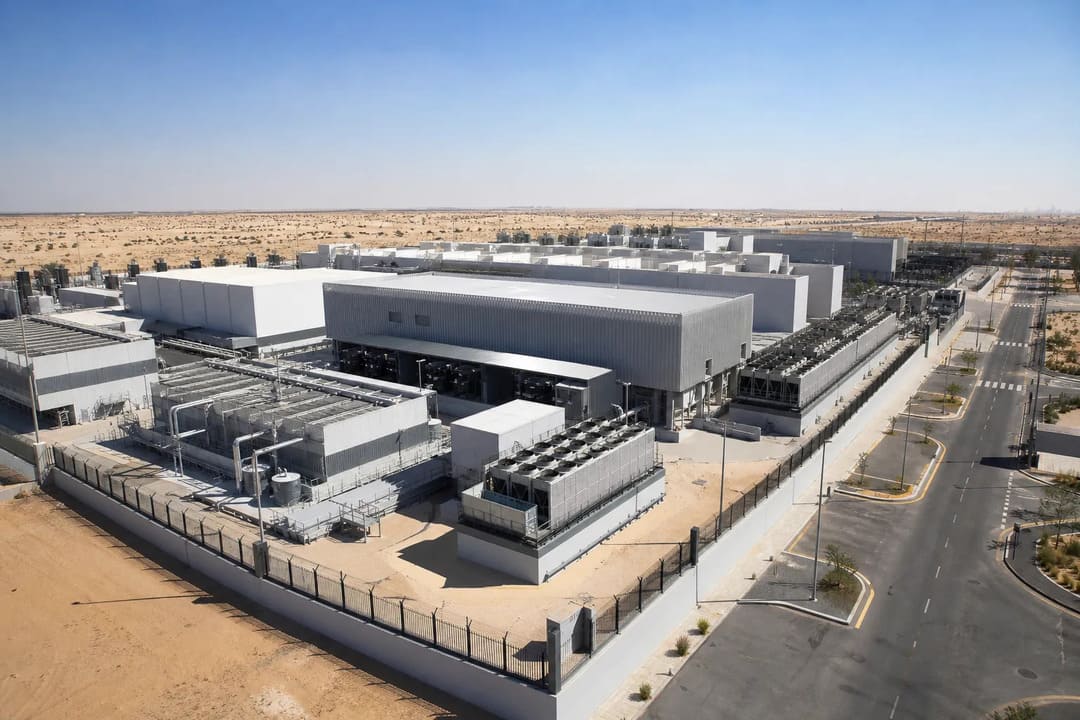
But concentration creates risk. A single massive campus can become easier to identify, model, threaten, and target. Even if the facility has strong perimeter security, its visible support systems substations, transmission lines, fuel supply, cooling infrastructure, fiber routes, access roads, and backup power can present attack surfaces.
That is why a distributed model may become more attractive. Multiple facilities spread across different sites can reduce single-point failure risk. If one site is damaged or isolated, workloads may shift elsewhere. If one power route is compromised, another site may remain available.
The tradeoff is complexity. Distributed AI infrastructure is harder to operate. It requires stronger networking, workload orchestration, redundancy planning, cybersecurity coordination, and physical security across multiple locations.
The security gain is real, but it is not free.
Hardened AI Campuses Will Look Less Like Ordinary Data Centers
The UAE case shows that the next phase of AI infrastructure may require design assumptions borrowed from defense, energy, and telecom resilience.
| Design Choice | Conventional Data Center Logic | Hardened AI Infrastructure Logic |
|---|---|---|
| Large single campus | Easier scale, operations, and power planning | Higher concentration risk |
| Distributed sites | More complex networking and orchestration | Better survivability if one site is hit |
| Above-ground facilities | Lower construction cost and faster buildout | More exposed to missiles, drones, and surveillance |
| Underground components | Expensive and slower to construct | Better protection for critical systems |
| Standard perimeter security | Controls access by people and vehicles | May not address aerial or standoff threats |
| Airspace monitoring | Rarely central to design | Becomes part of critical-infrastructure defense |
The table captures the new reality. AI data center security is moving beyond guards, gates, and cameras. The threat model now includes drones, missiles, sabotage, satellite visibility, cyber-physical attacks, and regional conflict escalation.
CISA’s drone-security materials warn that unmanned aircraft systems can create both cyber and physical risks for critical infrastructure, including surveillance, disruption, and unauthorized data access through critical infrastructure drone risks.
That type of guidance was once easier to treat as a concern for airports, stadiums, borders, and military facilities. AI campuses are now moving into that risk category.
The Real Vulnerability May Be the Support Infrastructure
A hardened server hall is useful, but a data center is only as resilient as the systems around it. That is the hard lesson for large AI campuses.
Compute depends on electricity. Electricity depends on substations, transformers, switchgear, fuel supply, generation assets, and transmission routes. Cooling depends on chillers, water systems, pumps, heat exchangers, and control software. Connectivity depends on fiber paths, carrier hotels, undersea cable routes, and network operations centers.
Those systems are not always inside the most secure part of a campus. Some may be outside the perimeter. May be shared with local utilities. Some may involve contractors, vendors, and public infrastructure.
That means the strongest security design cannot focus only on the data hall. It has to protect the full operating chain.
For AI workloads, downtime is not merely an inconvenience. If a campus supports government AI services, cloud inference, defense-aligned compute, or financial systems, a disruption can become a national resilience issue.
The future data center risk map may look less like a server diagram and more like an infrastructure dependency graph.
The Next Signal Is Whether AI Campuses Become Defense Assets
The UAE revision should make other governments think harder about AI siting. If a country builds a massive AI campus near military infrastructure, energy infrastructure, or geopolitically sensitive routes, it should assume that adversaries will notice.
That does not mean every AI data center needs bunkers and air defense. It means the risk model must match the strategic value of the facility.
Watch for three next signals. First, whether new AI campuses are announced as distributed networks rather than single mega-sites. Second, whether underground construction, airspace surveillance, and hardened power systems become part of public project language. Third, whether governments begin treating AI compute facilities like energy grids, ports, telecom exchanges, and defense supply chains.
Also watch insurance and financing. If lenders and insurers begin pricing geopolitical exposure into AI campus deals, security architecture will become a financial requirement, not just an engineering preference.
The most important AI infrastructure question may soon be: can this facility survive the world it is being built in?
AI data center security is becoming a defining issue because frontier compute is now too important to be treated as ordinary commercial real estate. The UAE’s reported rethink does not weaken the case for major AI infrastructure. It clarifies the stakes.
The countries and companies building the next generation of AI capacity will need chips, power, cooling, land, and fiber. They will also need survivability. A data center that anchors sovereign AI capability must be designed not only to run models, but to keep running when the surrounding risk environment gets worse. The AI race is becoming a security race, and the strongest campuses will be the ones built with that reality in mind.