AI Data Center Energy has moved from a facilities concern to a planning issue for utilities, data center operators, cloud providers, and security teams. The basic relationship is direct but not simple: more AI training and inference capacity means more servers, denser racks, more cooling demand, and larger electrical infrastructure. The uncertainty lies in how fast those systems are deployed, where they connect to the grid, and how efficiently they operate once installed.
The U.S. Department of Energy reported that U.S. data centers consumed about 4.4% of total U.S. electricity in 2023, with consumption rising from 58 TWh in 2014 to 176 TWh in 2023. The same DOE-backed analysis projected that data centers could account for 6.7% to 12% of U.S. electricity consumption by 2028, depending on assumptions about deployment and efficiency DOE data center report. Those ranges matter because grid planning depends on specific interconnection locations, substation capacity, transmission availability, and load profiles rather than national totals alone.
Why AI Data Center Energy Is Rising
AI Data Center Energy Is Not Just Server Count
The first cause is compute density. AI workloads often use accelerated servers with high power draw, and those systems can be installed in clusters that require concentrated electrical and cooling capacity. Counting buildings or server cabinets is not enough. A smaller room filled with high-density AI hardware can create a larger electrical load than a much larger legacy enterprise data hall.
The second cause is utilization. Traditional enterprise systems often had wide differences between provisioned capacity and actual usage. AI training clusters can run for long periods at high utilization when models are being trained or tuned. Inference systems may have different profiles, but large-scale deployment can still add meaningful demand if service volume grows. AI Data Center Energy is therefore shaped by workload scheduling, accelerator efficiency, cooling design, and power distribution losses, not only by the number of chips purchased.
The Utilization Shift Matters
Higher utilization changes the practical meaning of a data center load forecast. A facility may be electrically sized for peak use, but sustained high compute activity affects cooling runtime, backup design, maintenance windows, and utility demand charges. If AI systems run continuously, the power system must support both the average load and the peaks without degrading reliability.
For operators, this creates a tighter link between software scheduling and physical infrastructure. Batch jobs, model training windows, storage access, and networking patterns can influence energy draw. That does not mean software alone can solve the energy issue, but it does mean infrastructure planning should include workload behavior rather than treating AI compute as a generic IT load.
What The Official Electricity Numbers Show
DOE Estimates Show A Short-Term Step Change
The DOE figures show why the issue has gained attention. Moving from 58 TWh in 2014 to 176 TWh in 2023 represents a large increase before the full effect of newer AI infrastructure is reflected in operating data. The DOE’s 2028 projection range of 325 to 580 TWh per year also shows the width of uncertainty. The lower end would still require significant planning; the upper end would place much heavier pressure on local power delivery systems.
These numbers should be read as planning signals rather than exact outcomes. Projections can shift with accelerator efficiency, data center utilization, cooling design, power procurement, and the pace of AI deployment. A cautious reading is that demand is rising fast enough that utilities and operators cannot wait for perfect forecasts before addressing interconnection queues, transmission limits, and site-level power architecture.
EIA Shows Pressure Inside Commercial Buildings
The U.S. Energy Information Administration estimated that data center server electricity use would make up about 7% of electricity consumption in the commercial sector in 2025, rising to 22% to 33% by 2050 depending on scenario assumptions EIA commercial energy analysis. This framing is useful because it places servers inside the broader building stock rather than treating data centers as isolated facilities.
That commercial-sector share also clarifies why efficiency gains may not fully offset growth. More efficient processors, better cooling, and improved power distribution can reduce energy per unit of computation. Yet total electricity use can still rise if installed capacity and workload volume grow faster than efficiency improves. This rebound effect is a recurring infrastructure planning issue, not a reason to dismiss efficiency work.
Why Load Growth Is Hard To Absorb
Power Delivery, Cooling, And Redundancy Interact
Data center energy demand is not only a matter of buying electricity. A large AI facility needs utility interconnection, transformers, switchgear, backup systems, cooling equipment, controls, and maintenance procedures. Each layer has lead times and failure modes. A delay in one component can limit the usefulness of the rest of the site.
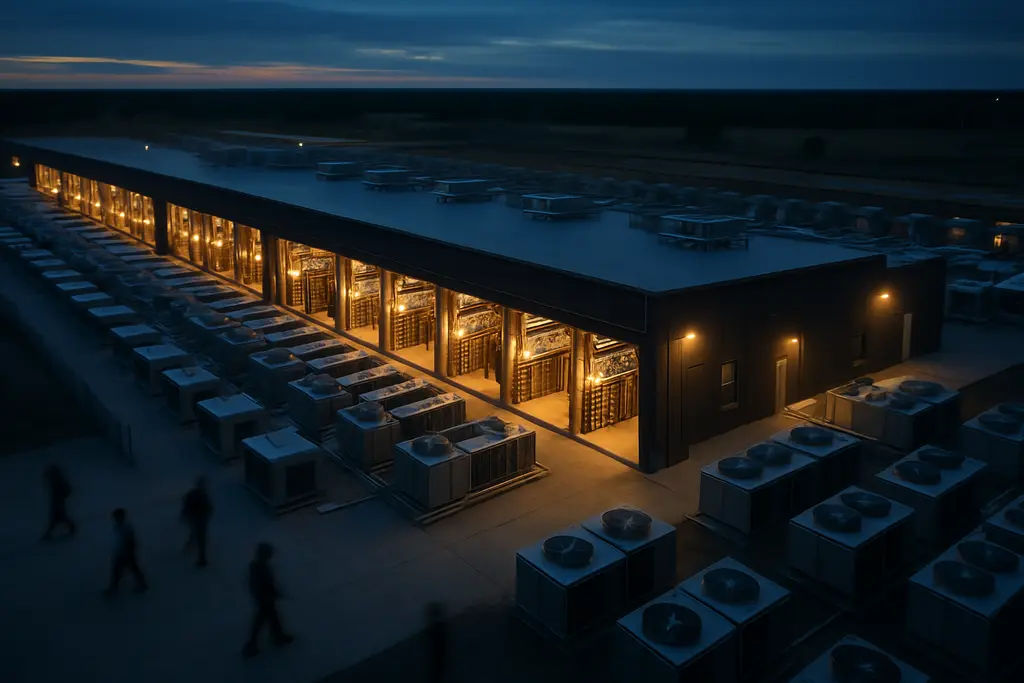
Cooling is closely tied to electrical planning. Dense AI racks produce concentrated heat, and cooling systems consume energy while also affecting water use and mechanical maintenance. Liquid cooling can reduce some air-cooling constraints, but it introduces pumps, heat exchangers, leak detection, and service requirements. Air cooling remains relevant in many facilities, but high-density hardware can push it toward practical limits.
Regional Siting Can Concentrate Stress
National electricity percentages can hide regional strain. If new AI capacity is concentrated near existing fiber routes, cloud regions, tax incentives, or land availability, the local grid may face pressure even if the national share appears manageable. Substations, transmission lines, and generation resources are not interchangeable across regions.
This is why regional planning has become a technical issue rather than a public-relations topic. Site selection now needs to account for available megawatts, energization timelines, cooling resources, grid congestion, and resilience requirements. Related coverage of data center energy trends tracks how those constraints are shaping power and cooling decisions across AI-era facilities.
Operational And Cybersecurity Effects

Energy Systems Become Operational Technology
As data centers grow larger and more power-intensive, electrical and cooling systems become part of the operational technology environment. Building management systems, power monitoring platforms, generator controls, battery systems, and cooling controllers all become more important to uptime. They also widen the set of systems that security and infrastructure teams must monitor.
The security concern is defensive rather than speculative. If a facility depends on integrated control systems to balance cooling, power quality, and backup capacity, then configuration control, access management, logging, patch governance, and network segmentation become essential operating practices. A conventional IT outage may affect workloads; a control-system failure can affect the physical conditions that allow those workloads to run.
Capacity Planning Becomes A Security Dependency
Energy constraints can also affect cybersecurity indirectly. Overloaded facilities may defer maintenance windows, compress change-control timelines, or operate closer to thermal and electrical limits. Those conditions can increase operational risk, even when no attacker is involved. Security teams should understand these dependencies because resilience planning depends on physical capacity as well as software controls.
- Facilities teams need accurate load forecasting, not just nameplate server inventory.
- IT teams need workload scheduling data that can inform power and cooling plans.
- Security teams need visibility into management systems that affect uptime and safety.
- Executives need to treat grid availability as a deployment constraint, not a procurement detail.
If you are interested in further technical infrastructure insights from our network, Camp Techwise offers additional analysis on computing systems and operational technology topics.
AI Data Center Energy And U.S. Planning Discipline
What A Cautious Baseline Should Include
A practical baseline starts with measured facility load, expected server deployment schedules, realistic utilization assumptions, cooling design limits, and utility interconnection status. It should separate committed projects from speculative plans. It should also distinguish training clusters, inference capacity, storage systems, and networking equipment because their energy profiles are not identical.
AI Data Center Energy should be treated as a systems problem that connects chips, cooling, software scheduling, utility planning, and cybersecurity operations. The official figures show a clear upward direction, but the exact level of demand will depend on deployment pace, efficiency gains, geographic concentration, and operating discipline. For U.S. infrastructure teams, the safest assumption is not that every high-end forecast will occur. It is that energy availability has become one of the gating factors for AI growth, and it needs the same engineering scrutiny as compute, storage, and network capacity.