The most important developments in artificial intelligence are no longer happening only on screens. They are starting to happen in motion, under pressure, and in the split-second physical exchanges that define the real world.
That is why Sony’s latest robotics breakthrough matters right now. A machine that can compete with elite human table tennis players is not simply a flashy demo. It is a clear sign that physical AI is entering a new phase, one in which perception, judgment, and action are beginning to operate together at a level that starts to resemble high-performance human skill.
The Moment AI Leaves The Screen
For years, the public conversation around AI has centered on language models, image generators, and software assistants. Those systems changed how people write, search, code, and create, but they largely remained confined to digital environments. Even when they appeared powerful, their intelligence was often measured in tokens, prompts, and outputs rather than in movement, timing, and spatial judgment.
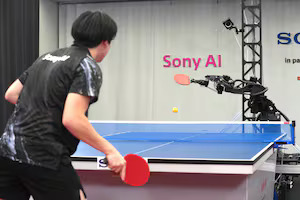
I see Sony’s table tennis robot as a sharp break from that era. Table tennis is one of the hardest environments in which to prove machine intelligence because it demands much more than recognition or prediction in isolation. The system must track a tiny object moving at extreme speed, interpret spin and trajectory almost instantly, position itself with precision, and execute a response within a vanishingly small window of time. The challenge is not theoretical. It is physical, adversarial, and unforgiving.
That is what makes this moment so consequential. When a robot can perform in that kind of environment against elite humans, AI begins to look less like a software layer and more like an embodied decision-making system.
Why Table Tennis Is Such A Serious Test
Table tennis may sound like an unusual proving ground for robotics, but in practice it is close to ideal. The sport compresses perception, planning, and motor execution into fractions of a second. It also forces the machine to deal with uncertainty. Every shot changes the state of play. Every return alters pace, angle, and spin. There is no fixed script.
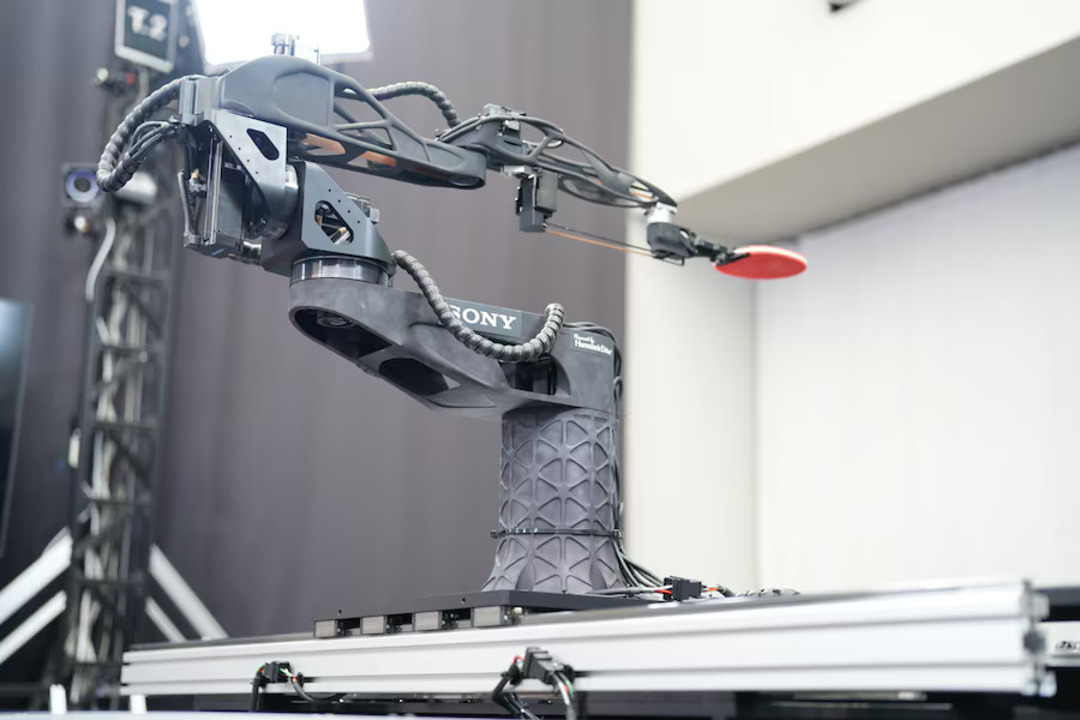
Sony’s system, known as Ace, was built to handle exactly that kind of fluidity. It combines advanced sensing, reinforcement learning, and precision robotics to respond in real time on a regulation table against highly skilled opponents. Its achievement is notable not just because it can return the ball, but because it can compete within official conditions and hold up against expert-level play.
In my view, table tennis exposes a truth that many AI discussions miss: intelligence in the real world is inseparable from control. A system is not genuinely capable simply because it can identify patterns. It must also convert those patterns into action under pressure. That is a much higher bar.
What Sony’s Robot Actually Changes
The deeper significance of Sony’s breakthrough is not about sport. It is about capability transfer. Once an AI system can perceive, decide, and act in a fast, noisy, physically dynamic setting, the implications spread far beyond the table.
Factories are an obvious example. Industrial robots already excel in structured, repetitive settings, but many struggle when conditions become variable or unpredictable. A new class of machines trained to respond to motion, uncertainty, and rapid change could push automation into tasks that have long resisted it. The same logic applies to logistics, warehouse handling, medical support systems, and safety-critical environments where timing and adaptation matter as much as strength.
What stands out to me is that Sony’s work suggests a convergence is underway. Vision systems, policy learning, sensing hardware, and mechanical control are no longer advancing on separate tracks. They are beginning to fuse into one operational stack. That stack is what makes physical AI meaningful. It is not just a better robot arm or a smarter model. It is the coordinated system that allows both to function as one.
How This Breakthrough Compares To Earlier AI Milestones
AI history has been shaped by symbolic contests. Chess demonstrated computational strategy. Go revealed a machine’s ability to navigate complexity and intuition. Generative AI showed that systems could produce fluid language and persuasive content at scale. Sony’s robot points to a different category of milestone: embodied competition.
That distinction matters. A chatbot can impress with fluency while remaining detached from the physical world. A robot athlete cannot fake competence. It either reads the ball, moves correctly, and returns the shot, or it fails in plain view. Physical performance is brutally transparent.
The progression is worth spelling out clearly:
| AI Era | Core Capability | Primary Domain | What Made It Significant |
|---|---|---|---|
| Strategy AI | Planning and optimization | Games like chess | Proved machines could outperform humans in rule-based reasoning |
| Generative AI | Language and content creation | Digital interfaces | Brought AI into mainstream daily work and communication |
| Physical AI | Real-time perception and action | Dynamic real-world environments | Moves AI from software assistance into embodied execution |
I think this is why the Sony demonstration lands so differently. It does not just expand AI’s résumé. It changes the test itself.
The Hard Problems That Still Remain
None of this means general-purpose robots are about to become commonplace overnight. That would be an overreach. The gap between excelling in one highly optimized task and achieving broad physical competence remains enormous.
A table tennis robot operates in a constrained environment, even if that environment is extremely fast and demanding. Homes, hospitals, construction sites, and city streets are messier. They involve clutter, ambiguity, changing objectives, safety constraints, and human behavior that is far less structured than a sports exchange. General robotics still faces severe challenges in manipulation, adaptability, robustness, and cost.
Even so, breakthroughs like this matter because they solve the right class of problem. They show that machines can now achieve a blend of speed, coordination, and decision-making that was once considered out of reach. In journalism, I try to separate spectacle from significance. This feels like significance. It narrows a real technical gap.
What Business Leaders Should Pay Attention To
The commercial lesson is not that every company needs a sports robot. It is that embodied intelligence is becoming investable. Companies that once focused only on software AI will increasingly have to think about sensors, actuators, real-time systems, and edge computing. The center of gravity is moving.
Three implications stand out to me:
- The next AI race will involve hardware as much as software.
- Real-time decision-making in physical settings will become a competitive advantage.
- Industries built around labor-intensive, variable tasks will face new automation pressure.
That shift will favor organizations that understand integration. The winners will not simply train better models. They will design systems that can interpret the physical world and act reliably inside it.
Why This Matters Right Now
Sony’s table tennis robot arrives at a moment when AI is often discussed in terms of productivity tools, consumer interfaces, and content generation. Those are important markets, but they are only part of the story. The bigger transformation may be the migration of intelligence into machines that move, react, and operate under real-world constraints.
I believe this is the threshold moment to watch because it changes the imagination of what AI can become. Once a machine can compete with elite human players in a sport defined by speed, spin, precision, and adaptation, the conversation shifts. AI is no longer just helping humans think. It is beginning to perform alongside them in dynamic physical space.
That is why this breakthrough matters now. It signals that the age of disembodied AI is giving way to something more consequential: systems that can sense the world, make split-second judgments, and act within it. Chatbots changed the interface of intelligence. Physical AI may change the machinery of everyday life.