
The Cerebras CS-4 AI server is not simply a faster version of the company’s previous accelerator. Announced August 18, 2026, it reorganizes the rack around three wafer-scale processors and a modular Nexus architecture that treats compute, power, cooling and I/O as systems that can evolve independently.
That matters because AI inference is becoming a rack-design problem as much as a chip-design problem. Faster processors help, but operators also have to move data, deliver power, remove heat and deploy capacity without turning every upgrade into a full infrastructure rebuild.
Why AI Inference Is Becoming a Systems Design Problem
AI infrastructure is reaching a point where adding more accelerators does not automatically produce a better system. As inference workloads scale, performance increasingly depends on how efficiently servers move data, deliver power, remove heat and coordinate processors across a rack. Those supporting systems can become bottlenecks long before the silicon itself reaches its theoretical limit.
That pressure is forcing server designers to rethink the traditional model of packing multiple discrete accelerators into a chassis and relying on increasingly complex networking to connect them. More devices mean more cables, switches, power stages and cooling hardware, all of which increase operational complexity as clusters grow.
Wafer-scale computing approaches the problem from a different direction. Instead of breaking compute across many smaller accelerator packages, it concentrates a much larger amount of processing and memory bandwidth onto a single wafer. The goal is to keep more communication close to the processor and reduce the amount of traffic that must travel through external interconnects.
Cerebras’ latest hardware pushes that idea beyond the processor itself. With CS-4 and the Nexus architecture, the company is treating the entire rack as part of the compute design, making power delivery, cooling, I/O and serviceability central to the platform rather than secondary infrastructure decisions.
The Cerebras CS-4 AI Server Is Really a Rack Redesign
CS-4 uses three WSE-3 Turbo processors, each built on Cerebras’ 46,225-square-millimeter wafer-scale design with four trillion transistors, 900,000 AI-optimized cores and 44GB of on-wafer SRAM. Cerebras rates the complete system at 750 PFLOPs of AI compute, 7.2 terabits per second of I/O and 129.6 petabytes per second of memory bandwidth.
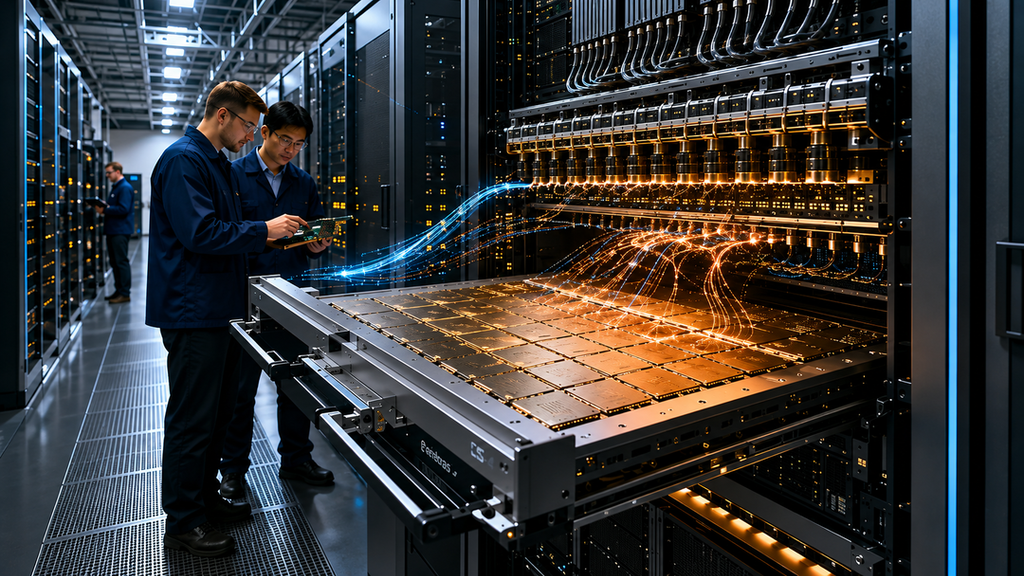
Those numbers are striking, but the more consequential change is physical. The new Nexus platform replaces the older chassis-centered approach with vertically mounted Wafer-Scale Backpacks that combine the processor, direct liquid cooling, power conversion, I/O and control electronics into self-contained assemblies.
Cerebras says the backpack contains 50% fewer components than the previous design and uses 60% more automated manufacturing. Its CS-4 architecture details also describe a deployment model intended to move installation from days toward hours. That shifts attention from peak performance toward deployment as a performance metric.
Wafer-Scale Computing Changes the Communication Problem
Conventional AI systems distribute work across many GPUs, then depend heavily on interconnects to keep those devices synchronized. Cerebras takes a different route by placing an enormous number of cores and SRAM on a single wafer.
The architectural advantage is locality. More communication can remain on the wafer instead of crossing packages, boards and switches. CS-4 lists total compute-fabric bandwidth of 160.5 PB/s and wafer-to-wafer latency as low as two microseconds.
That does not make networking irrelevant. It changes where networking becomes expensive and operationally important. Instead of treating every accelerator-to-accelerator interaction as an external fabric problem, wafer-scale systems push more communication inside the compute device and reserve external links for scaling across wafers, racks and heterogeneous systems.
That contrasts with the GPU ecosystem, where developments such as the HBM4 memory transition remain central to feeding processors with enough nearby bandwidth. Both approaches chase the same bottleneck, but they attack it from different physical starting points.
Nexus Separates Compute, Power, Cooling and I/O
The Nexus design matters because AI racks are becoming harder to upgrade as single units. A faster accelerator can demand different power delivery, cooling hardware and networking before an operator can actually use its performance.
CS-4 turns those dependencies into more modular building blocks. Power shelves sit at the front of the rack, while the wafer-scale compute backpacks mount at the rear. Cerebras also moves power conversion much closer to the processor, which it says reduces board-level loss and allows substantially more power to reach the WSE-3 Turbo.
The practical changes are easier to see side by side:
| CS-4 design element | Published specification | Infrastructure implication |
|---|---|---|
| Rack compute | Three WSE-3 Turbo processors | More wafer-scale compute per rack |
| AI compute | 750 PFLOPs | Higher inference capacity in one rack system |
| Memory bandwidth | 129.6 PB/s | Heavy emphasis on local data movement |
| External I/O | 7.2 Tbps | More bandwidth for scale-out and mixed systems |
| Compute module | Pluggable Wafer-Scale Backpack | Compute can be serviced as a modular assembly |
| Connectivity | RoCE v2 plus Direct Wafer Links | Supports switched and direct connections |
The table shows why rack modularity is the bigger story. CS-4 is designed around replacing or advancing subsystems without requiring every part of the rack to move at the same cadence.
Networking Becomes an Architectural Choice
Cerebras also redesigned the I/O path rather than treating networking as an accessory. The programmable Wafer I/O Module supports standards-based RoCE v2 RDMA over Ethernet alongside Direct Wafer Links for switch-free connections between systems.
That gives operators two distinct scaling paths. Ethernet can connect CS-4 into existing data-center fabrics and heterogeneous infrastructure, while direct links can reduce the network layers between closely coupled wafer-scale systems.
Independent launch context and deployment claims also point to reduced communication latency as a central goal of the redesign. For infrastructure teams, the question is therefore not simply whether CS-4 is faster than a GPU cluster. It is whether fewer external communication hops translate into simpler operations at production scale.
Deployment Will Test the Architecture
Cerebras says first CS-4 shipments begin this quarter. The next useful evidence will come from installations rather than headline benchmark comparisons.
Operators should watch how quickly Nexus racks can be commissioned, how the liquid-cooling and power assemblies behave under sustained inference loads, and whether modular backpacks reduce service time in real facilities. Network behavior will matter just as much: RoCE performance, congestion management and the topology of direct wafer links will shape how efficiently large clusters scale.
Cost is another pressure point. Cerebras claims up to 10 times more throughput per watt than CS-3 and up to 30 times faster inference than GPU systems in selected comparisons. Those figures need workload-specific scrutiny because inference economics depend on utilization, model size, latency targets, software maturity and the surrounding infrastructure.
The Bigger Shift Is the Server Itself
The Cerebras CS-4 AI server offers a useful preview of where high-end AI infrastructure may be heading. The competition is no longer confined to accelerator silicon; vendors are redesigning power delivery, cooling, memory locality, network topology and the mechanics of deployment around the workload.
Whether Nexus becomes a broadly adopted model will depend on production deployments and economics, not architectural elegance alone. But CS-4 makes the pressure clear: as inference clusters grow, the winning server architecture may be the one that removes the most complexity between the processor and the rack, not merely the one that adds the most compute.
Frequently asked questions
What is the Cerebras CS-4?
Cerebras CS-4 is a rack-scale AI inference system built around three WSE-3 Turbo wafer-scale processors. It combines compute, cooling, power delivery and networking within the modular Nexus architecture.
How is CS-4 different from a traditional GPU server?
Traditional GPU servers spread workloads across many discrete accelerators. CS-4 concentrates far more compute and memory bandwidth on wafer-scale processors, reducing some of the communication that would otherwise cross external interconnects.
Why does the Nexus architecture matter?
Nexus separates major rack components into modular systems, including compute, power and I/O. That design could make future upgrades, servicing and deployment less dependent on replacing or redesigning the entire rack.
How could CS-4 affect AI data-center networking?
By keeping more processor communication on the wafer, CS-4 may reduce dependence on external switching for some workloads. Ethernet and direct wafer links still remain important for scaling across multiple systems and racks.
What should data-center operators watch as CS-4 deployments begin?
The biggest signals will be real-world deployment speed, power efficiency, cooling performance, network behavior, serviceability and inference cost. Those factors will determine whether the architecture delivers operational advantages beyond benchmark performance.