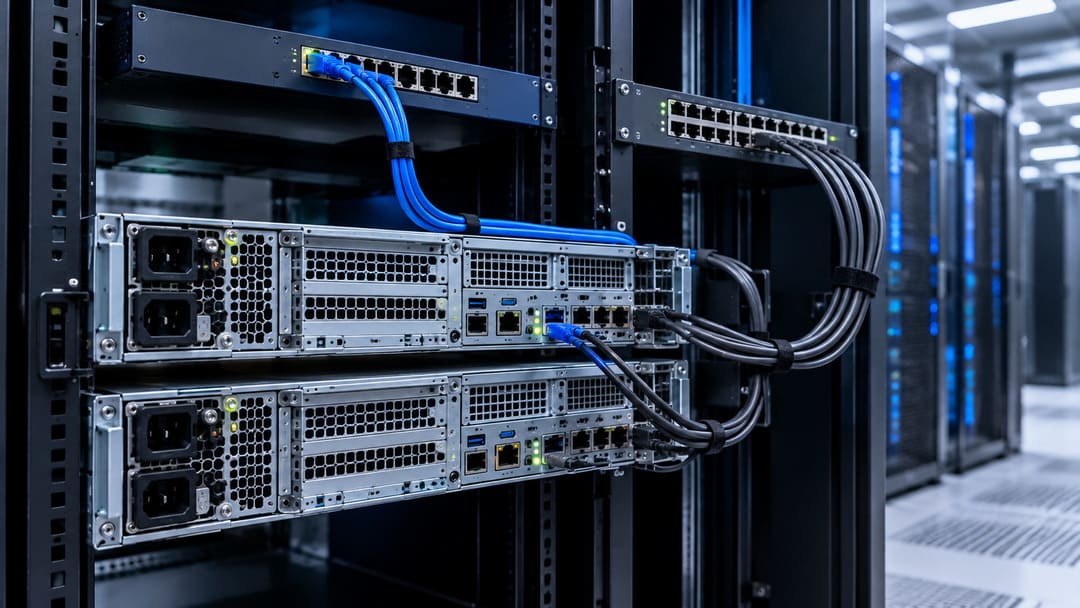
A rack server can have an Ethernet jack labeled iDRAC or iLO and still expose its management controls to more systems than intended. The cable might lead to a network reachable from production, or the controller might be using a shared network interface instead. A dedicated physical port can help, but it is not a complete access-control policy.
A baseboard management controller (BMC) runs independently of the server’s main operating system, often remaining available on standby power when the host is switched off. It can provide remote power control, hardware health data, a console and, where supported, virtual media. NSA and CISA’s BMC hardening guidance warns that these privileged capabilities also create an attack path traditional host security tools may not see. National Security Agency
An Independent Computer Needs Its Own Security Boundary
Out-of-band management became useful because administrators needed a way to diagnose and restart a server when its operating system or ordinary network service was unavailable. Vendor implementations include Dell iDRAC and HPE iLO. They are not simply web pages served by the host: their management firmware and access controls need separate attention.
That independence changes incident response. Reinstalling an OS, changing a host firewall rule or rebooting an application does not necessarily remove access to its BMC. Likewise, a management-console login is not proof that the intended access restriction exists. The question is which devices and identities can actually reach the controller, through which interfaces, and with which privileges.
Dedicated, Shared and Host-Side Paths Are Different
In Dell’s iDRAC9 network configuration guide, the Dedicated option uses a management interface separate from the host’s normal network ports. The documentation also describes shared LAN-on-motherboard (LOM) selections and, for supported shared configurations, a failover LOM. These are model- and firmware-dependent choices, not assumptions to make about every server. Dell US
Even a dedicated interface can be assigned an address in the same subnet as host traffic. Real isolation requires reviewing the connected switch port, VLAN, routing and firewall or access-control rules. A management cable connected to an ordinary production switch is not made safe by the label on the server chassis.
Some platforms additionally support communication between software on the host and the management controller. Such in-band or host-interface features are a distinct access path from the external management Ethernet connection. A VLAN test alone cannot establish how those local interfaces are controlled; check the manufacturer’s settings for the exact model and firmware.
Secure Protocols Do Not Replace Network Restrictions
Modern systems may expose a Redfish management API alongside a browser console and, in some configurations, older protocols such as IPMI. The DMTF Redfish specification defines TLS requirements, account resources and privilege controls, and also recognizes host-interface arrangements. Those standards make secure administration possible, but they do not guarantee a particular controller was configured safely. Redfish(TM) Developer Hub
An encrypted web connection protects information in transit. It does not establish that a production workstation should have access in the first place. Use individually attributable accounts, least-privilege roles and stronger authentication where supported; review who can power-cycle a server, mount virtual media or change firmware. Disable unused services only after confirming that monitoring, recovery and approved automation will continue to work.
Five Checks Before Calling the BMC Isolated
- Inventory the real endpoints. Record each controller’s model, firmware version, management addresses, active network mode, switch port and owner. Include IPv6 if enabled.
- Trace the external route. Confirm the management interface connects to the intended network and that switch, router and firewall rules admit only approved administrative paths. Do not assume a separate VLAN implies complete isolation.
- Validate reachability safely. With authorization, verify that an approved management workstation can use the required read-only functions and that representative production or user networks cannot reach the management service. Avoid disruptive scans, power commands or unapproved tests.
- Review accounts and services. Remove stale access, rotate shared or inherited credentials, restrict high-impact privileges, validate authentication and certificates, and evaluate whether IPMI, remote media and other features are needed.
- Keep an emergency route. Document how staff will regain access if the normal jump host, identity service or management network fails. Review alerts, firmware updates and recovery procedures before making a change that could strand a remote server.
Firmware Integrity Is a Separate Part of the Test
Network access controls lower the chance of unauthorized BMC access; they do not establish that its firmware is authentic or recoverable. NIST’s platform firmware resiliency guidelines describe protection against unauthorized changes, detection of corruption and trustworthy recovery. These are design and procurement principles, not a claim that every BMC implements every mechanism. CSRC
HW Server’s earlier analysis of NIST secure hardware adoption explains why supply-chain evidence and long-term firmware support can be difficult to verify. For an installed server, the useful follow-up is more specific: confirm vendor support status, approved update packages, the update window and the documented recovery route for that exact hardware.
The success criterion is not that a technician can log in through the dedicated jack. It is that authorized administrators retain the access needed to recover the server, while other networks and identities have no unintended route to its management functions. Both sides of that test need evidence.