By The Ruben Salgaado | Published February 2, 2026
If you have read our guide on What is Edge Computing?, you understand the concept: bringing computation closer to where data is created.
But in 2026, the definition of “computation” has changed. Three years ago, an “edge server” was often just a glorified gateway collecting sensor data to send to AWS or Azure. Today, thanks to the explosion of Small Language Models (SLMs) and efficient inference chips, the Edge Server has become a self-contained AI powerhouse.
We are witnessing the death of the “dumb” edge. Here is what defines the modern AI Edge Server hardware stack this year.
1. The Death of the General Purpose CPU?
In traditional data centers, the CPU is king. In the 2026 edge server, the CPU is merely a traffic cop.
The defining characteristic of the new wave of edge hardware (like the latest Dell PowerEdge XR series or Supermicro’s IoT SuperServers) is the NPU-first architecture.
- The Shift: We are seeing a move away from power-hungry, full-size GPUs for edge deployments. Instead, integrators are favoring dedicated Neural Processing Units (NPUs) or high-efficiency inference cards (like NVIDIA’s latest Jetson Orin successors or Qualcomm’s Cloud AI 100 Ultra variants).
- Why: An edge server in a retail closet or a factory floor cannot draw 1000W. The new standard is high TOPS (Trillions of Operations Per Second) per Watt. If your edge box isn’t delivering at least 200 TOPS at under 75W, it’s already obsolete.
2. Form Factor: The “Short-Depth” Revolution
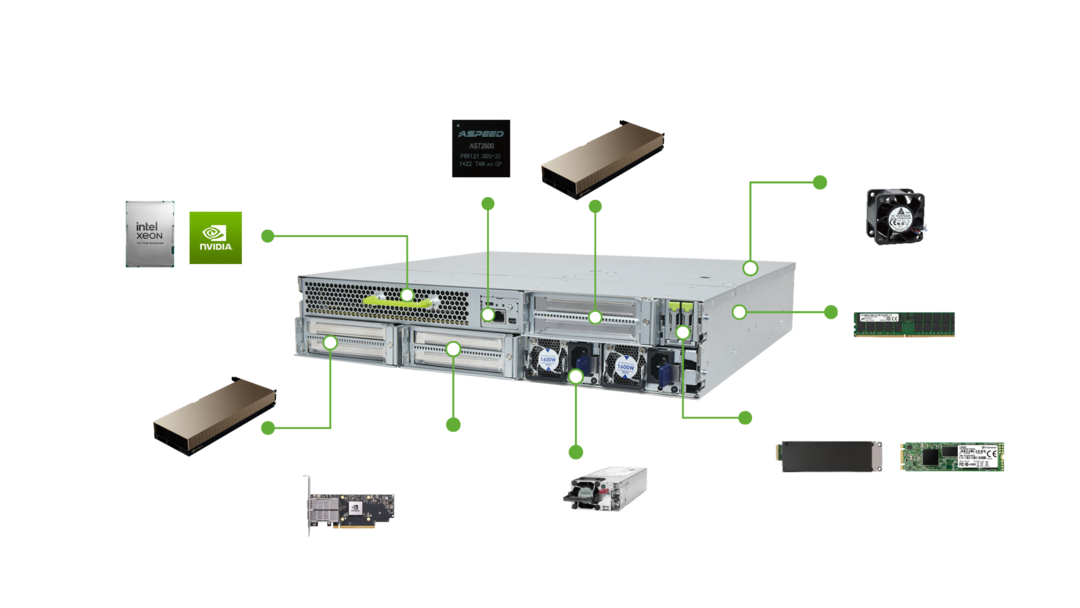
Data centers have luxury; they have space. Edge locations have closets. The hottest category in server hardware right now is the 2U Short-Depth chassis.
- Ruggedization is Standard: We are seeing “telco-grade” features becoming standard for enterprise edge. Dust filters, shock vibration resistance (for servers mounted on heavy machinery or vehicles), and wider operating temperature ranges (-5°C to 55°C) are now baseline requirements.
- Front Access I/O: Unlike traditional servers where ports are in the back, modern edge servers place all I/O and power supplies on the front. Why? Because in a cramped wiring closet, nobody can walk behind the rack.
3. Storage: The Rise of E3.S
The M.2 drive was great for consumer gadgets and laptops, but the Edge Server needs density and hot-swap capability. Enter the E3.S (EDSFF) form factor.
- 2026 has been the breakout year for these “ruler” SSDs in edge deployments. They allow for massive storage density (petabytes in 1U) and better thermal management than the old 2.5-inch U.2 drives. With AI models needing fast access to vector databases locally, the read/write speed of Gen5 NVMe in an E3.S form factor is non-negotiable.
4. The “Air-Cooled” Miracle
While hyperscalers are moving to liquid cooling, the edge remains an air-cooled world. You cannot plumb water cooling into a Starbucks back office or a 5G cell tower.
- Hardware manufacturers have responded with advanced heatsink designs and high-static pressure fans that can cool 300W TDP chips using only ambient air. This is the unsung engineering marvel of 2026—keeping high-performance AI silicon from throttling without a drop of liquid coolant.
The Verdict: Latency is the Enemy
Why is this hardware selling out? Because of the speed of light. An autonomous forklift in a warehouse or a fraud-detection system at a checkout counter cannot wait 200 milliseconds for a signal to go to a data center and back.
The Edge Server of 2026 isn’t just a computer; it’s a decision engine. It takes in video, audio, or sensor data and makes a complex decision instantly, on-site.
If you are still speccing your edge deployments with standard 1U rack servers from 2023, you are building a museum piece. The future is rugged, short-depth, and AI-native.
Related Articles: