Think of your smartphone as a caffeine addict. Traditional cloud systems make it travel 200 miles for espresso. But edge infrastructure brings a coffee cart right next door. This change brings processing power to industrial IoT basics.
Gartner says 75% of enterprise data will soon skip cloud datacenters. Why? Latency is now a major issue. Would you trust a self-driving car that texts California servers before swerving? Exactly. Edge for remote monitoring makes distant places smart enough to handle local crises without calling headquarters.
The real magic is in industry-specific applications. Imagine wind turbines negotiating with seabreezes like Wall Street traders. Or hospital robots detecting sepsis patterns faster than seasoned nurses. This isn’t just tech evolution – it’s digital democracy, empowering devices to think locally while acting globally.
So next time your smartwatch nags about hydration, remember: that judgment came from your wrist, not some server farm judging your life choices. The future’s decentralized, and honestly? It’s about time.
Traditional vs. Edge Architectures
Imagine King Arthur trying to rule Silicon Valley with carrier pigeons and stone castles. That’s how traditional IT works today. Our old data centers are struggling to keep up with today’s needs.
Data Center Dinosaurs vs. Edge Ecosystems
Traditional systems are like fax machines in today’s digital world. Here’s why:
- Response times: 200ms+ for cloud systems vs. sub-10ms at the edge
- Failure points: One cloud castle vs. many edge fortresses
- Scalability: Adding servers vs. using smart sensors
A global consulting firm had a 200-office network. It was like using medieval messengers. But after using Hybrid Edge-Cloud Solutions, they went from hours to minutes for incident response. It was like switching from quill pens to ChatGPT.
Bandwidth Bottlenecks Unplugged
Why spend on data highways when you can process locally? Edge computing cuts bandwidth costs by:
- Filtering 80% of raw data at source
- Only sending critical insights upstream
- Eliminating cloud storage fees for redundant information
But, Edge Security Fundamentals are key with 200 mini-data centers. It’s not just about firewalls anymore. We’re talking about military-grade encryption in devices small enough for your lunchbox.
“The edge isn’t coming – it’s already rearranging the furniture while cloud computing naps on the couch.”
Manufacturing plants using Edge Hardware Essentials show the hybrid’s power. They run critical processes locally and sync non-essential data to the cloud when it’s quiet. It’s like having your cake and eating it too, but remember to lock the bakery door.
Core Concepts: Proximity, Latency, Bandwidth
Imagine your data traveling like a Formula 1 car. Edge computing isn’t just about speed, but strategic positioning. The closer processing happens to the action, the fewer pit stops your data makes. Let’s look at the three pillars that make edge systems efficient.
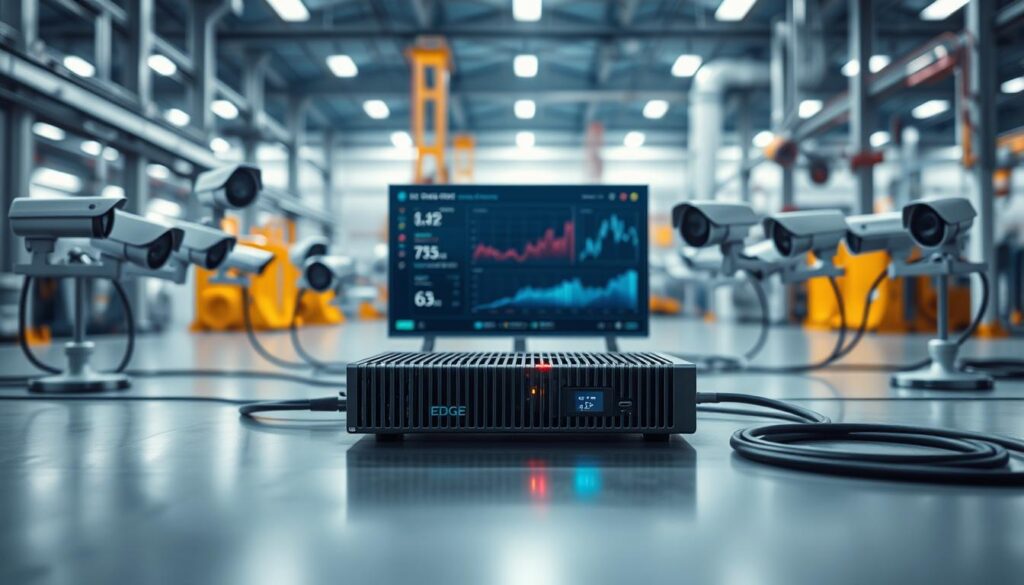
The Triad of Edge Efficiency
Proximity is key, not just for real estate agents. In offshore wind farms, edge devices analyze turbine vibrations on-site. This catches mechanical issues before they become expensive repairs. It’s like having a pit crew inside every machine.
Latency is another important factor. When a robotic arm in Detroit’s auto plants hesitates for 0.3 seconds, it loses $20k/minute. Edge solutions reduce response times, turning microseconds into measurable ROI.
Bandwidth is like the HOV lane of data highways. Autonomous vehicles generate 5TB daily. Edge computing filters this data locally, sending only critical alerts to the cloud. It’s like having a bouncer for your data pipeline.
Milliseconds That Move Markets
Energy companies now treat latency reduction like Wall Street quant firms. When wind farms adjust blade angles 0.5 seconds faster during storms, they prevent $800k in downtime per turbine annually. Those milliseconds are like stacks of Benjamins.
| Scenario | Traditional Setup | Edge Solution |
|---|---|---|
| Wind Turbine Adjustments | 2.1 sec latency | 0.4 sec latency |
| Data Transmission Volume | 5TB/day raw | 120GB/day processed |
| Annual ROI Impact | $1.2M loss | $3.8M savings |
This isn’t just tech jargon – it’s financial alchemy. As edge computing evolves, companies treating microseconds as currency will dominate their sectors. The question isn’t “Can we afford edge?” but “Can we afford not to edge?”
Common Applications by Sector
Imagine if your toaster could talk to the power grid. While kitchen appliances aren’t there yet, edge computing is changing how industrial equipment works. From factories to oil fields, industry-specific applications are making operations more efficient.
Smart Factories: Edge’s Killer App
Modern assembly lines are smarter than many people. BMW’s Leipzig plant uses edge-enabled robots that don’t just weld. They predict failures by analyzing vibrations before they happen. It’s not just maintenance; it’s like they have a sixth sense.
Why is this important?
- Real-time quality control cuts defects by up to 40%
- Energy use is as good as Tesla’s batteries
- Worker safety systems react faster than humans
Logistics Lifelines and Energy Grid CPR
FedEx’s Memphis hub uses edge-powered robots that are faster than gymnasts. These robots sort packages in real-time, like in Minority Report. Texas wind farms adjust turbine angles during storms, playing 4D chess with the weather.
| Sector | Challenge | Edge Solution | Impact |
|---|---|---|---|
| Manufacturing | Equipment downtime | Vibration analysis nodes | 92% fewer breakdowns |
| Logistics | Delivery delays | Autonomous routing AI | 37% faster throughput |
| Energy | Grid instability | Weather-responsive turbines | 15% output increase |
The real MVP? Edge hardware essentials are built tough. They can handle dust storms, subzero temps, and factory chaos. John Deere’s latest combines use military-grade edge nodes that can survive anything.
“Our edge systems reduced irrigation errors by 68% – they’re basically agricultural neurosurgeons.”
Key Technologies
Edge computing needs more than just better tech. It requires hardware that can withstand a zombie apocalypse and outsmart cybercriminals. Let’s look at the heroes behind distributed intelligence, from servers as tough as Marvel superheroes to security systems stronger than Fort Knox.
Ruggedized Servers: Edge’s Battle Armor

Forget about climate-controlled data centers. Edge devices face harsh environments that would scare Bear Grylls. Modern edge hardware essentials handle extreme temperatures and vibrations with ease. For example, servers keep vaccine data safe in Arctic warehouses, even in freezing temperatures.
So, what makes these servers special? They have three key features:
- Self-healing firmware that fixes problems fast
- Power-saving designs that last for years
- Tamper-proof casings that erase data if breached
AI Co-Processors and Security Firebreaks
Now, let’s talk about edge security fundamentals. Next-gen chips combine AI with top-notch encryption. Imagine Sherlock Holmes and Edward Snowden creating a microprocessor together. These co-processors:
- Check traffic patterns in real-time
- Create strong defenses around each device
- Quarantine suspicious data quickly
In healthcare, this tech keeps devices like pacemakers and insulin pumps safe. An engineer said, “Our encryption is so strong, even the data needs clearance to move.” This means networks can handle hackers like unwanted party guests, with virtual bouncers and electronic pepper spray.
Future Trends
Edge computing is changing fast—it’s having a big revolution. Imagine a world where data doesn’t go to the cloud but stays close to you. The next ten years will make edge computing key for businesses, with measuring edge ROI as important as checking your emails.
5G’s Shotgun Wedding with Edge
5G and edge computing are a perfect match. They work together so well, it’s like they eloped. This combo is fast, with 5G’s quick speeds making edge nodes super efficient.
Retailers are already using this team to save a lot of money. They track inventory in real-time, catching shoplifters quickly. It’s like they’re using the latest tech to stay ahead.
Sustainable Edge and Quantum Curves
Future edge nodes will do more than just compute. They’ll even make their own energy, like plants. Solar-powered data centers are turning parking lots into green spaces.
Hybrid edge-cloud solutions are also making things more efficient. They work like a DJ, mixing tasks for the best results. And, new quantum-inspired algorithms are making old hardware work better, without needing new tech.
| Industry | Use Case | ROI Metric | Impact |
|---|---|---|---|
| Retail | AI-powered loss prevention | $12B annual savings | 37% theft reduction |
| Manufacturing | Predictive maintenance | 18% downtime decrease | $4M/plant yearly |
| Energy | Smart grid optimization | 22% efficiency gain | 4.3M tons CO2 avoided |
The old saying “build it and they will come” is outdated. Now, it’s all about “deploy it and prove it.” With edge analytics growing fast, CFOs want to see clear ROI. Even the latest tech can’t ignore the need for solid business results.
Summary
We’ve explored edge computing’s impact on factories and server farms. Here, milliseconds are key to profits. Centralized cloud systems are now outdated, like delivering pizza from another time zone.
Edge computing doesn’t just process data. It fights against slow speeds and limited bandwidth. It’s not just theory; it’s real.
Take John Deere’s smart harvesters. They make quick decisions in the field. Siemens’ neural factories predict when equipment will fail. These examples show how real-time data leads to real savings.
For those who lag behind, the costs are high. Shell saves $7 million a year per rig with edge computing. Walmart cuts inventory errors by 30% with local AI. If your competitors are faster, you’re falling behind.
Edge computing is a game-changer. It’s what separates winners from losers. It’s time to switch to edge solutions quickly. If you’re slow, you’ll be left behind.
Industrial IoT basics teach us to treat data like it’s local. The future is about quick insights, not slow cloud processing. Edge computing is changing industries like smart grids and ports. It’s time to act fast.