I’ve been watching the AI industry evolve at an almost uncomfortable pace, but one shift in 2026 stands out above everything else: the quiet but decisive move away from traditional GPUs. For years, GPUs powered the AI boom, from training massive language models to running inference at scale. Now, however, that dominance is being challenged not by a better GPU, but by something fundamentally different.
What’s emerging is a new class of hardware: custom AI chips, purpose-built for specific workloads. This is no longer a niche experiment. It is becoming the backbone of modern AI infrastructure, and the implications are far-reaching.
Why Custom AI Chips Are Taking Over
At its core, the rise of custom AI chips comes down to efficiency. GPUs were never designed specifically for AI they were adapted from graphics processing. That flexibility made them powerful, but also inefficient for specialized tasks.
Custom silicon changes the equation entirely.
Instead of a one-size-fits-all architecture, companies are now designing chips that are optimized for very specific operations such as large language model inference or recommendation engines. The result is dramatically improved performance per watt, lower latency, and reduced operational costs.
This matters because AI is no longer experimental. It is infrastructure. And infrastructure demands efficiency. In large-scale deployments, even a small improvement in efficiency can translate into millions of dollars saved annually. That’s why companies are no longer satisfied with general-purpose hardware they want precision tools.
The NVIDIA–Marvell Signal: A Strategic Pivot
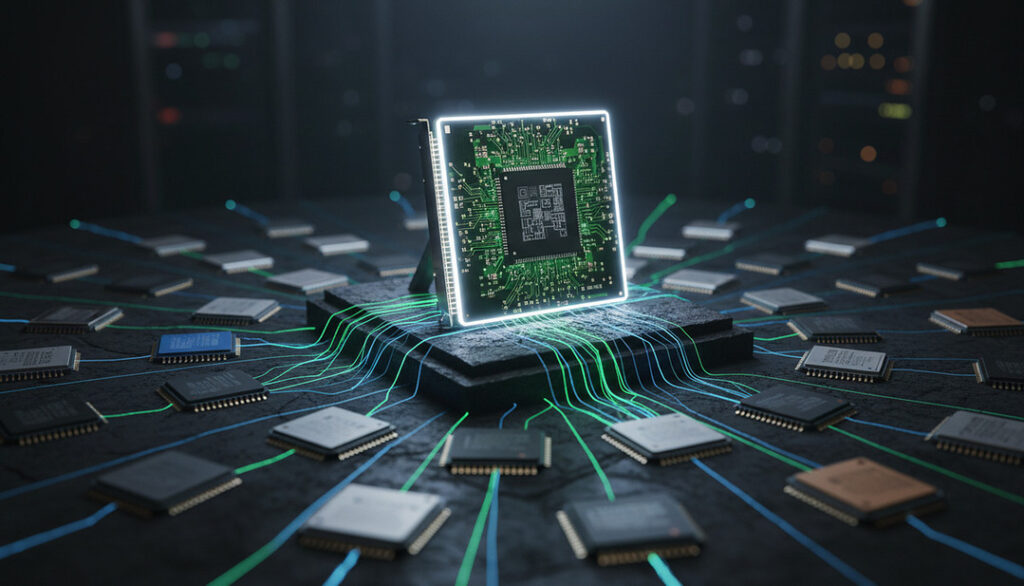
One of the clearest signals of this shift came when NVIDIA invested into Marvell to accelerate custom AI infrastructure development. At first glance, it might seem surprising why would the world’s leading GPU company invest in alternatives to its own dominance?
The answer is simple: NVIDIA understands the direction of the market.
Rather than resisting change, it is positioning itself to lead the next phase. This move reflects a broader realization across the industry: the future of AI hardware will not be defined by standalone GPUs, but by integrated, customized systems.
This is not about abandoning GPUs entirely. It is about evolving beyond them.
Big Tech Is Designing Its Own Silicon
Perhaps the most telling indicator of this trend is what the largest technology companies are doing behind the scenes. Amazon, Google, and Meta are no longer relying solely on third-party hardware. They are building their own chips each tailored to their unique ecosystems.
Amazon’s Trainium and Inferentia chips are optimized for cloud-based machine learning workloads. Google continues to refine its Tensor Processing Units (TPUs), which are deeply integrated into its AI stack. Meta is investing heavily in custom accelerators to power its recommendation algorithms and generative AI platforms.
This shift is not just technical it’s strategic. By controlling their hardware, these companies gain:
- Greater efficiency
- Lower long-term costs
- Independence from external suppliers
- The ability to optimize software and hardware together
In other words, hardware is becoming a competitive advantage, not just a commodity.
From General-Purpose to Workload-Specific Computing
What fascinates me most is how this shift reflects a deeper change in computing philosophy. For decades, the industry moved toward general-purpose systems machines that could do everything reasonably well. AI is reversing that trend. Today, the most valuable systems are those that do one thing exceptionally well.
Custom AI chips are designed with a narrow focus, but that focus unlocks extraordinary performance. Whether it’s processing natural language, running recommendation models, or enabling real-time inference at the edge, specialization is winning.
This is why the phrase “forget GPUs” has started to circulate in industry conversations. It’s not a dismissal of GPUs it’s a recognition that they are no longer the endpoint of innovation.
Efficiency, Cost, and Scale: The Real Drivers
Behind the headlines, the economics of AI are driving this transformation. Running large AI models is expensive both in terms of energy consumption and infrastructure costs. As AI adoption grows, these costs scale rapidly. Custom chips offer a solution by reducing power usage and increasing throughput.
Here’s a simple comparison that highlights the shift:
| Hardware Type | Strength | Limitation |
|---|---|---|
| GPUs | Flexible, widely supported | Higher energy use, less optimized |
| Custom AI Chips | Highly efficient, optimized | Less flexible, workload-specific |
The trade-off is clear: flexibility versus efficiency. And in a world where AI workloads are becoming more predictable and standardized, efficiency is winning.
The Rise of AI Infrastructure as a System
Another important development is that hardware is no longer being built in isolation. Companies are now designing entire AI systems combining chips, memory, networking, and software into a unified architecture.
This system-level thinking is critical. A powerful chip alone is not enough. What matters is how efficiently data moves between components, how well software is optimized, and how seamlessly everything integrates.
As outlined in NVIDIA’s broader strategy and industry research from sources like IBM, custom AI chips are most effective when they are part of a fully optimized ecosystem rather than standalone components.
This is why we are seeing the emergence of “AI factories” massive, integrated environments designed specifically for training and deploying models at scale.
Why This Shift Matters Right Now
The transition to custom AI chips is not a distant future it is happening now, and it is accelerating.
What makes this moment particularly important is the convergence of three forces:
- Explosive demand for AI across industries
- Rising costs of large-scale model deployment
- Increasing need for speed, efficiency, and scalability
Together, these forces are pushing companies to rethink their entire hardware strategy. Even smaller organizations are beginning to benefit indirectly, as cloud providers adopt custom silicon and pass those efficiency gains down to customers.
The Future of AI Hardware
Looking ahead, it’s clear that GPUs will not disappear. They will continue to play a critical role, especially in research and early-stage model development. But their dominance is no longer absolute. Instead, we are moving toward a hybrid world where GPUs, custom AI chips, and other specialized processors coexist each serving a specific purpose.
What’s different now is the balance of power. Custom AI chips are no longer experimental they are becoming the default choice for large-scale AI deployment.
Final Thoughts
If there is one takeaway from everything unfolding in 2026, it is this: the AI race is no longer just about algorithms it is about hardware.
Custom AI chips represent a fundamental shift in how intelligence is built, scaled, and delivered. They are faster, more efficient, and increasingly essential in a world where AI is embedded in everything from cloud services to everyday devices.
The companies that master this transition those that can design, optimize, and deploy their own silicon will define the next era of artificial intelligence. And from where I stand, that future is already taking shape.