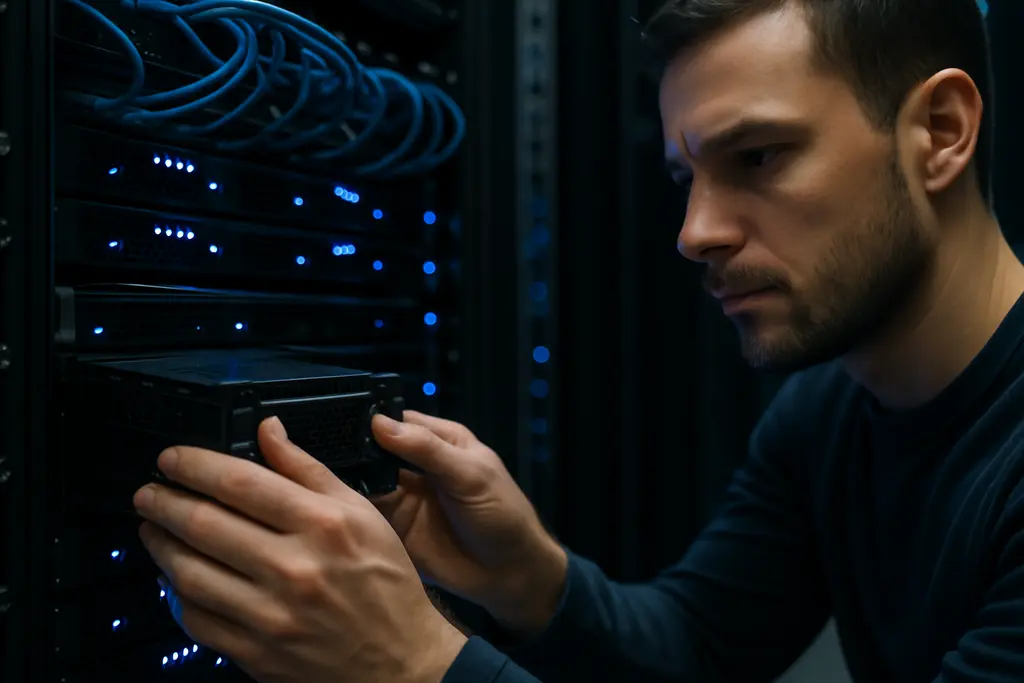
AMD Helios arrived on July 23, 2026, as AMD’s rack-scale AI infrastructure system for frontier AI, large-scale inference, and foundation-model training. AMD positioned the system as a full-stack rack design rather than a set of discrete accelerators, CPUs, networking components, and software pieces assembled by the customer. That distinction matters because power delivery, network topology, memory bandwidth, serviceability, and software maturity are now tightly linked in large AI clusters.
For data center operators, the useful question is not whether a rack has impressive peak arithmetic. It is whether the system can deliver repeatable work per watt, per dollar, and per operational hour under real model-serving and training conditions. AMD’s public material gives enough detail to assess the direction of the architecture, but not enough to independently validate rack-level energy efficiency. That gap should shape procurement reviews.
What AMD Helios Changed At Rack Scale
AMD Helios Rack Composition
AMD launched the system at Advancing AI 2026 and described it as a unified rack-scale platform combining Instinct accelerators, EPYC CPUs, Pensando networking, and ROCm software, according to the company’s July 23 announcement. A single AMD Helios rack integrates 72 AMD Instinct MI455X GPUs with 18 AMD EPYC “Venice” sixth-generation CPUs. That ratio shows AMD is not selling the GPU as an isolated part; it is trying to control more of the rack design, from host compute to accelerator fabric.
The design follows a pattern now visible across high-end AI infrastructure: the rack is becoming the practical unit of deployment. This changes how capacity planning works. Operators must consider aisle power density, liquid-cooling readiness, switch placement, firmware management, spare-parts strategy, and software update procedures before evaluating accelerator count alone.
Open Standards And Software Stack
AMD says the system uses the Open Rack Wide form factor defined by Meta through the Open Compute Project, Ultra Accelerator Link, Ultra Ethernet Consortium work, and ROCm software. The open-standards direction is significant, but it should not be read as automatic interoperability. In practice, support matrices, cable reach, switch firmware, accelerator firmware, kernel versions, ROCm releases, and orchestration tooling decide whether a cluster behaves predictably.
Open interfaces can reduce lock-in risk over time, yet they can also expose integration gaps early in a product cycle. Operators should ask which exact rack configurations have been qualified, what failure domains AMD has tested, and how software support will be handled across multi-year deployments.
Compute, Memory, And Fabric Capabilities
Precision Claims Need Workload Context
AMD’s published rack specifications list up to 1.4 exaFLOPS at FP8 precision and 2.9 exaFLOPS at FP4 precision, with 31 TB of HBM4 memory in the rack and 23.3 TB/s of memory bandwidth per GPU on the Helios product page. Those are peak figures, not application-level throughput guarantees. FP8 and FP4 can be valuable for AI inference and some training flows, but accuracy targets, quantization methods, model architecture, batch size, and software kernels determine how much of that peak capability becomes useful work.
The system also lists about 260 TB/s of aggregate scale-up bandwidth across the 72 GPUs and 43 TB/s of scale-out bandwidth using industry-standard Ethernet based on Pensando networking. These numbers indicate an architecture aimed at keeping accelerators fed across both intra-rack and multi-rack operations. Still, network behavior under mixed inference and training traffic remains workload dependent.
| Subsystem | Published Detail | Operational Question |
|---|---|---|
| Accelerators | 72 Instinct MI455X GPUs per rack | How service events affect rack availability |
| Host CPUs | 18 EPYC “Venice” sixth-generation CPUs | How CPU scheduling maps to GPU utilization |
| Memory | 31 TB HBM4 per rack | How models are partitioned across devices |
| Scale-out network | 43 TB/s Ethernet-based bandwidth | How congestion is controlled at cluster scale |
Memory Bandwidth Is A Scheduling Constraint
AI systems often fail to reach useful throughput because memory movement, not arithmetic, becomes the limiter. The published 23.3 TB/s per-GPU HBM4 bandwidth is therefore central to the rack’s value. Large inference services depend on fast access to model weights and key-value cache handling, while training runs need predictable movement across accelerators.
The main caveat is that bandwidth is only useful when software scheduling, model partitioning, and fabric behavior align. ROCm maturity, framework integration, kernel coverage, and observability tools will shape the operator experience. A high-bandwidth rack with weak telemetry can be hard to tune and harder to debug during production incidents.
Energy Efficiency Limits For AMD Helios
Claims That Can Be Checked
AMD claims up to 30% more inference tokens per dollar than leading competitive systems. That is a cost-efficiency statement, not a complete energy-efficiency disclosure. For operators evaluating AMD Helios, the missing public details are just as important as the published performance figures: rack power draw, cooling requirements, coolant temperature envelopes, power-supply redundancy, and measured tokens per joule across named models.
Performance-per-dollar can improve even if absolute power density rises. A rack may justify higher power if it completes more inference or training work in the same time, but that depends on local electricity pricing, cooling design, utilization rate, and workload mix. Without rack-level power data and test methodology, energy efficiency remains a procurement question rather than a settled fact.
Cooling And Power Data Still Matter
High-density AI racks tend to move constraints from server procurement into facility engineering. Electrical rooms, busways, backup power, liquid-cooling distribution, leak detection, maintenance windows, and heat-rejection systems all affect whether a rack can run at intended load. A published FLOPS number does not answer whether a facility can host the rack without redesign.
Operators should request measured data for sustained inference, mixed-precision training, idle behavior, partial-rack failure states, and recovery after component replacement. They should also ask whether the reported efficiency assumes a full rack, a qualified cluster size, a specific ROCm release, and a defined model set. Small differences in methodology can change the result enough to affect site planning.
Security And Operations Risk

Ethernet Management And Cluster Exposure
The use of Ethernet-based scale-out networking helps align the system with familiar data center practices, but it also increases the need for disciplined segmentation. AI clusters carry model artifacts, training data, credentials, telemetry streams, and orchestration control traffic. Management networks should be separated from workload paths, and access to firmware tools, switch configuration, and accelerator management interfaces should be tightly controlled.
Security reviews should treat the rack as a distributed system. That means maintaining inventories for GPU firmware, CPU firmware, network adapters, switches, baseboard controllers, ROCm components, container images, and orchestration agents. Public AI infrastructure discussion often centers on accelerator speed, but the larger operational risk is configuration drift across many high-value nodes.
Supply Chain And Firmware Hygiene
Because the system combines CPUs, GPUs, networking, software, and rack integration, support boundaries matter. Buyers should identify who owns firmware qualification, emergency patch sequencing, spare-part logistics, and root-cause analysis when failures cross component lines. A rack-scale product can reduce integration work for the customer, but it does not remove lifecycle management.
Related coverage of AI data center capacity has shown why access to power and facilities can be as strategic as access to accelerators. For readers exploring connected technology and infrastructure insights, Abacus News offers complementary coverage beyond this site’s server-infrastructure specialization.
AMD Helios Adoption Signals
Late-2026 Availability Will Be The First Test
AMD said Helios racks were in production and that Microsoft Azure would deploy the system for frontier model inference starting in late 2026. AMD also named Celestica as a partner to bring the rack to market, with availability expected in late 2026. As of September 6, 2026, those deployments were best treated as near-term execution milestones rather than proven fleet-scale operating evidence.
The most useful signs to watch are not broad performance claims. They are confirmed cluster deployments, published facility requirements, software release cadence, customer references with workload context, and measured efficiency data under named models. If those data points arrive, the industry will be able to compare the rack against alternatives on operational grounds rather than peak specifications alone.
What Buyers Should Ask Before Deployment
- What is the sustained rack power draw under the intended model and batch profile?
- Which ROCm, firmware, and switch software versions are qualified together?
- What cooling water conditions or facility assumptions are required?
- How are failed GPUs, NICs, and power components isolated and replaced?
- Which metrics are available for per-job energy use, network congestion, and memory pressure?
The technical direction is clear: AMD is pushing from component supply toward rack-scale AI infrastructure. The unresolved question is how the system performs under real operating constraints. For cautious infrastructure teams, the correct posture is neither dismissal nor hype. The rack deserves close evaluation, but energy claims should be tied to measured power, cooling, utilization, and model-level throughput before capacity plans are locked.