AI data center capacity is becoming the real prize in the chip war, and AMD’s deal with Core Scientific shows why. The company is not only trying to sell more accelerators; it is trying to make sure customers have enough power, land, racks, and physical infrastructure to deploy them.
That is the missing layer in many AI chip stories. The same race visible in China AI infrastructure is now playing out in the U.S. market, where the winner may be the company that can connect silicon supply with actual data center capacity.
AI Data Center Capacity Is Now Part of the Chip Sale
AMD signed a deal with Core Scientific to secure access to as much as 2.5 gigawatts of data center capacity, starting with more than 500 megawatts in 2027. The arrangement gives AMD a way to help customers deploy AI systems using its chips and software rather than leaving them to find scarce infrastructure on their own.
That is a major strategic turn. AI accelerator companies used to compete mainly through performance, price, software maturity, and supply availability. Now they are competing through deployment pathways. A buyer may want AMD GPUs, but that does not matter much if the customer cannot get power and rack capacity.
The latest AMD-Core Scientific agreement shows how data center capacity is becoming bundled into the AI hardware conversation. AMD is not buying a conventional customer relationship. It is buying a route to infrastructure scale.
This is the new pressure point: chips need a home.
Why a Bitcoin Miner Fits the AI Moment
Core Scientific is a useful partner because it already understands high-density digital infrastructure. The company built much of its identity around Bitcoin mining, a business that required large power contracts, industrial sites, cooling discipline, and round-the-clock operations.
Those same ingredients now matter for AI and high-performance computing. The hardware is different, the customers are different, and the margins may be different, but the underlying asset is familiar: controlled access to power-heavy computing environments.
Core Scientific’s second-quarter 2026 update said the AMD partnership could support up to 2.5 gigawatts of leasable capacity and is anchored by 15-year agreements for approximately 530 megawatts across five sites. It also said the agreements represent more than $14 billion of potential base contracted revenue through its latest high-density colocation update.
That language shows how the company wants investors to see it: less as a pure crypto miner, more as a high-density colocation platform for AI workloads.
The Crypto-to-AI Pivot Is About Power, Not Branding
The easy version of the story is that Bitcoin miners are rebranding because AI is hotter. That misses the deeper infrastructure logic.
Bitcoin mining facilities were built around cheap or available electricity, large-scale site operations, and constant compute demand. AI data centers require more sophisticated networking, security, cooling, and hardware integration, but they begin with the same scarce input: power.
That makes crypto mining companies attractive when AI firms need speed. They may have land, substations, utility relationships, permits, fiber access, and operational teams already in place. Converting those facilities is not automatic, but it can be faster than starting from raw land.
The difference is that AI customers are more demanding. They need higher reliability, tighter service-level expectations, advanced chips, stronger network design, and more complex facility engineering.
| Decision Factor | Bitcoin Mining Site Advantage | AI Data Center Requirement |
|---|---|---|
| Power access | Existing large-load relationships | Stable delivery for dense GPU clusters |
| Land and facilities | Industrial sites may already exist | Higher security and cooling standards |
| Revenue model | Mining depends on crypto economics | AI hosting depends on customer contracts |
| Hardware density | Built for continuous compute | Requires specialized rack and network design |
| Customer expectations | Self-operated or mining clients | Enterprise and cloud-grade reliability |
The table explains why the pivot is logical but not effortless. A mining site is not automatically an AI data center. It is a starting point with valuable infrastructure.
AMD Is Trying to Solve Nvidia’s Ecosystem Advantage Differently
Nvidia’s strength is not only GPU performance. It controls a deep software ecosystem, strong customer familiarity, networking options, and a broad deployment culture around AI training and inference. AMD has been trying to close that gap through Instinct GPUs, EPYC CPUs, ROCm software, and larger infrastructure partnerships.
The Core Scientific deal fits that strategy because it gives AMD a way to make adoption easier. Customers do not want to assemble every piece of the stack alone. They want a reliable path from chip selection to operational capacity.
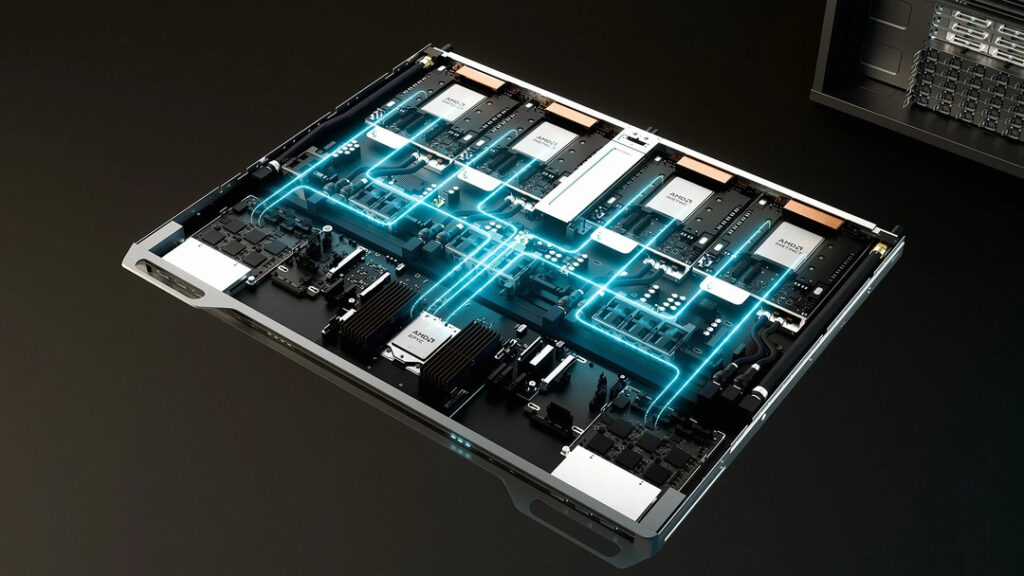
AMD’s own product stack now spans Instinct accelerators, EPYC processors, and ROCm software, with the company positioning the AMD Instinct platform around AI training and inference workloads. But hardware specifications are only one part of the sale.
If AMD can say that customers can get chips, infrastructure design, and capacity access through a partner ecosystem, it becomes easier to compete for serious deployments.
That creates a fuller AI stack, even without owning the entire cloud.
The Capacity Race Has a Financial Edge
The warrants in the Core Scientific deal also matter. AMD will receive market-priced warrants to purchase Core Scientific common stock, subject to commercial conditions. That structure gives AMD potential upside if the infrastructure partner benefits from AI demand.
This is becoming a pattern across AI infrastructure. Chip companies, cloud providers, data center operators, energy firms, and financing partners are getting more entangled because the required capital is too large for simple vendor contracts.
A chip sale is no longer just a chip sale. It can be connected to capacity agreements, financing structures, data center leases, power commitments, and customer deployment guarantees.
For AMD, the upside is strategic leverage. For Core Scientific, the upside is credibility and long-term contracted demand. For customers, the upside is access to AI infrastructure that might otherwise be difficult to secure.
The risk is execution. Gigawatts look impressive in an announcement, but facilities still need power delivery, equipment, cooling, networking, construction schedules, and customer demand.
The Next Signal Is Whether Customers Actually Fill the Capacity
The first development to watch is whether AMD customers commit to deployments using the Core Scientific capacity. A framework is valuable, but the market will judge real utilization.
The second signal is site readiness. More than 500 megawatts beginning in 2027 is meaningful, but AI-ready capacity requires more than electrical availability. It requires dense rack infrastructure, cooling design, hardware integration, and operational resilience.
The third signal is whether more former mining operators become AI infrastructure partners. If Core Scientific succeeds, other crypto-era power owners may try to position themselves as fast-track AI capacity providers.
The fourth signal is AMD’s software progress. Infrastructure access can open the door, but customers still need confidence in the ROCm ecosystem, workload portability, model support, and operational tooling.
That makes this deal a deployment test, not only a power deal.
Bitcoin Miners May Become the AI Landlords
The AI boom is forcing chip companies to compete outside the chip package. AMD’s Core Scientific deal shows that AI data center capacity is becoming a strategic weapon because customers need a complete route from silicon to live workloads.
This is where Bitcoin mining’s second life becomes clear. The mining boom created companies that understood power-heavy computing before AI made that skill more valuable. Some of those firms now have the physical assets and operating experience that AI companies need urgently.
AI data center capacity will decide which hardware ecosystems can scale beyond demos and benchmarks. AMD can announce faster chips and stronger software, but the harder win is helping customers deploy those systems in facilities that actually exist. If that works, the crypto-to-AI pivot may become one of the most important infrastructure shortcuts in the AI race.