
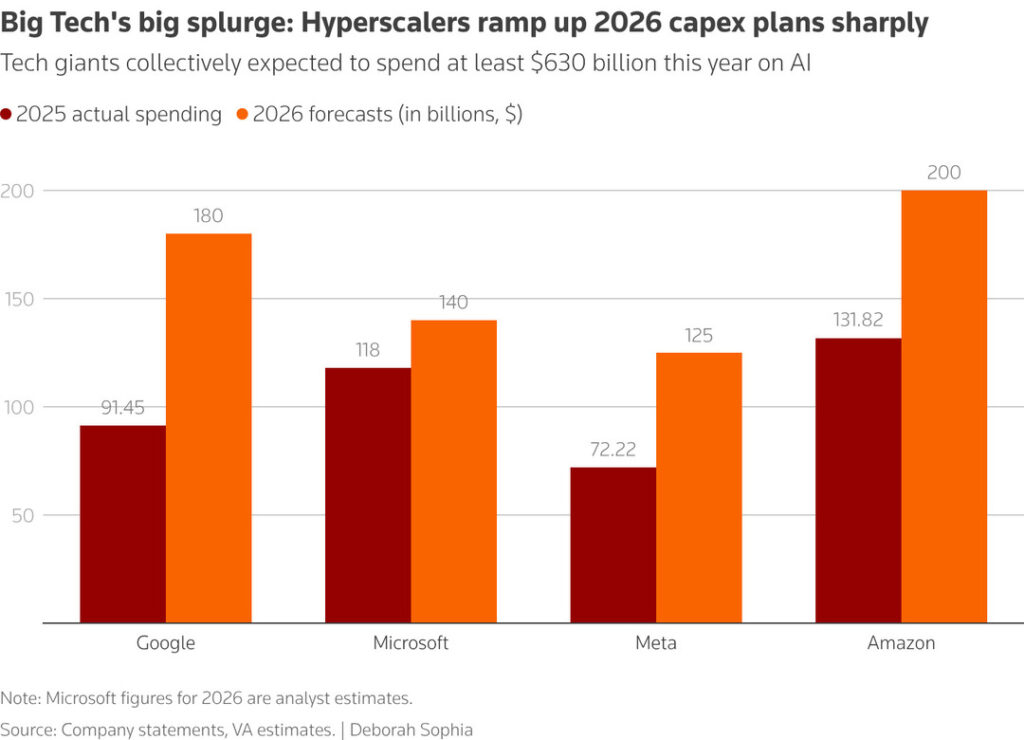
Amazon is preparing for one of the largest infrastructure expansions in corporate history, announcing plans to double its annual capital expenditures to an unprecedented $200 billion for 2026. Most of this colossal investment will fuel Amazon Web Services (AWS), as the company looks to cement its position as the leader in cloud computing and artificial intelligence infrastructure.
This move comes on the heels of Amazon’s robust Q4 2025 results, where operating income soared to $25 billion, up from $21 billion year-over-year. AWS, the crown jewel of Amazon’s portfolio, posted an impressive $12.5 billion in quarterly operating income, reflecting growing enterprise demand for cloud and AI capabilities.
AWS: At the Heart of Amazon’s Spending Surge
While Amazon’s capex figures cover all areas of the business including e-commerce operations and logistics CEO Andy Jassy made it clear that AWS data center investments are the driving force behind the increased spending projections. Speaking to investors, Jassy said, “If you look at the capital we’re spending and intend to spend this year, it’s predominantly in AWS.”
This heightened focus is a response to two key trends:
- Rapidly growing demand for both traditional (non-AI) workloads.
- Explosive interest in AI-powered applications and services.
Jassy explained, “Some of it is for our core workloads, which are non-AI workloads, because they’re growing at a faster rate than we anticipated. But most of it is in AI, and we just have a lot of growth and a lot of demand.”

Why AI Is Prompting Massive Cloud Investment
Artificial intelligence has moved to the center of the enterprise cloud conversation. Both established corporations and emerging startups are racing to secure the compute power needed for cutting-edge AI training, inference, and analytics. As a result, cloud platforms like AWS have become strategic partners for virtually every sector, from finance and healthcare to entertainment and retail.
The $200 billion capex commitment underscores Amazon’s strategy: securing enough infrastructure to power the next generation of AI breakthroughs. It’s a bet that growing AI workloads will demand unprecedented data center capacity and network resilience.
Reactions from Investors and Market Impact
Not everyone is convinced that such massive capital outlays are a sure bet. Following the Q4 earnings announcement, Amazon’s stock price slipped as much as 11%, reflecting Wall Street’s concerns about long-term returns and capital efficiency. However, Jassy defended the plan by pointing to AWS’s proven track record of forecasting demand and optimizing capacity.
“We have a fair bit of experience in AWS of forecasting demand signals, and doing it in such a way that we don’t have a lot of wasted capacity, and that we also have enough capacity to serve the demand that’s there,” Jassy told analysts.
Amazon’s conviction in riding the next big AI wave may carry risk, but it also positions the company to retain its edge over tightening competition from Microsoft Azure, Google Cloud, and other players.
What Does This Mean for Amazon Customers and Partners?
AWS’s rapid expansion will have wide-reaching implications:
- Enhanced Service Capacity: Customers will benefit from greater data center capacity, improving cloud reliability and scalability even during demand surges.
- Expanded AI Services: Expect a broader portfolio of AI tools, infrastructure, and managed solutions, catering to enterprise clients’ growing appetite for machine learning and data analytics.
- Potential for New Offerings: With more data centers, AWS may launch region-specific services and enhanced disaster recovery options, further increasing its appeal to global organizations.
The Bigger Picture: Cloud Competition and Industry Impact
Amazon’s assertive $200 billion bet reflects broader industry changes. As cloud computing underpins digital transformation worldwide, providers are racing to build, innovate, and scale. The battle for AI supremacy is only just heating up, and whoever can deliver high-performance compute at scale is likely to set the pace for cloud innovation over the next decade.
Other hyperscalers including Google, Microsoft, and Oracle are also ramping up their own data center investments, signaling an era where cloud infrastructure is as vital as oil refineries or power plants for the global economy.
Looking Forward: Will Amazon’s Gamble Pay Off?
Only time will determine whether Amazon’s historic capex surge will deliver outsized returns. The company is no stranger to aggressive investment previous waves of spending on logistics, Prime Video, and cloud laid the foundation for its global dominance. If the AI boom continues and if AWS’s demand forecasts are accurate Amazon could emerge even more powerful and profitable.
For now, investors, competitors, and customers are watching closely as Amazon reshapes the landscape of digital infrastructure for the years ahead.