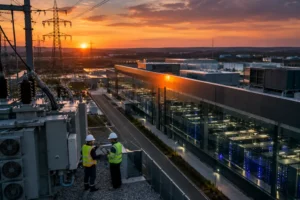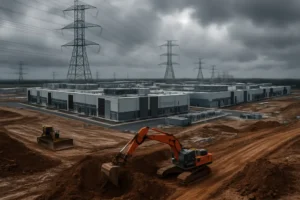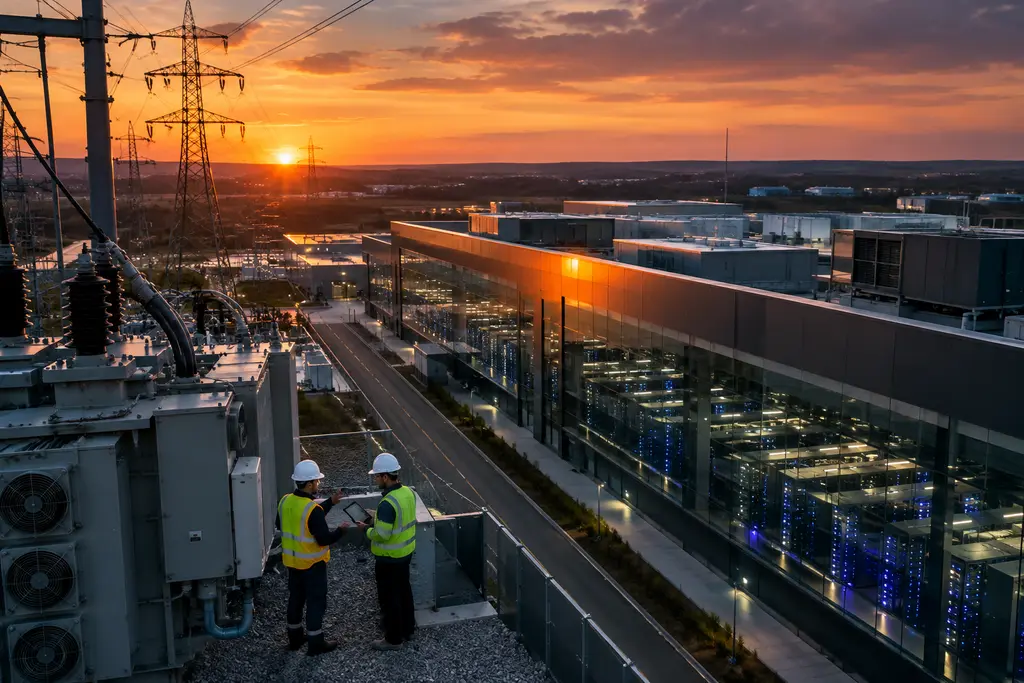
AI Data Centers are changing the timing model for grid connections. The issue is not only how much electricity a new campus may need after construction. It is also whether utilities, grid operators, equipment suppliers, and developers can coordinate large-load interconnection studies, substation work, protection systems, and power-quality requirements on schedules that match compute deployment plans.
The evidence points to a physical infrastructure constraint rather than a single policy failure. Goldman Sachs projected that global data center power demand would rise 170% from 2025 to 2030, with more than 60% of that growth coming from the United States, according to an October 20, 2026 Axios report on the AI energy bottleneck. That scale of load growth does not translate directly into connected capacity, because each project still depends on local transmission headroom, distribution assets, transformers, backup architecture, land, permitting, and credible construction timelines.
Why AI Data Centers Stress Grid Connections
AI Data Centers Turn Power Into A Site Constraint
Large compute campuses behave differently from many traditional commercial loads. They often seek high-capacity service at a small number of concentrated sites, and they need dependable power before racks, cooling systems, and network links can operate at scale. For AI Data Centers, the interconnection request is therefore part of the product schedule, not an after-the-fact utility formality.
The technical challenge begins with load certainty. A utility has to decide whether a proposed facility is a funded project, a speculative placeholder, or one of several duplicate requests from developers testing multiple sites. If the request is treated as real, planners may reserve capacity, study transmission impacts, order long-lead equipment, and design substation upgrades. If that project later fails, other customers can be affected by planning churn and stranded engineering work.
Demand Growth Is Not Evenly Absorbed
The national demand figures are useful, but they can hide regional stress. A grid connection is granted locally, at a particular point on a transmission or distribution system. A region with available generation may still face constraints if transmission paths are congested or if the serving utility lacks substation capacity near the proposed campus. The reverse can also occur: a site may appear attractive because land is available, but the power-delivery path may require upgrades that take longer than the building shell.
This is a connectivity issue in the strict engineering sense. Data center networks depend on fiber routes, carrier diversity, and latency targets, yet those advantages mean little if energization slips. The power grid becomes another access network with capacity limits, study queues, physical ports, and upgrade dependencies.
Equipment Shortages Shift The Bottleneck
Transformers And UPS Capacity Set The Pace
A May 2026 Johns Hopkins supply-chain analysis identified severe shortages in grid-supporting equipment. Under high-growth scenarios, it projected unmet demand by 2027 of 14.1 GVA, or about 76%, for transformers and 22.1 GVA, or about 82%, for UPS systems; by 2030, unmet demand for bulk transformers was expected to reach 107.3 GVA, according to the report on grid-supporting equipment. These figures matter because a power connection is not complete just because generation exists somewhere on the system.
Transformers, switchgear, UPS systems, and control equipment determine whether electricity can be delivered at the voltage, continuity, and quality required by the facility. A delay in any one of these components can block commissioning even if construction crews finish the building. This makes supply-chain planning part of grid connectivity, not a separate procurement concern.
Interconnection Is A Hardware Problem Too
Interconnection discussions often focus on queue reform and regulatory process, but hardware limits can dominate the actual schedule. A utility may finish an engineering study and still wait for transformers. A developer may secure land and network access but still lack the electrical equipment needed to bring a phase online. A grid operator may approve a connection only after upgrades that require their own materials and outage windows.
AI Data Centers do not only request energy; they request a package of power capacity, reliability, voltage transformation, backup behavior, and operational coordination. That package is harder to deliver during a period when multiple projects are asking for similar equipment at the same time.
On-Site Power Is A Workaround, Not An Escape
Behind-The-Meter Designs Change Risk Ownership
Some developers are responding by considering on-site generation, fuel cells, or other behind-the-meter power arrangements. That approach can reduce dependence on a utility energization date, but it does not remove the need for electrical engineering discipline. The site operator takes on more responsibility for fuel supply, generation maintenance, emissions compliance, protection coordination, backup systems, and failure recovery.
For projects evaluating this path, the tradeoff is speed against operating responsibility. A campus that generates more of its own power may have better control over schedule, but it also becomes a power operator in addition to a compute operator. The same issue is analyzed in related site coverage of onsite data center power, where faster energization is treated as a practical response to grid delays rather than a universal solution.
Connectivity Still Depends On Utility Coordination
Even when a facility uses on-site generation, grid coordination usually remains relevant. Sites may need standby service, black-start planning, synchronization rules, export restrictions, or emergency operating procedures. Protection systems have to prevent faults from propagating between the facility and the utility network. Maintenance windows also need planning, because compute operators cannot assume that generation, batteries, UPS systems, and utility service will all be fully available at every moment.
The result is a more complicated operating boundary. Instead of waiting only for a utility connection, the developer must prove that its own power stack can support the data hall while interacting safely with the grid. That can shorten one part of the schedule while adding new engineering review.
Operational And Security Effects

Power Quality Affects Network Availability
Grid constraints can show up as network reliability problems. Voltage sags, transfer events, UPS faults, generator trips, or poorly coordinated switching can affect routers, optical gear, storage systems, and cooling controls. Facility engineers and network engineers therefore need shared visibility into events that cross the power and packet domains.
This does not mean every data center power event becomes an outage. Well-designed redundancy can absorb many disturbances. The cautious view is that higher electrical density reduces the margin for weak coordination. Testing, maintenance discipline, and clear operating procedures become as important as raw capacity.
Cyber Controls Extend Into Facility Systems
Greater dependence on digital control systems also broadens the defensive scope. Building-management systems, generator controllers, UPS monitoring, battery systems, and remote maintenance interfaces require access control, logging, patch planning, and segmentation from production networks. These are defensive concerns, not reasons to delay every project, but they should be included in readiness reviews before a campus is treated as operationally mature.
Security assessment also benefits from separating enterprise endpoints from facility control environments. For those interested in comparing general endpoint-protection practices, Best Antivirus Pro provides insights into related security tooling within the same network.
AI Data Centers And Grid Connection Discipline
The central challenge is timing alignment. Compute developers want to deploy quickly, utilities need credible load forecasts, equipment suppliers face capacity limits, and grid operators must protect reliability for existing customers. None of those constraints disappears through a larger power-purchase agreement or a public announcement about new capacity.
AI Data Centers will be easier to connect when requests are phased, documented, and backed by realistic engineering milestones. Utilities will also need better methods to distinguish firm load from speculative demand without blocking legitimate projects that can help fund infrastructure upgrades. The most useful near-term signal is not a headline capacity number, but evidence that each phase has land, financing, equipment orders, interconnection studies, protection design, cooling plans, and operating staff aligned.
The cautious assessment is that grid connections are becoming a gating item for new compute capacity. Demand growth is real in the cited forecasts, but the binding limits are local and physical: transformers, UPS capacity, substations, transmission headroom, and operational proof. Treating power connectivity as a first-order engineering dependency gives developers and utilities a better chance of separating executable projects from queue noise.