
AI has moved well beyond the novelty stage, and that is precisely why its weaknesses now matter more than its promises. As more companies push artificial intelligence into workflows that affect money, jobs, decisions, and trust, the real story is no longer what these systems can do in a demo, but what happens when they fail in the real world.
I see this moment as a turning point. The most consequential AI debate in business today is not about who has the largest model or the fastest chip stack. It is about whether organizations can deploy these systems responsibly, securely, and at scale without creating new operational, legal, and human costs that outweigh the upside.
The Hype Cycle Has Given Way To Operational Reality
For the past two years, the conversation around AI has been dominated by product launches, valuation surges, infrastructure spending, and headline-grabbing capability gains. That phase is not over, but it is no longer sufficient. Inside companies, the practical questions have become far sharper: Can the system be trusted? Can it be audited? Can it be secured? Can it be integrated without destabilizing teams?
That shift matters because enterprise adoption lives or dies on consistency. A chatbot that drafts a sloppy paragraph is an inconvenience. A system that invents a clause in a legal summary, introduces an error in a medical workflow, or misstates a financial recommendation becomes a liability. The closer AI gets to high-stakes decision environments, the less tolerance there is for uncertainty masquerading as intelligence.
This is why reliability has become the central constraint on the next phase of adoption. Businesses are discovering that fluent output is not the same thing as dependable output. AI may sound right, look polished, and move quickly, yet still produce results that are incomplete, fabricated, or contextually wrong.
Reliability Is The Ceiling On High-Stakes AI
The core technical weakness remains familiar: large language models can generate confident answers that are false. What has changed is the commercial context. This is no longer a laboratory concern. It is now a boardroom issue.
In low-stakes settings such as brainstorming, first drafts, or internal ideation, a degree of inaccuracy can be managed. In regulated or high-impact settings, that margin disappears. I increasingly view hallucination not as a minor flaw but as the practical ceiling on autonomous deployment. Companies may automate portions of work, but many still hesitate to hand over final authority where the cost of being wrong is too high.
That explains why the most serious enterprise implementations are leaning toward constrained systems rather than unrestricted ones. Retrieval-based architectures, validation layers, rule-based safeguards, and human review mechanisms are not signs that AI is failing. They are signs that leaders are learning how brittle generalized systems can be when dropped into complex institutional environments.
The emerging pattern is clear: adoption is still moving forward, but with tighter guardrails and lower trust in unsupervised outputs.
Security Has Become A First-Order AI Question
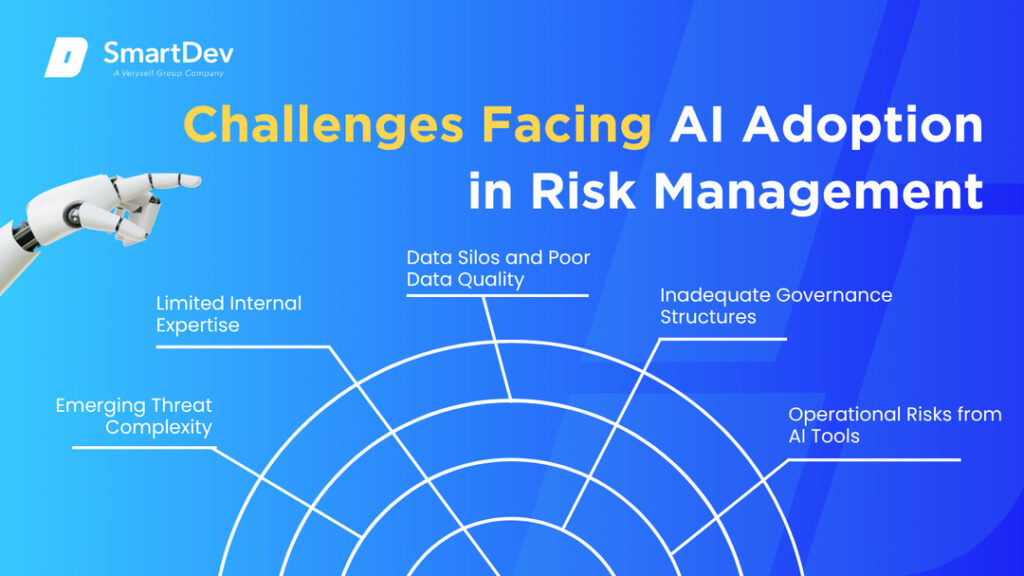
At the same time, AI is creating an entirely new attack surface. The same tools that can accelerate coding, analysis, and automation can also amplify misuse. Prompt injection, model manipulation, synthetic phishing, automated vulnerability discovery, and data leakage are no longer niche concerns for security researchers. They are now live business risks.
I think many organizations initially treated AI as if it were just another software feature. That assumption is rapidly breaking down. AI systems are not merely applications; they are dynamic interfaces that ingest language, respond probabilistically, and can be steered in unexpected ways. That makes them uniquely exposed to abuse.
The table below captures the shift companies are now making.
| Risk Area | What It Looks Like In Practice | Business Consequence |
|---|---|---|
| Reliability | Confident but incorrect outputs | Legal, financial, or reputational exposure |
| Security Misuse | Prompt injection, phishing, exploit discovery | Breach risk and operational disruption |
| Workforce Effects | Role compression and automation pressure | Restructuring, morale strain, hiring shifts |
| Governance | Unclear accountability for AI decisions | Compliance gaps and liability concerns |
This is where AI risk management stops being a compliance phrase and starts becoming a strategic discipline. The companies that treat AI as an operational risk category, not just a productivity layer, are likely to be the ones that sustain adoption rather than retreat from it after a failure.
The Workforce Impact Is More Subtle Than The Headlines Suggest
Public discussion often swings between two extremes: either AI will replace most white-collar work immediately, or its labor impact is overstated. Neither view captures what is happening on the ground.
What I see instead is a quieter but more pervasive form of disruption. Companies are not always eliminating entire functions overnight. More often, they are compressing roles, slowing hiring, and redesigning teams around AI-assisted output. One person is expected to do more. Junior roles become narrower. Administrative layers thin out. Some functions are restructured before workers fully understand why.
The result is not always a dramatic wave of layoffs with AI explicitly named as the cause. It is a broader reconfiguration of labor economics across knowledge work.
The pressure tends to show up in a few recurring ways:
- teams are asked to increase output without proportional headcount growth
- entry-level work becomes less available as routine tasks are automated
- managers reorganize workflows around AI tools before training and governance are fully mature
That creates a second-order risk many executives still underestimate: workforce trust. Employees are more likely to resist AI adoption when the technology is introduced primarily as a cost-cutting instrument rather than as a tool for augmentation, quality improvement, or safety. If leadership wants durable adoption, it has to address not only efficiency metrics but also legitimacy.
Governance Is Becoming A Competitive Divide
The final issue is accountability. When AI contributes to a harmful or costly outcome, who owns the decision? The engineer who shipped the feature, the manager who approved the workflow, the vendor that built the model, or the executive who pushed for faster deployment?
This question is no longer theoretical. As AI systems expand across legal, healthcare, finance, customer operations, and software development, governance is becoming a differentiator. Organizations that can document decisions, audit outputs, establish escalation pathways, and define human responsibility will have a structural advantage over those that treat governance as paperwork.
In practice, the winners in AI may not be the companies with the boldest claims, but the ones with the strongest controls. That may sound less glamorous than frontier-model announcements, yet it is what determines whether AI can move from experimentation to institutional trust.
Why This Matters Right Now
This matters now because AI has entered the phase where consequences are catching up with capability. The technology is no longer being judged only by its potential. It is being tested by its reliability under pressure, its vulnerability to misuse, its effect on workers, and the quality of the governance surrounding it.
I believe that is the real story of AI in 2026. The future of adoption will not be decided solely by smarter models or larger capital budgets. It will be decided by whether businesses can make AI dependable enough to use, secure enough to trust, and accountable enough to defend. That is what separates a passing wave of enthusiasm from a durable transformation of how work gets done.