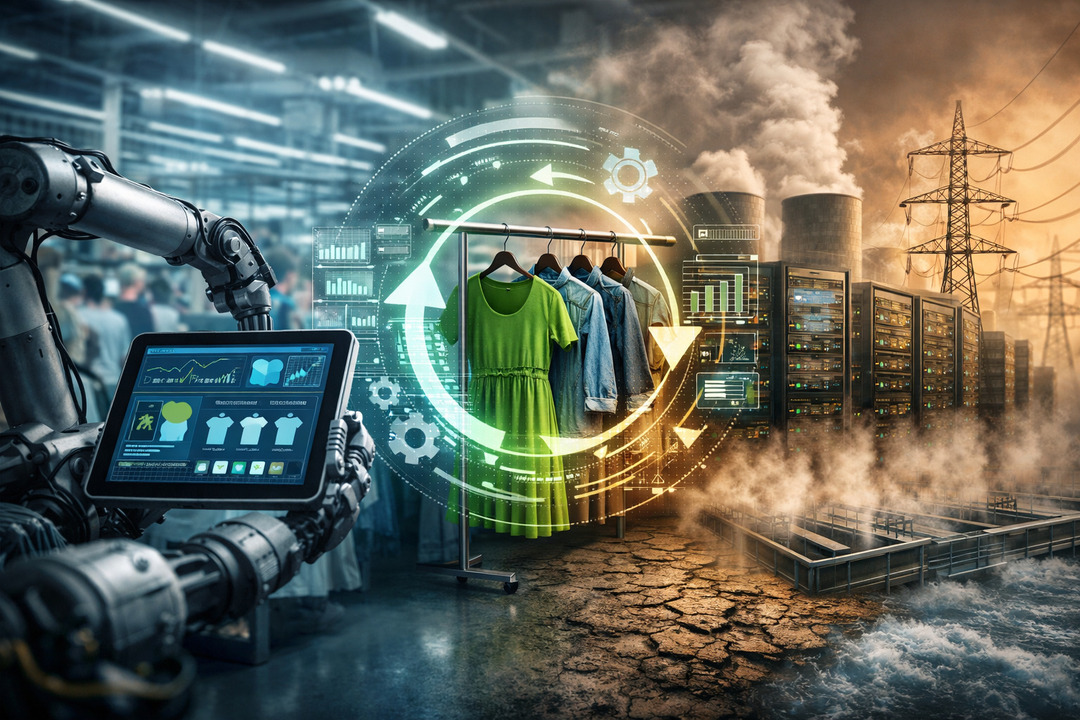
Fashion has spent years trying to solve one of its most damaging habits: making far more clothing than consumers will ever buy. What makes this moment urgent is that artificial intelligence is now being used as a practical tool to tackle that waste problem at scale, even as it introduces a new environmental cost of its own.
I see this as one of the clearest modern case studies in corporate sustainability because it captures a tension many industries are now facing. AI can help fashion become more precise, leaner, and less wasteful, but it also depends on infrastructure that consumes substantial energy and water. That contradiction is exactly why this story matters right now.
Why Fashion Is Turning To AI
For decades, fashion has relied on prediction, intuition, and seasonal momentum to decide what to produce. That system has always been prone to error. When brands misread demand, they are left with excess inventory, deep markdowns, storage costs, and mountains of unsold garments that represent wasted fabric, labor, transport, and resources.
AI promises something the industry has rarely achieved consistently: sharper forecasting. Large fashion groups including H&M, Kering, and Mango are using AI to analyze purchasing trends, regional demand, product performance, and supply patterns in ways that allow them to better estimate what customers are actually likely to buy. The goal is simple but powerful: produce closer to real demand and avoid flooding the market with clothing that may never leave the rack.
That shift is not just a technological upgrade. It represents a structural change in how fashion thinks about inventory. Instead of operating on broad assumptions, brands can move toward more dynamic and informed production planning.
How AI Is Reshaping The Supply Chain
The biggest sustainability impact may be happening far from the storefront. Fashion’s supply chain is sprawling, fragmented, and often inefficient, with sourcing, production, shipping, warehousing, and retail stretching across multiple markets. Small errors in one part of the chain can quickly become expensive and environmentally damaging in another.
AI is increasingly being used to tighten those weak points. It can help brands decide how much stock to produce, where to send it, when to replenish it, and when to pull back before excess accumulates. That means fewer speculative orders and a greater ability to respond to real consumer behavior.
The operational value becomes clearer when viewed side by side:
| Area | How AI Is Used | Sustainability Effect |
|---|---|---|
| Demand Forecasting | Predicts likely consumer purchases more accurately | Reduces overproduction |
| Inventory Allocation | Sends products to stores and regions with stronger demand | Lowers unsold stock |
| Supply Chain Optimization | Improves ordering, routing, and replenishment timing | Cuts waste across logistics |
| Product Performance Analysis | Flags weak sellers earlier | Prevents unnecessary repeat production |
This is why AI in fashion sustainability has gained such traction as both a business strategy and an environmental talking point. When companies produce more selectively, they reduce waste before it happens, which is often far more effective than dealing with excess after the fact.
Why The Business Case Is So Strong
One reason AI has advanced so quickly in fashion is that it does not ask companies to choose between sustainability and profitability. It offers the possibility of both. Less excess inventory can mean fewer markdowns, lower warehousing costs, better margins, and reduced waste at the same time.
That matters in an industry where sustainability efforts often struggle when financial pressure rises. AI-driven systems are easier for executives to defend because they are tied directly to efficiency. In other words, environmental gains are being pursued through operational discipline, not just brand positioning.
I find that especially significant because it reveals how sustainability often gains traction in corporate settings. It tends to move faster when it is embedded in core business systems rather than treated as a separate ethical initiative.
The Environmental Trade-Off No One Can Ignore
Still, this is not a neat success story. AI systems require heavy computing power, and that infrastructure comes with real environmental consequences. Data centers consume electricity at scale, and cooling systems can require substantial water use. As AI adoption expands, those resource demands are becoming harder to overlook.
That creates a difficult but necessary question: does the environmental benefit of reducing fashion overproduction outweigh the environmental cost of running the AI systems behind it?
This is where the case study becomes more complicated and far more interesting. Fashion may be reducing waste in one part of its model while increasing resource use in another. The sustainability claim only holds if the full equation is measured honestly.
The central tension can be summarized this way:
- AI helps brands make fewer unwanted products
- AI can improve inventory precision across complex supply chains
- AI also depends on energy-intensive and water-intensive infrastructure
That final point is critical. Efficiency alone does not automatically equal sustainability. If brands celebrate lower overproduction while ignoring the footprint of the technology enabling it, they risk turning AI into another polished narrative rather than a fully accountable solution.
What Brands Will Need To Prove
The next phase of this debate will depend on evidence, not enthusiasm. Fashion companies will need to show that AI is doing more than improving commercial forecasting. They will need to demonstrate that it is meaningfully lowering environmental impact across the broader system.
That means measuring not only the reduction in unsold garments, but also the energy and water footprint of the digital tools being used. It means asking whether AI is shrinking the total burden of production or merely shifting it from factories and warehouses to servers and cooling systems.
For companies that can answer those questions clearly, the upside is significant. They will be able to present AI as a credible operational model for more responsible fashion. For companies that cannot, the sustainability argument will remain incomplete.
Anyone tracking this shift can see how quickly it is evolving, and the wider implications are becoming harder to dismiss. The broader debate around AI in fashion sustainability is no longer about whether the technology is useful. It is about whether its benefits can be proven in full environmental terms.
Why This Matters Right Now
Fashion is being pushed to rethink how it makes, moves, and sells products. Consumers want less waste. Regulators want more transparency. Companies want tighter control over margins and inventory. AI appears to offer an answer to all three pressures at once, which is exactly why expectations have risen so quickly.
I believe this is the real importance of the moment. Fashion is not just experimenting with a new tool; it is testing a new model of sustainability, one built on prediction, precision, and data-driven restraint. If AI truly helps brands produce only what consumers are likely to buy, it could reduce one of the industry’s most persistent failures. But if the environmental cost of AI remains uncounted, then the solution will be only partial. Right now, the industry is being forced to confront a harder truth: the future of sustainable fashion will depend not only on making less waste, but on proving that the technology used to achieve that goal is sustainable too.