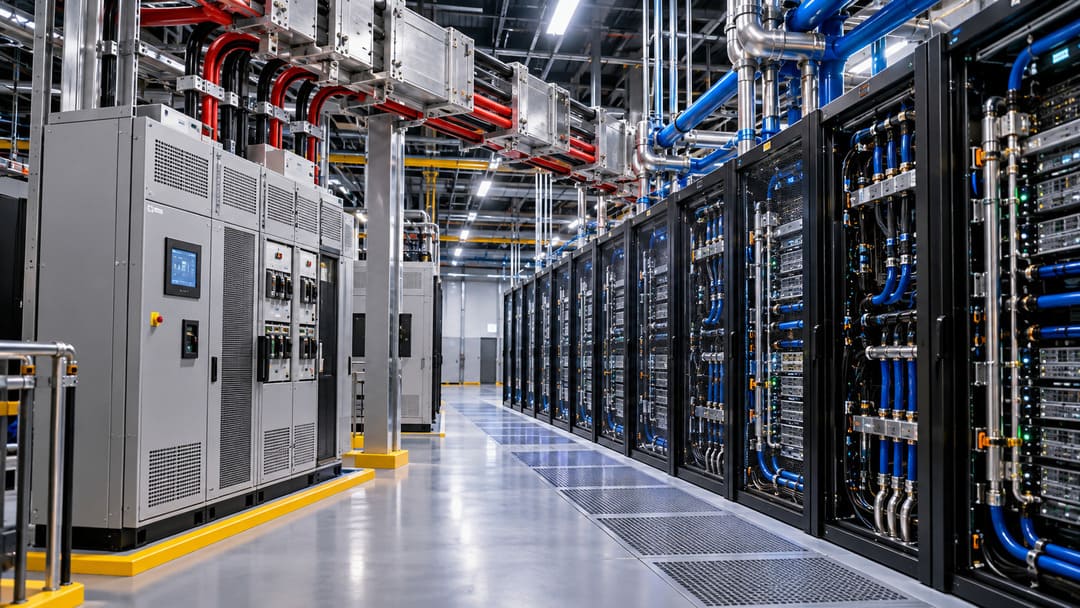
An “800 VDC-ready” rack is not the same thing as a data hall ready to operate it. Before approving a deployment, require evidence for the complete power path, its electrical protection, and the cooling and maintenance arrangements around it. A voltage label is not a commissioning result.
800 VDC means 800 volts direct current. Higher-voltage distribution can deliver a given amount of power at lower current, reducing the pressure on conductors and moving power-conversion equipment out of crowded compute racks. NVIDIA’s architecture proposals treat this as a redesign of power delivery, not simply a new server connector.
The case for changing low-voltage rack power architecture is the starting point. The purchasing decision needs a different question: what must the supplier and facility team demonstrate before the installation is accepted?
Define where AC ends and DC begins
Two projects can both describe themselves as 800 VDC deployments while requiring very different facility work.
The Open Compute Project’s August 2026 architecture update describes a side-power-rack approach: a separate cabinet near the compute racks converts existing 480 V alternating current, or AC, into DC. It also describes a longer-term approach that converts medium-voltage AC into 800 VDC upstream and distributes DC through the data hall.
The first can preserve existing upstream electrical infrastructure where sufficient capacity and row space are available. The second changes a much larger part of the facility’s power system. Neither description, by itself, establishes compatibility with a particular building or rack.
Start the review with a one-line electrical diagram showing the proposed power path. Mark which equipment stays, which equipment changes, where conversion occurs, and where the supplier’s responsibility ends.
Specify the electrical arrangement, too. OCP discusses both ±400 VDC and 0–800 VDC implementations. An 800-volt difference between conductors does not, on its own, define their relationship to ground or establish interchangeable equipment. Request the exact voltage range, grounding arrangement, connectors, and supported rack configuration not a promise of future compatibility.
Use the current calculation without overselling the savings
The electrical motivation is easy to demonstrate. The mistake is turning that demonstration into a claim about the entire facility.
Consider a hypothetical DC distribution segment delivering 400 kilowatts, ignoring conversion and wiring losses. Current equals power divided by voltage. At 400 VDC, that segment carries 1,000 amperes. At 800 VDC, it carries 500 amperes.
For unchanged circuit resistance, resistive losses follow the square of current. Halving current therefore reduces those particular losses to one-quarter of their previous value.
That is not a 75% reduction in data-center electricity consumption. It is a result for one idealized distribution comparison. It also does not establish a 75% reduction in copper: changing conductor size changes resistance, temperature rise, and the assumptions behind the calculation.
The comparison is between two DC voltages, not between 400 or 480 volts three-phase AC and 800 VDC. An AC comparison must account for its phase configuration and power factor rather than applying the same calculation blindly.
Use this arithmetic to understand why higher voltage helps. Ask the supplier for a separate, measured efficiency case covering the actual equipment and operating conditions. NVIDIA identifies lower conductor burden and fewer conversion stages as architectural benefits, but those benefits still need to be evaluated within the proposed installation.
Verify protection and the scope of certification
Electrical safety cannot be inferred from lower normal operating current. A fault is a different operating condition.
On September 24, 2026, UL Solutions announced a certification program for medium-voltage solid-state power units, based on UL 2877. Its evaluations address electrical protection, insulation, grounding, enclosures, interlocks, and abnormal conditions, including short-circuit testing. This provides a certification path for a defined equipment class—not blanket approval of every component in an 800 VDC installation.
The purchasing implication is straightforward: identify exactly what has been evaluated. Ask for the equipment model, configuration, certification scope, and installation conditions covered by that evaluation. Do not accept a reference to a standard as a substitute for evidence that the supplied equipment meets the applicable requirements.
System-level fault behavior requires its own review. In its analysis of 800 VDC arc-flash risk, Schneider Electric explains that converter behavior, capacitor placement, fault location, and fault-clearing time affect the outcome. Arc flash is the release of intense heat and pressure associated with an electrical arc. The company’s work uses simulations of particular architectures; its results are not safety guarantees for another installation.
Have qualified electrical engineers document how the proposed protection devices work together, including contributions from connected energy storage and other power paths. The review should explain which equipment disconnects during a fault and which loads remain supported.
It should also establish the maintenance conditions under which personnel can work safely. Neither “DC is inherently safer” nor “higher voltage is automatically more dangerous” is an adequate system assessment. The relevant evidence is the behavior of the actual design.
Test changing loads, not just steady output
A power system can deliver its rated output steadily and still need additional controls for rapid changes in demand.
NVIDIA’s power-and-storage architecture makes an important distinction: moving to 800 VDC addresses high-density power delivery, but does not by itself eliminate the power swings created by synchronized AI workloads. The proposal combines short-duration storage near compute equipment with longer-duration storage for larger, slower changes and backup transitions.
Ask what the proposed storage is intended to do. Smoothing repeated workload fluctuations is not the same service as keeping equipment running while backup generation starts. A storage-capacity figure alone does not describe response time, power-delivery capability, or recovery between events.
The recommended acceptance plan should include an agreed workload profile rather than only a constant-load demonstration. Have the supplier explain the expected response to startup, rapid load increases, load rejection, and transitions between supported power sources. Record acceptable voltage behavior and the limits that trigger alarms or protective action.
Require separate evidence for steady-state capacity, workload smoothing, and backup ride-through. They are related capabilities, but proof of one should not stand in for proof of the others.
Count sidecar heat and cooling dependencies
Moving power conversion out of a server rack does not make its heat disappear. It changes where some of that heat must be removed.
Schneider Electric’s cooling analysis describes early sidecar arrangements that reject conversion heat to room air, even when the neighboring GPU racks use liquid cooling. It also explains that moving toward centralized DC distribution can change how cooling equipment receives electrical power.
A hypothetical calculation shows why this matters. A converter delivering 1 megawatt of DC output at an assumed 98% efficiency would require approximately 1.0204 megawatts of input. The difference is about 20.4 kilowatts of conversion loss.
That is an illustration, not a measured product result. But where those losses become heat in an air-cooled cabinet, the room must accommodate them. “The GPUs are liquid-cooled” is not a complete thermal specification.
Request separate heat-rejection figures for the compute racks and power equipment. Establish how much heat goes into the liquid loop, how much remains in the room air, and which operating conditions produce the maximum cooling requirement. Include the sidecar footprint and maintenance access in the layout review.
Then trace the electrical supply to the cooling equipment. A GPU rack supplied with DC may still depend on pumps, coolant distribution units, or air-handling equipment supplied through AC circuits. Those dependencies need to remain available during the operating transitions the compute system is designed to survive.
For existing buildings, HW Server’s discussion of data-center retrofit limits provides wider context for assessing room-level power, cooling, space, and maintenance constraints.
Put acceptance evidence into the purchase agreement
The final check is contractual: decide what evidence counts as a successful delivery before placing the order.
A useful acceptance plan defines measurement boundaries. An efficiency figure for one converter is not the same measurement as efficiency from the facility electrical input to the rack. A complete power path includes distribution, conversion, supporting equipment, and their operating dependencies. Schneider Electric’s architecture guidance similarly treats 800 VDC as part of an integrated power-and-cooling system rather than an isolated product.
For the proposed purchase, request efficiency data at the expected operating points—not only at the supplier’s best-performing load. State whether fans, controls, storage charging, and other auxiliary consumption are included. Agree how readings will be collected and which party is responsible for resolving discrepancies.
The recommended handover should also connect factory testing to site commissioning. Define which capabilities are demonstrated before shipment, which require the installed facility, and which remain outstanding until an integrated test is complete. Use approved procedures and agreed limits; commissioning is not permission to improvise electrical fault tests.
Finally, assign responsibility for interfaces between suppliers. When the rack, converter, storage, protection equipment, and cooling controls come from different organizations, the owner needs a named party responsible for resolving integration failures.
A credible deployment proposal should make those responsibilities and acceptance conditions explicit. Where they remain unclear, the next step is a bounded engineering assessment or pilot not treating “800 VDC-ready” as authorization to energize a production installation.