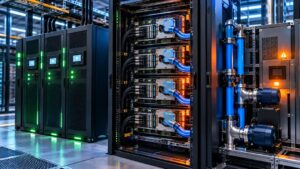
AI Power Delivery has become a limiting factor for AI infrastructure planning because the constraint is no longer only rack density, accelerator supply, or cooling design. The hard question is whether enough dependable electricity can be brought to the site on a schedule that matches the compute build-out. In June 2026, federal regulators ordered grid operators to speed service to energy-hungry AI data centers, while the Associated Press reported that data centers accounted for about 5% of U.S. electricity demand and could triple by 2035 AP reported.
That order did not remove the engineering work. It made the dependency more visible. For infrastructure teams, the practical response is to treat power delivery as a staged system: grid interconnection, local distribution, behind-the-meter generation, energy buffering, load scheduling, monitoring, cybersecurity, and community acceptance. For insights into broader technological changes, you might explore a related site in our network at TechnCoins, which covers shifts in technology and infrastructure.
Why AI Power Delivery Is A Build-Out Constraint
Demand Growth Has Changed The Planning Baseline
The pressure on utilities and data center developers is driven by load concentration. AI clusters do not behave like ordinary office or mixed-use commercial demand. They can add large, relatively steady loads at specific substations, and those loads may arrive faster than conventional utility upgrade cycles. That creates friction across transmission planning, distribution capacity, substation equipment, transformer availability, protection studies, and permitting.
The result is not simply a question of whether a region has enough annual electricity generation. A data center needs capacity at the right node, with adequate voltage support, fault-current analysis, protection coordination, and reliable operating procedures. If any part of that chain lags, the site may be physically built before it can be fully energized.
AI Power Delivery Starts With Interconnection
Interconnection reform is therefore a first-order recommendation, not an administrative detail. Operators should ask utilities for transparent study milestones, queue status, substation constraints, and realistic service dates before committing to aggressive construction schedules. Utilities, in turn, need structured data from the customer: phased load profiles, power quality requirements, backup generation plans, expected ramp rates, and any flexibility the facility can provide during grid stress.
A related analysis of data center energy constraints noted that energy planning now affects water, security, and siting decisions as well as electrical design. That connection matters because power approvals often interact with zoning, environmental review, fuel logistics, and community concerns.
Interconnection Practices That Reduce Schedule Risk
Use Phased Energization Instead Of One Large Cutover
A practical build-out should avoid treating energization as a single event. Phased energization lets a site bring initial halls, cooling plants, networking areas, or support systems online while utility upgrades continue. This approach can reduce idle capital risk, but only if the design supports safe partial operation. Protection settings, switchgear sequencing, emergency power systems, and commissioning plans need to reflect partial-load modes rather than assume the final campus configuration is already present.
The U.S. Department of Energy-hosted report on the role of the distribution system in serving data centers and other large loads highlighted phased energization, hosting capacity maps, and structured interconnection frameworks as strategies for aligning utility planning with rapid deployment pressure DOE-hosted report. These tools help both sides identify where capacity exists, where upgrades are needed, and which loads can be served without compromising reliability.
Map Hosting Capacity Before Site Commitment
Hosting capacity maps are useful because they shift part of site selection from negotiation to evidence. A developer can compare areas where distribution or transmission assets have headroom against areas requiring major reinforcement. The maps do not replace engineering studies, and they may not capture every local constraint. They do, however, reduce the chance that a project discovers late in design that the selected site is poorly matched to the grid.
For AI campuses, that evidence should be paired with staged load forecasts. A vague request for future megawatts gives utilities little basis for planning. A year-by-year and phase-by-phase load plan is more useful, especially when it separates critical IT load, cooling load, commissioning load, and noncritical auxiliary demand.
Engineering Controls For AI Power Delivery
On-Site Generation Should Be Treated As Critical Infrastructure
On-site generation can reduce dependence on slow grid expansion, but it is not a shortcut around engineering accountability. Natural gas generation, solar-plus-storage, batteries, and hybrid arrangements all create operating obligations. Fuel supply, emissions compliance, black-start procedures, maintenance windows, spare parts, and control system security become part of the data center’s availability model.
For AI Power Delivery, behind-the-meter generation should be evaluated against the actual duty cycle of the compute load. A system sized for emergency backup is different from a system intended to support sustained operation. Batteries can smooth short-duration transitions and support ride-through events, but they do not remove the need for well-designed primary generation or utility coordination.
Grid-To-Chip Design Reduces Avoidable Losses
Power architecture also needs attention inside the facility. Higher rack power densities increase the value of reducing conversion stages, shortening high-current paths, and aligning facility distribution with server power requirements. High-voltage DC distribution is being evaluated in the industry for these reasons, although adoption depends on equipment availability, standards maturity, safety practices, protection devices, and staff training.
Operators should be cautious about treating any one electrical architecture as a universal answer. The best design depends on load density, redundancy tier, cooling architecture, geographic risk, utility service arrangement, and the maturity of vendor support. A design that works for a hyperscale AI hall may not fit an enterprise colocation deployment with mixed workloads and frequent customer turnover.
Operating Governance And Security Implications

Energy Flexibility Needs Operational Rules
Demand response and workload scheduling can help align compute activity with power availability, but they require clear operating rules. Some AI training jobs may tolerate delayed scheduling; inference services with user-facing latency commitments may not. Facilities should classify workloads by power flexibility, service criticality, and recovery tolerance before offering flexible demand to grid operators or utilities.
This creates a governance issue. The team that controls accelerator scheduling may not be the same team responsible for electrical reliability. A useful operating model links data center facilities, platform engineering, security operations, and business owners through defined escalation paths. If a demand response event occurs, the organization needs to know which workloads can pause, which must continue, and who has authority to change operating states.
Power Systems Expand The Cybersecurity Boundary
Power delivery also widens the security boundary. Substation interfaces, building management systems, generator controls, battery management systems, meters, and monitoring platforms can all become part of the operational technology environment. Defensive controls should include asset inventory, network segmentation, access logging, patch governance, backup configuration files, and incident response procedures that include facilities equipment.
The risk is not only outage. Incorrect telemetry, unstable control logic, or poorly managed remote access can impair decision-making during grid stress or equipment faults. Security teams should work with facilities staff to define what data is trusted, how alarms are validated, and how manual operation is handled if automation fails.
AI Power Delivery Operating Discipline
Recommendations For Infrastructure Teams
Practical recommendations should be specific enough to affect procurement and operations. The following actions are suitable starting points for operators, utilities, and engineering teams planning large AI facilities:
- Require phased load forecasts before site acquisition, including commissioning, cooling, IT, and auxiliary demand.
- Use hosting capacity data and formal interconnection studies to compare candidate sites before committing to major construction.
- Design phased energization into switchgear, commissioning, protection settings, and operating procedures.
- Assess on-site generation as a maintained production asset, not only as backup equipment.
- Evaluate high-voltage distribution changes against standards maturity, safety training, spares, and vendor support.
- Classify workloads by power flexibility so demand response does not conflict with service obligations.
- Include electrical control systems in cybersecurity asset inventories and incident response exercises.
- Engage local communities early on land use, noise, water, fuel logistics, and emergency planning.
What The Evidence Does Not Yet Prove
The available public evidence supports a cautious approach. It shows that grid interconnection, distribution planning, and staged energization matter for AI build-outs. It does not prove that every large AI campus should move off-grid, or that a single voltage architecture will dominate all sites. Costs, reliability, emissions, permitting, and staffing differ by region and by utility territory.
AI Power Delivery is best managed as an engineering and operating discipline rather than a one-time utility request. The organizations most likely to reduce schedule risk are those that provide utilities with credible load data, design for partial energization, secure their operational technology, and avoid assuming that power availability will automatically follow data center construction.