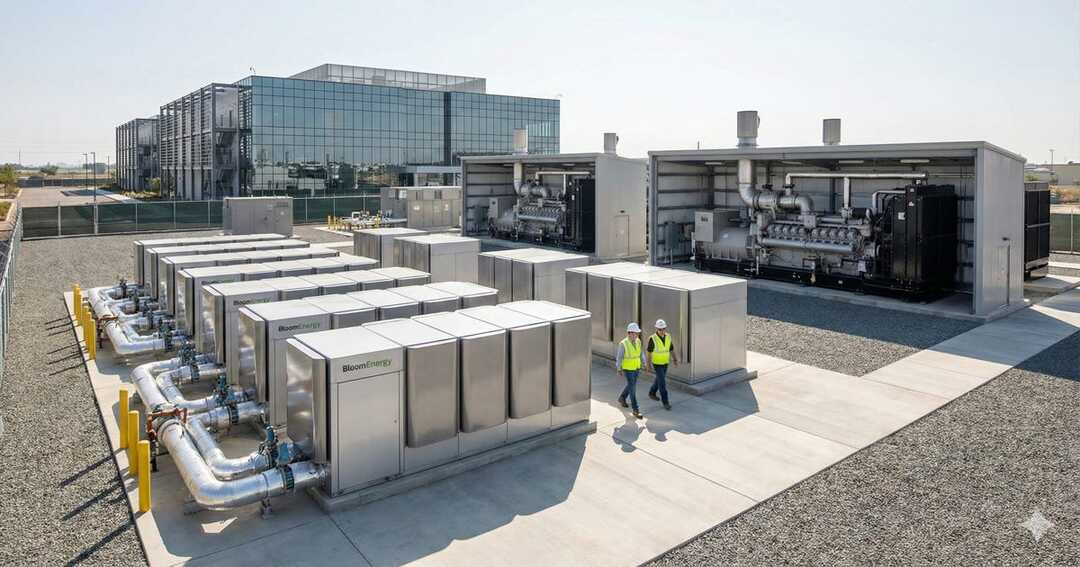
Onsite data center power is becoming the AI industry’s shortcut around one of its most stubborn bottlenecks: waiting for the grid. As data centers chase faster energization, companies are increasingly treating private generation, microturbines, batteries, and behind-the-meter systems as part of the compute stack rather than emergency backup.
That shift matters because AI infrastructure is no longer limited by chips alone. The same pressure visible in the broader AI data center power fight is now pushing developers to ask a sharper question: why wait years for utility capacity if the power can be built closer to the load?
Onsite Data Center Power Is Moving From Backup to Strategy
For decades, onsite generation at data centers was mostly framed as resilience. Diesel generators, UPS systems, and backup designs existed to keep servers running when the grid failed.
AI is changing that logic. Onsite power is no longer only about surviving outages. It is becoming a development strategy for companies that need capacity faster than utilities can deliver new interconnections, substations, transmission upgrades, or generation resources.
Capstone Energy+ CEO Vince Canino recently said grid bottlenecks are pushing businesses toward larger onsite power systems, with demand coming from sectors including healthcare and data centers. Capstone has deployed its technology at smaller enterprise data centers and is pursuing larger data center opportunities as customers seek larger onsite power systems.
The important signal is not one vendor’s order book. It is the market behavior behind it. Companies that used to think in kilowatts or small backup systems are now asking for multi-megawatt blocks of power.
That turns electricity into a speed-to-market tool.
Why the Grid Timeline No Longer Fits AI
The traditional data center model depends on utility coordination. A developer finds a site, studies power availability, enters interconnection processes, waits for upgrades, and eventually receives enough grid capacity to operate.
That model still works in some markets. But AI data centers are larger, denser, and more urgent. A hyperscale or neocloud customer does not want vague power availability five years from now. It wants a credible energization timeline tied to compute deployment, chip delivery, and customer contracts.
The Department of Energy has warned that data center expansion, AI, domestic manufacturing, and electrification are driving a return to rising U.S. electricity demand. It cites EPRI estimates that data centers could consume up to 9% of U.S. electricity generation annually by 2030, up from 4% of total load in 2023, in its discussion of data center electricity demand.
That demand growth is colliding with slow physical systems. Transmission takes time. Transformers take time. Permitting takes time. New generation takes time. Utility planning was not built around every AI company suddenly needing hundreds of megawatts.
So developers are looking for alternatives.
Behind-the-Meter Power Changes the Business Model
Behind-the-meter systems can include natural gas generation, fuel cells, microturbines, batteries, solar-plus-storage, or hybrid systems that sit on the customer side of the meter. In some cases, they operate alongside the grid. In others, they are designed to provide more independent power supply.
For AI data centers, the appeal is obvious. If a site can secure power locally, it may become viable sooner. The generation is paired with storage and controls, the facility may gain more operational flexibility. If the system can island during grid stress, it may improve reliability.
But the model also shifts risk.
| Power Model | Main Advantage | Main Risk |
|---|---|---|
| Utility grid connection | Uses established power system planning | Slow interconnection and upgrade timelines |
| Backup-only generation | Protects uptime during outages | Does not solve everyday capacity limits |
| Behind-the-meter gas | Provides firm local power | Emissions, permitting, and fuel-price exposure |
| Hybrid onsite system | Blends grid, generation, and storage | More complex control and regulatory design |
| Fully private power campus | Maximizes energy certainty | Higher capital cost and local scrutiny |
The comparison shows why onsite data center power is attractive but not simple. It can solve timing problems, but it introduces new questions about emissions, financing, operations, and public trust.
The Emissions Debate Will Follow the Megawatts
The fastest onsite power options are not always the cleanest. Natural gas generation can provide reliable electricity around the clock, which makes it attractive for AI workloads that cannot tolerate interruptions. But gas-powered systems also raise concerns about carbon emissions, local air pollution, methane leakage, noise, and long-term fossil dependence.
That will matter politically. Developers may argue that onsite generation prevents data centers from overwhelming the grid. Communities may respond that the project is effectively bringing an industrial power plant next door.
Both arguments can be true.
The strongest onsite power strategy will likely be hybrid rather than ideological: cleaner resources where available, gas or fuel cells where reliability demands it, batteries where they reduce peaks, and grid interaction where it supports the broader system.
The weakest strategy will be treating onsite generation as a way to bypass public scrutiny.
AI companies should assume that private power is visible power.
Reliability Is Not Just About Owning Generation
Owning or contracting onsite generation does not automatically make a data center reliable. Equipment must be maintained. Fuel must be available. Controls must manage changing loads. Cooling systems must stay synchronized with compute demand. Batteries must be sized correctly. Grid interconnection rules may still matter if the facility imports or exports electricity.
AI workloads add another complication. Training and inference can create large, fast-changing load patterns. A power system designed for steady industrial output may need more advanced controls to handle AI cluster behavior safely.
That is why onsite power should not be viewed as a shortcut around engineering. It is a different engineering problem.
A well-designed system can improve reliability. A rushed system can create new failure points.
The same is true financially. Onsite generation may help a project move faster, but the capital cost has to be carried somewhere: by the data center owner, the tenant, a power developer, or investors. If utilization falls short, those costs become harder to absorb.
The Next Signal Is Who Pays for Energy Certainty
The next pressure point is not whether more AI data centers will explore onsite power. They will. The better question is who pays for it, who regulates it, and who carries the risk if the model underperforms.
Watch for more long-term power-service agreements attached to data center campuses. Thats for energy firms becoming data center partners. Watch for local permitting fights around gas turbines, microturbines, and backup systems that run more often than residents expected.
Also watch utility responses. Some utilities may welcome onsite systems that reduce peak strain. Others may worry about stranded grid investments, lost load, or operational complexity. Regulators may eventually ask whether large data centers using private power still need to contribute to shared grid costs.
That is where the debate becomes bigger than one project.
Onsite data center power may become one of the defining shortcuts of the AI infrastructure race because it offers what developers crave most: energy certainty. But certainty for the developer does not automatically mean certainty for the community, the grid, or the climate.
The AI buildout is teaching data center operators that electricity is not just an input. It is a strategic asset. The companies that handle onsite data center power well will treat it as infrastructure that must be engineered, disclosed, permitted, and defended. The companies that treat it as a way around the grid may discover that the fastest connection can still lead straight into a public fight.