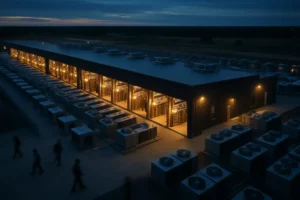
AI data center power risk is no longer a spreadsheet problem tucked inside a utility planning meeting. xAI’s Memphis-area buildout has turned the power behind artificial intelligence into a public fight over generators, permits, emissions, neighborhood trust, and whether the AI race is moving faster than the infrastructure meant to hold it.
The uncomfortable lesson is that the AI industry can assemble GPUs faster than cities can absorb the physical consequences. That is exactly why the land, power, and permitting questions around massive AI campuses now matter as much as model performance, and why the debate over AI data centers getting too big for land has quickly become a debate over who carries the cost when compute demand collides with the real world.
Memphis Shows Where the AI Race Leaves the Cloud Behind
The public image of artificial intelligence is still clean and weightless: chat windows, copilots, code assistants, image generators, and productivity tools that appear instantly on a screen. Memphis cuts through that illusion.
Behind the interface is a machine room that needs land, transmission access, cooling, substations, backup systems, gas turbines, maintenance crews, environmental review, and local political tolerance. When that machine room grows quickly enough, it stops looking like “the cloud” and starts looking like industrial infrastructure.
That shift is the real story. xAI is not merely trying to run a large data center. It is exposing how AI companies are beginning to behave like power-intensive industrial operators, even when their branding still sounds like software.
The GPU may be the glamorous part of AI. But the generator is where the argument becomes local. Power is the bottleneck that turns a technology race into a land-use dispute, a permitting challenge, and a security question.

Why AI Data Center Power Risk Is Bigger Than xAI
The Memphis case matters because it reveals a pattern that will not stay in Memphis. AI data centers need dense, reliable electricity at a scale that can overwhelm normal planning cycles. Utilities think in years. AI companies often move in quarters.
That timing mismatch creates pressure to solve power locally, quickly, and sometimes awkwardly. Temporary generation, dedicated substations, behind-the-meter power, and private energy deals are becoming part of the AI infrastructure playbook.
The U.S. Department of Energy’s work on data center electricity demand makes the broader point clear: AI is becoming a major force in near-term electricity planning. Once that demand becomes concentrated in specific places, local infrastructure turns into a strategic constraint.
For HW Server readers, this is where the story becomes more than an environmental fight. It is about system design. Any AI campus that depends on extraordinary power workarounds is also creating new failure points: regulatory delays, fuel logistics, public opposition, grid interconnection risk, and reputational exposure.
A model can be retrained. A facility stuck in a permitting war is harder to patch.
Generators Are Not Just Backup Anymore
Data centers have always used backup power. That part is not new. What is changing is the role backup-style infrastructure plays in the AI buildout.
Traditional backup systems are designed to protect uptime during outages. The emerging AI data center problem is different. When grid capacity is delayed or insufficient, on-site generation can become a bridge, a workaround, or, in the eyes of critics, a shadow power plant.
That distinction matters because regulators do not view every engine or turbine the same way. The EPA’s Clean Air Act resources for data centers show how power sources used around data centers can trigger air rules, especially when stationary engines, combustion turbines, or portable units become part of the operating plan.
Here is the operational split that AI builders can no longer blur:
| Infrastructure Choice | What It Solves | What It Can Create |
|---|---|---|
| Utility grid connection | Stable long-term power planning | Long waits, transmission constraints, queue delays |
| On-site gas generation | Faster power availability | Permitting fights, emissions scrutiny, fuel dependence |
| Renewable-plus-storage mix | Cleaner public positioning | Intermittency, land needs, higher design complexity |
| Dedicated substation buildout | Better capacity control | Capital cost, construction delays, local approvals |
| Demand-flexible AI workloads | Less pressure during grid stress | Harder scheduling, operational compromises |
The table shows why this is not a simple “more power” problem. Every solution shifts risk somewhere else. Backup becomes strategy when AI companies cannot wait for the grid to catch up.
The Security Problem Is Physical Before It Is Digital
Most AI security discussions focus on model misuse, data leakage, jailbreaks, supply chains, or cyber intrusion. Those issues matter. But the Memphis fight is a reminder that AI infrastructure security starts with the physical layer.
A data center dependent on contested power assets is vulnerable in ways that do not fit neatly inside a cybersecurity dashboard. Local opposition can delay expansion. Permit disputes can limit operations. Air-quality challenges can invite litigation. Fuel supply can become a continuity issue. A politically sensitive site can become a reputational liability for customers, investors, and partners.
That is not a soft concern. It is infrastructure risk.
For enterprise buyers, the lesson is practical. When a company sells AI capacity, customers should care where that capacity lives and how it is powered. A high-performance cluster is less impressive if its operating model depends on fragile local arrangements.
This is where the AI market may be underestimating the boring questions. Who owns the energy assets? What permits are required? What happens if a regulator intervenes? What is the fallback if temporary generation is restricted? Can the site scale without turning every expansion into a public fight?
Those questions used to sound like utility paperwork. Now they are part of AI due diligence. Infrastructure trust matters because AI workloads are becoming too valuable to sit on unstable foundations.
Community Pushback Is Now a Compute Constraint
The tech industry often treats community resistance as a communications issue. In AI infrastructure, it is more serious than that. Public trust can become a limiting input, just like power, land, water, or fiber.
Memphis and nearby communities are not reacting to an abstract data-center trend. They are reacting to visible equipment, industrial noise, emissions concerns, local health anxieties, and the feeling that a fast-moving company may be making decisions before residents have a meaningful voice.
That creates a legitimacy problem for the AI sector. Companies want public enthusiasm for AI adoption, but the physical footprint of AI is landing unevenly. The benefits are distributed through digital products and investor narratives. The burdens are concentrated near industrial sites, substations, cooling systems, traffic routes, and power equipment.
This is the part of the AI boom that cannot be solved with a better demo. If communities believe they are being treated as hosting zones for private compute empires, backlash will harden. Local consent scales slowly, and that is a serious problem for an industry built around speed.
The Signals That Will Decide Whether This Becomes a Template or a Warning
The next stage is not just whether xAI keeps expanding. The more important question is whether other AI developers copy the same speed-first infrastructure model or adapt before local resistance catches up.
The first signal is permitting discipline. If AI companies can show that large facilities will follow clear air, power, and land-use processes, the industry has a chance to normalize growth. If projects appear to rely on aggressive temporary workarounds, more communities will organize earlier.
The second signal is power transparency. Data center operators do not need to reveal every commercial detail, but they will face growing pressure to explain how much electricity they need, where it comes from, and what backup or on-site systems are being used.
The third signal is utility coordination. AI campuses that arrive before grid capacity is ready will keep creating friction. Projects planned around credible transmission, substation, and generation timelines will be easier to defend.
The fourth signal is customer pressure. Enterprise AI buyers may eventually ask infrastructure questions that cloud providers and AI labs would prefer to keep behind procurement walls. If reliability, compliance, and environmental exposure become part of vendor selection, power strategy will move from the facilities team to the boardroom.
That is where AI data center power risk becomes unavoidable. The industry can keep talking about chips, tokens, and model benchmarks, but the decisive constraint may be whether the physical plant can operate without turning every expansion into a legal, political, and community stress test.
Memphis is not just a local controversy. It is a preview of the AI buildout’s hardest truth: compute does not float above the grid. It lands somewhere, draws power from something, affects someone, and eventually has to justify the infrastructure choices that made the model possible.