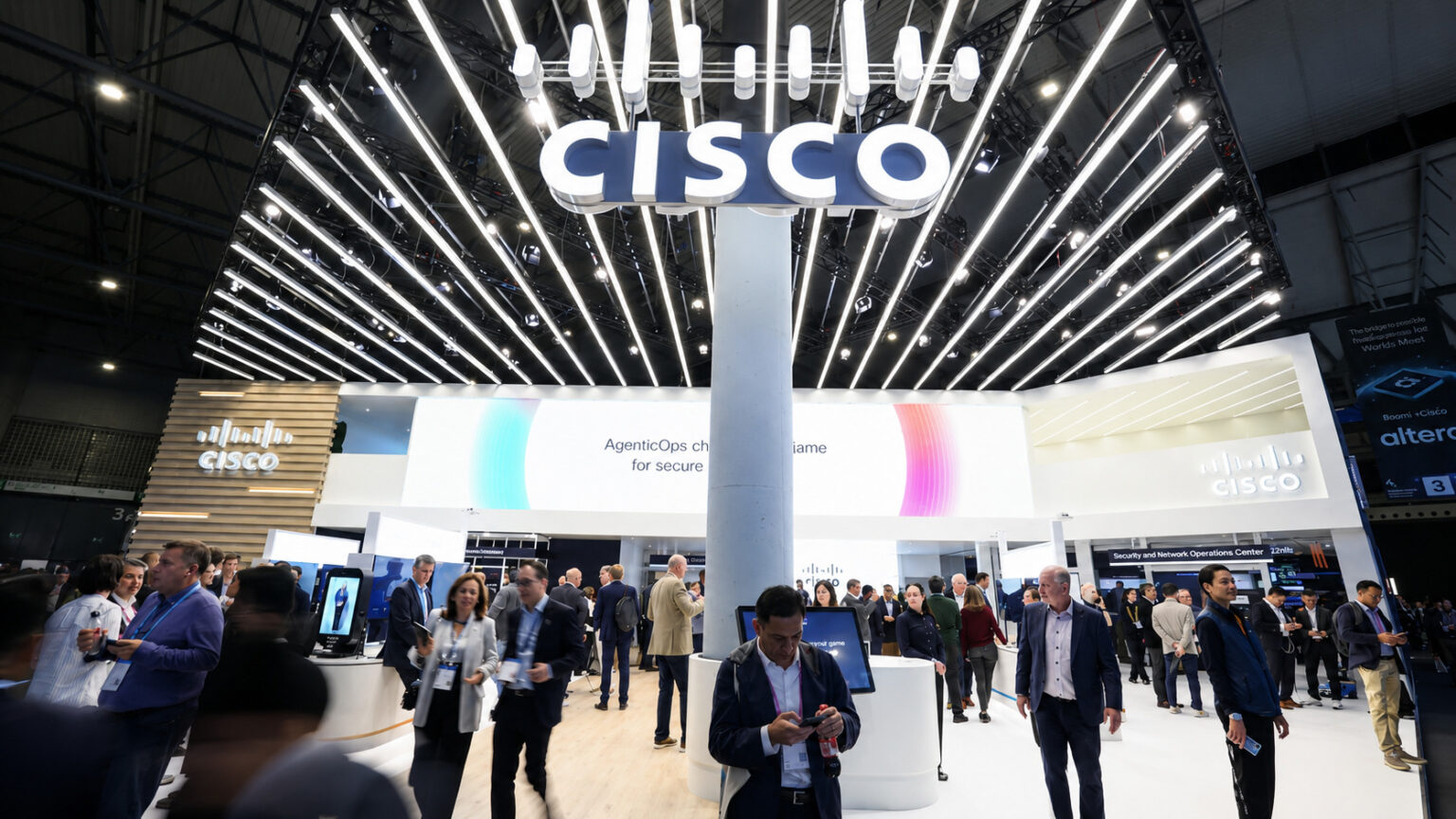
Cisco’s $9.3 billion in fiscal 2026 hyperscaler AI infrastructure orders is a useful correction to the way the AI hardware boom is often framed. GPUs still dominate the conversation, but AI networking infrastructure is becoming just as critical to whether those accelerators can operate efficiently at scale.
Cisco took $4 billion in hyperscaler AI infrastructure orders during its fiscal fourth quarter alone, bringing the full-year total to $9.3 billion, while networking product orders rose 40% year over year. For server buyers tracking the broader AI server market, the implication is clear: compute performance increasingly depends on the fabric connecting the compute.
Cisco’s $9.3 Billion Order Total Is More Than a Sales Headline
Cisco closed fiscal 2026 with $63.3 billion in revenue, up 12% year over year. Q4 revenue reached $17.3 billion, and networking revenue grew 28%. Its fiscal 2026 earnings results also show $9.3 billion in hyperscaler AI infrastructure orders, including $4 billion in Q4.
That does not mean Cisco generated $9.3 billion of AI revenue during the year. Orders and recognized revenue are different measures. Cisco said it delivered approximately $4 billion of hyperscaler AI infrastructure revenue in fiscal 2026 and expects $7.5 billion in fiscal 2027.
The distinction matters because orders point toward future deployment. The order pipeline is the signal: major AI builders are committing substantial capital to networking alongside accelerator purchases.
AI Networking Infrastructure Is Becoming Part of the Compute Budget
An AI cluster is not simply a collection of GPUs. Training and inference systems move data among accelerators, storage, hosts, and sometimes multiple data centers. If the network introduces congestion or lacks bandwidth, expensive processors can spend more time waiting for data or synchronization.
That changes the economic role of networking. In a large AI cluster, network performance can directly influence how effectively the accelerator fleet is used. Connectivity becomes a utilization problem, not merely a cabling problem.
Cisco is designing around that assumption. Its current AI data center networking portfolio includes Silicon One-based systems, Nexus switches, Cisco 8000 systems, and optics spanning 400G through 1.6T connectivity. Its Silicon One G300 is positioned at up to 102.4 Tbps for high-scale AI networking.
AI Clusters Are Turning Network Design Into a Performance Decision
That shift changes how infrastructure teams should think about procurement. A switch is no longer just a supporting component bought after the servers are selected. In large AI deployments, network architecture can influence how many accelerators can operate efficiently as one system.
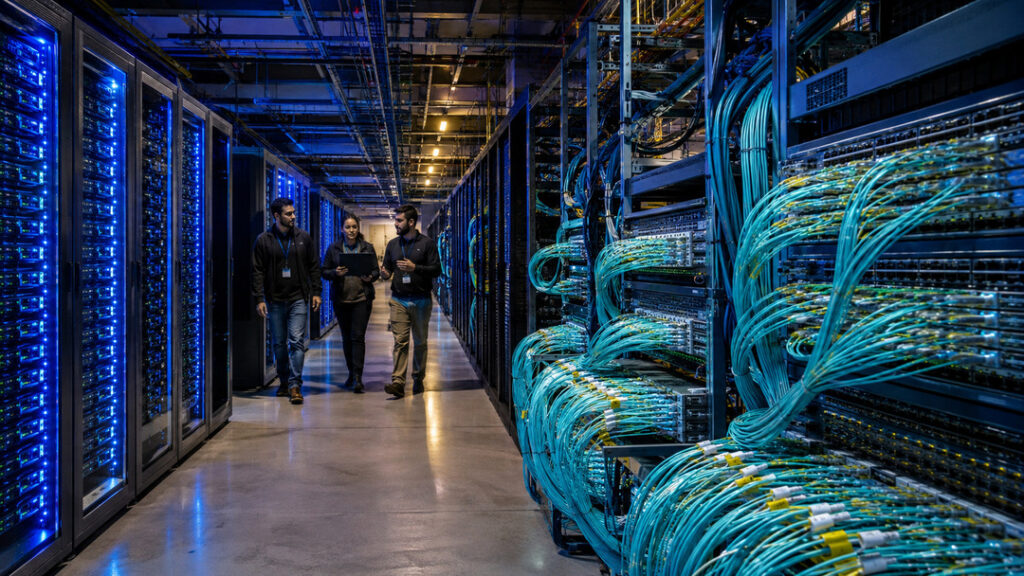
Topology becomes especially important as clusters scale. More GPUs create more east-west traffic, more synchronization, and more pressure on links between racks and nodes. Poorly matched switching capacity can create performance bottlenecks outside the server, even when the accelerators themselves are exceptionally fast.
Optics also become part of the equation. Higher-speed links such as 400G, 800G, and eventually 1.6T increase bandwidth, but they also affect power consumption, cooling, transceiver density, cabling complexity, and overall deployment cost. That makes networking a capacity-planning issue as much as a connectivity issue.
For operators, the practical lesson is straightforward: GPU count, memory capacity, storage speed, and network fabric now have to be designed together. An AI system can be limited by whichever layer is weakest, and increasingly that weak point may sit between the servers rather than inside them.
Here is the hardware shift in practical terms:
| AI infrastructure layer | Traditional focus | AI-era pressure |
|---|---|---|
| Accelerators | Peak compute | Cluster utilization |
| Switching | Ports and throughput | Massive east-west bandwidth |
| Routing | WAN connectivity | Linking distributed AI capacity |
| Optics | Reach and link speed | Dense 400G, 800G and faster links |
| Network software | Configuration | Congestion and fabric operations |
The larger point is that networking is no longer downstream from the AI architecture. It increasingly determines whether the rest of the hardware can perform as designed.
Silicon and Optics Are Moving Into the GPU Conversation
The networking stack is becoming more specialized. Cisco’s Silicon One architecture spans switching and routing roles across hyperscalers, data centers, service providers, and enterprises rather than treating AI connectivity as a conventional Ethernet upgrade.
AI fabrics put unusual pressure on latency, bandwidth density, buffering, power, and traffic behavior. Cisco’s current portfolio includes 102.4 Tbps switching silicon and systems designed for 400G through 1.6T connectivity, showing how quickly network hardware is being engineered around accelerator-scale traffic.
Optics deserve equal attention. As clusters expand within facilities and across locations, moving data at high speed over distance becomes a hardware problem of its own. AI scale creates an optical bill as surely as it creates a GPU bill.
For infrastructure planners, comparing AI systems only by processor count or HBM capacity is incomplete. Network topology, switch silicon, transceiver density, power consumption, and interconnect strategy can all affect the usable value of compute.
The 40% Networking Order Jump Reaches Beyond AI
Cisco said networking product orders increased 40% year over year in fiscal Q4, marking an eighth consecutive quarter of double-digit networking order growth. That figure includes more than AI-specific hardware, so it should not be treated as a pure AI-demand metric.
Still, the timing matters. Hyperscaler AI orders are rising while the broader networking portfolio is accelerating. Networking revenue grew 28% year over year in Q4, while services revenue was flat.
That suggests AI is arriving during a wider infrastructure refresh rather than in isolation. Enterprises and service providers still need switching, routing, campus, security, and connectivity upgrades while AI adds another bandwidth-intensive workload.
The result is a denser hardware stack. AI investment can pull demand through accelerators, servers, switches, routers, optics, storage, cooling, and power systems at the same time.
Fiscal 2027 Will Test How Much Demand Converts to Revenue
Cisco expects $7.5 billion in hyperscaler AI infrastructure revenue in fiscal 2027, up from approximately $4 billion in fiscal 2026. That forecast will test how rapidly booked orders translate into deployed hardware.
Margins are another pressure point. Cisco’s Q4 non-GAAP product gross margin was 64.8%, down from 67.5% a year earlier. Strong hardware demand does not automatically produce equally strong margin expansion when product mix and component costs are moving.
For data center operators, the operational test is different: whether network capacity is planned at the same time as accelerator capacity. Buying more GPUs without enough fabric bandwidth can simply move the bottleneck.
Networking Has Joined the Core AI Hardware Stack
Cisco’s $9.3 billion order total does not mean networking has replaced accelerators as the center of AI investment. It shows that the boundaries between compute and connectivity are becoming less useful. The network increasingly determines how well accelerators communicate and how clusters expand.
That makes AI networking infrastructure a first-order hardware decision. Server teams need to model switching, routing, optics, topology, power, and operations alongside GPUs and memory—not after them.
The AI hardware race is becoming a systems race. The strongest architectures will not merely assemble the most accelerators; they will keep those accelerators connected, supplied with data, and productively occupied.
Frequently asked questions
What does Cisco’s $9.3 billion AI order figure represent?
It represents fiscal 2026 AI infrastructure orders from hyperscaler customers, not recognized revenue. Cisco said approximately $4 billion of hyperscaler AI infrastructure revenue was delivered during the same fiscal year.
Why is networking so important for AI servers?
Large AI clusters depend on high-bandwidth, low-latency communication among accelerators, storage, and hosts. Weak network performance can create congestion and reduce how effectively expensive GPUs are used.
What networking hardware is becoming more important for AI?
High-capacity switches, routing silicon, 400G and 800G optics, faster interconnects, and congestion-management software are becoming more important as AI clusters scale and require increasingly dense east-west traffic.
How can poor networking reduce GPU performance?
If data or synchronization traffic cannot move quickly enough between accelerators, GPUs may spend more time waiting instead of processing workloads. That lowers utilization and can reduce the return on expensive AI hardware.
What should data center operators monitor next?
Operators should watch hyperscaler order conversion, 800G and 1.6T adoption, network power consumption, optical spending, congestion-management improvements, and whether networking capacity is being upgraded at the same pace as accelerator deployments.