Riot Platforms is no longer asking the market to imagine what a Bitcoin mining campus might be worth in the AI era. Its Rockdale, Texas, site now has a 20-year lease for 191 MW of critical IT capacity, making Bitcoin mining data center conversion one of the clearest new paths for expanding AI infrastructure.
Riot disclosed the agreement on August 10, 2026, describing the customer only as a leading frontier AI lab; reporting on August 11 identified that tenant as Anthropic. The bigger story is not simply the $9.1 billion contract value. Power access, land, interconnection capacity, and existing electrical infrastructure are becoming strategic assets as AI infrastructure bottlenecks move beyond GPUs and into the physical systems required to run them.
Riot’s Rockdale Deal Changes the Value of a Mining Campus
Under the 20-year Rockdale lease, Riot expects to deliver the first 96 MW of critical IT capacity in December 2027 and the full 191 MW by June 2028. The initial term is expected to generate approximately $9.1 billion, while two optional five-year extensions could increase the potential contract value to about $16.1 billion.
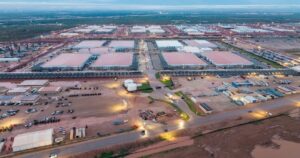
Those figures are significant, but the physical asset behind them deserves just as much attention. Riot says Rockdale already has approximately 700 MW of developed capacity serving Bitcoin mining and data center leasing. Power-ready real estate is becoming compute infrastructure because AI developers cannot deploy large GPU clusters without first solving the far less glamorous problems of electricity, substations, land, construction, and grid connectivity.
Riot had already started proving the model with AMD. Its January 2026 agreement initially covered 25 MW, followed by an additional 25 MW expansion, with further capacity options available. By August, Riot said its two major data center agreements represented 241 MW of contracted critical IT capacity.
Why Bitcoin Mining Data Center Conversion Has an Advantage
Bitcoin mining and AI computing are technically very different businesses. A mining hall designed around ASIC machines cannot simply be filled with GPU servers and instantly become an enterprise AI facility. High-performance computing brings stricter demands for networking, cooling, redundancy, physical security, power quality, and service availability.
Still, miners can begin with an unusually valuable head start.
Large Bitcoin operations were built specifically to consume enormous amounts of electricity. Many already control substantial land, electrical infrastructure, substations, transmission access, and operating teams familiar with high-density equipment. Building those foundations from scratch can become one of the slowest parts of developing an AI campus.
Riot’s project makes the distinction clear. Its 191 MW commitment is a build-to-suit Tier 3 data center project rather than a superficial reuse of existing mining halls. Conversion still requires major engineering, but starting with energized infrastructure can eliminate an expensive early hurdle.
Power Access Is Becoming the Real Competitive Advantage
Securing hundreds of megawatts is increasingly difficult in regions where utilities are already handling requests from hyperscalers, cloud providers, manufacturers, and other large electricity users. That gives operators with existing grid connections a meaningful head start. Riot does not have to begin with an undeveloped parcel and hope adequate power becomes available years later; much of the electrical foundation is already in place.
For AI customers, that head start can translate into faster development schedules. GPU clusters may attract most of the attention, but servers cannot generate revenue until substations, transformers, transmission capacity, cooling systems, fiber connections, and buildings are ready to support them. Available power can become the limiting resource long before companies run out of demand for processors.
Existing mining campuses also offer something less obvious: experience operating continuously at industrial-scale electrical loads. Teams accustomed to managing high-density equipment, power distribution, maintenance, and energy costs already understand parts of the operating environment required for large compute facilities. AI tenants still impose more demanding networking, redundancy, cooling, and service requirements, but the infrastructure gap can be smaller than starting from an empty site.
That advantage does not mean every Bitcoin miner can follow Riot’s path. Location, utility agreements, fiber availability, financing, land, cooling potential, and construction capability will determine which campuses can realistically attract AI customers. As competition for powered sites intensifies, the most valuable mining assets may increasingly be measured in megawatts and infrastructure readiness, not simply in the number of mining machines they can operate.
Mining Infrastructure and AI Infrastructure Are Not Interchangeable
Power availability creates an opportunity, not a finished AI facility. Understanding that distinction is essential before assuming every large cryptocurrency mine can successfully pivot toward high-performance computing.
| Infrastructure factor | Bitcoin mining priority | AI data center priority |
|---|---|---|
| Electrical capacity | Extremely high | Extremely high |
| Network connectivity | Moderate | Very high |
| Cooling complexity | High | Very high at dense GPU loads |
| Uptime and redundancy | Workload dependent | Often mission-critical |
| Facility design | Optimized for mining hardware | Optimized for dense compute |
| Customer obligations | Mainly internal operations | Enterprise service requirements |
AI tenants may need redundant electrical paths, advanced cooling systems, high-capacity fiber connectivity, backup infrastructure, tighter environmental controls, and contractual uptime expectations.
That changes the economics of conversion. A mining company can possess hundreds of megawatts and still lack the engineering capability or capital required to turn those megawatts into reliable AI capacity. Riot’s development and engineering operations therefore matter alongside its existing power footprint.
Long-Term AI Leases Change the Revenue Equation
Bitcoin mining economics fluctuate with cryptocurrency prices, network difficulty, mining rewards, electricity costs, and hardware efficiency. Long-term data center leases introduce a different model built around contracted infrastructure payments rather than relying almost entirely on mining output.
Riot’s second-quarter results show the transition beginning to appear financially. Bitcoin mining generated $113.7 million of quarterly revenue, while its newer data center segment produced $23.2 million. Rather than abandoning mining immediately, Riot is using assets developed for that business to establish another source of revenue.
Capital requirements remain substantial. Riot arranged a $573 million interim credit facility tied to the new data center development, with proceeds intended to fund long-lead equipment procurement and other project costs. The company’s quarterly regulatory filing also confirms the lease structure, delivery schedule, and financing arrangement.
That financing is a reminder that AI conversion is capital intensive. Existing electricity infrastructure can shorten the path, but it does not remove the need for new buildings, electrical systems, cooling equipment, networking, and tenant-specific fit-outs.
Power Will Decide Which Miners Can Make the Jump
Future conversions are likely to depend less on whether a company calls itself a Bitcoin miner and more on the quality of the infrastructure it controls.
A site with large electrical capacity but poor fiber access, limited expansion room, insufficient cooling potential, or difficult permitting may struggle to become competitive AI infrastructure. By contrast, campuses with expandable power, existing interconnections, construction expertise, and room for high-density facilities begin with assets that are increasingly difficult to assemble quickly.
Execution will be the next test. Investors and infrastructure operators should look beyond announcements and track contracted megawatts, construction milestones, financing, power availability, cooling architecture, and delivery dates. Megawatts only matter when they become usable compute capacity.
Riot expects 96 MW from the new deployment in late 2027 and the remaining capacity by June 2028. Meeting those milestones would provide a much stronger demonstration of the conversion model than the contract announcement alone.
Crypto Campuses Are Joining the AI Capacity Map
Riot’s Rockdale agreement shows how the AI infrastructure race is expanding beyond hyperscalers and traditional colocation companies. Bitcoin miners spent years accumulating exactly the type of energy-intensive infrastructure that AI developers now need in enormous quantities.
Not every mining operation will make that transition successfully. Strong Bitcoin mining data center conversion candidates will be sites where electricity, land, interconnection capacity, engineering, cooling, fiber, financing, and customer demand align closely enough to support high-density workloads for years.
Rockdale makes the strategic shift unusually visible. AI demand is giving existing mining campuses a second potential purpose, and their future value may increasingly depend not only on how efficiently they can mine Bitcoin, but on how quickly they can transform available power into dependable AI compute infrastructure.
FAQs
Why are Bitcoin miners moving into AI data centers?
Bitcoin miners often already control large power connections, land, electrical equipment, and energy-intensive facilities. Those assets can provide a head start when developing AI infrastructure, although substantial upgrades are usually required.
Can a Bitcoin mining facility simply be converted into a GPU data center?
Not directly. AI facilities may require different cooling, networking, redundancy, security, building design, and uptime standards. Existing power infrastructure is valuable, but significant engineering and capital investment may still be necessary.
How large is Riot’s new AI data center agreement?
Riot disclosed a 191 MW, 20-year Rockdale lease expected to generate roughly $9.1 billion during its initial term. Two five-year extension options could raise the potential contract value to approximately $16.1 billion.