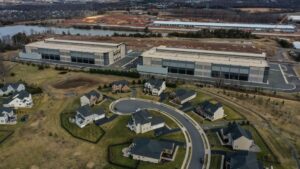
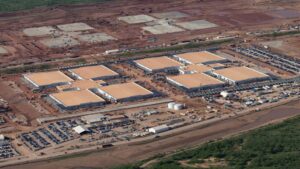
AI Data Center Water Use has become one of the clearest ways to understand the real-world cost of artificial intelligence because the debate is no longer abstract. In Fayetteville, Georgia, a massive QTS data center campus became a public flashpoint after 29 million gallons of water were tied to unbilled or improperly tracked connections, leaving residents to ask a blunt question: who is really paying for the infrastructure behind the AI boom?
Why AI Data Center Water Use Became The Flashpoint
The Georgia dispute matters because it turns a technical infrastructure issue into something ordinary residents can feel. People may not follow chip supply chains, cloud contracts, or model-training costs, but they understand low water pressure, conservation notices, and the suspicion that a large industrial customer received more patience than a household would have received. That is why the story carries so much force and urgency.
The viral version is simple: a data center used nearly 30 million gallons of water through “secret pipes.” The more careful version is more complicated. Public details point to water connections, account tracking, meter readings, and billing problems during a period when the QTS campus was under heavy construction. The phrase “secret pipes” may capture public anger, but the core issue is visibility and oversight.
That distinction matters. If the public conversation turns into a cartoon, it becomes easy for companies and officials to dismiss legitimate concerns as exaggeration. Yet if the conversation stays too technical, it can hide the deeper problem. Large data center projects are arriving faster than many communities can evaluate their true impact and burden.
The Fayette County situation exposes a broader tension in the AI economy. Artificial intelligence is often marketed as software: clean, digital, invisible, weightless. The infrastructure behind it is anything but invisible. It needs land, electricity, fiber, backup generation, cooling systems, water planning, construction labor, zoning approvals, tax negotiations, and long-term utility coordination. That creates pressure and complexity where local governments are not always prepared.
What Actually Happened In Fayetteville
The QTS campus in Fayetteville is not a small server room tucked behind an office park. It is a data center development south of Atlanta, tied to digital infrastructure growth. During construction, millions of gallons of water were later connected to billing and tracking questions, with a retroactive bill around the $147,000 to $150,000 range.
For residents, the numbers landed badly. The controversy surfaced against a backdrop of water conservation concerns and neighborhood complaints about low pressure. A major industrial customer appeared to receive cooperation and correction rather than punishment. That perceived double standard damaged trust and confidence.
Local officials later offered a more nuanced explanation, saying the issue involved meter-reading and account problems during a broader transition to smart-meter infrastructure. That clarification is important because it pushes the discussion away from pure scandal and toward operational failure. Still, operational failure is not a minor footnote when the customer is a large data center campus drawing industrial-scale resources. The key word is accountability and the test is scale.
QTS has also framed the water use as connected to temporary construction activity, not necessarily the completed facility’s everyday cooling demand. Construction can require water for concrete work, dust control, truck washing, site preparation, worker facilities, and system testing. A completed data center may operate differently from the buildout phase. Still, communities are right to ask for a clear separation between temporary usage, ongoing demand, emergency capacity, and future expansion. That is basic clarity and context.
The “Secret Pipes” Phrase Explains The Public Mood
The phrase “secret pipes” works because it captures suspicion. It suggests hidden extraction, special treatment, and a powerful company drawing resources while residents follow restrictions. Even if the technical record is messier, the phrase reveals a real civic anxiety: people do not believe they can see what industrial-scale digital infrastructure is doing around them. That is a credibility and anxiety problem.
That anxiety is not irrational. Most people interact with AI through a prompt box, a search result, an image generator, or a work tool. They do not see the buildings that support the experience. They do not see the cooling loops, substations, utility agreements, water meters, emergency generators, construction schedules, or economic development documents. The product looks frictionless. The infrastructure carries the cost and footprint.
This is where the Georgia story becomes bigger than one campus. Communities are being asked to accept enormous facilities whose benefits may be diffuse and whose burdens may feel local. A data center can support cloud growth, enterprise computing, AI training, digital services, and regional investment. But the nearby resident may experience it as truck traffic, noise, utility stress, land-use change, and uncertainty over long-term water demand. That is a real tradeoff and challenge.

Why Water Is Now Part Of The AI Infrastructure Debate
Power demand usually dominates the AI infrastructure conversation, and for good reason. AI workloads can require vast computing capacity, and that capacity needs electricity. But water is becoming the more emotionally charged issue because it feels local, finite, and personal. When residents are told to conserve, every unexplained industrial draw becomes a matter of fairness and water.
Water also complicates the clean-tech narrative around data centers. A facility can buy renewable energy credits, pursue efficient hardware, and promote closed-loop cooling, but communities still want to understand actual water use across construction and operations. Efficiency claims are not enough. Residents want measurable evidence and disclosure.
That is why data center water controversy stories have such strong staying power. They translate an invisible digital economy into a household-level concern. A person may not know how much water a cooling system uses, but they know what it means when the neighborhood pressure drops or a conservation request appears while a large project continues.
The issue also cuts across political lines. Some residents worry about environmental strain, government favoritism, property rights, utility costs, tax incentives, or infrastructure planning. The shared concern is control and power: who approves these projects, who monitors them, and who gets timely information when something goes wrong?
What The Georgia Case Reveals
The central lesson is not that all data centers are reckless. The lesson is that communities need better systems before projects reach this scale. A large industrial customer should not depend on confused letters, retroactive bills, or public-records discoveries to explain resource use. That is not a sustainable model for governance and systems.
| Issue | Why It Matters | Better Question To Ask |
|---|---|---|
| Metering | Large users can distort normal utility assumptions | Are all industrial connections independently verified? |
| Billing | Retroactive charges may not satisfy public concern | Are penalties and correction processes consistent? |
| Construction Water | Temporary use can still be substantial | What is peak buildout demand versus normal operations? |
| Public Communication | Silence creates suspicion quickly | What is disclosed before residents complain? |
| Long-Term Operations | Cooling design affects future demand | How much water will the finished campus require? |
| Local Capacity | Utilities may need staffing and monitoring upgrades | Can the system manage industrial-scale customers? |
The table shows why this is not just a data center story. It is a municipal capacity story. If a county water system has limited staff, aging processes, or a major metering transition underway, adding a massive industrial customer raises the stakes. Mistakes become more visible, more expensive, and more politically damaging. That is a resilience and capacity challenge.
For data center developers, the message should be obvious. The old strategy of working quietly through technical approvals is no longer enough. Communities want plain-language explanations before controversies erupt. They want water-use estimates, construction timelines, emergency plans, billing safeguards, and a clear view of how infrastructure upgrades will be funded. They also want assurance that residential customers will not be treated as secondary users in their own towns. That is a priority and planning issue.
The AI Boom Is Testing Local Government Capacity
The AI economy is moving at corporate speed. Local government often moves at permitting speed. A large technology company can hire consultants, engineers, attorneys, lobbyists, and public affairs teams. A county water department may be managing old systems, staffing limits, public complaints, and a surge of industrial complexity at the same time. That imbalance creates risk.
It does not automatically mean corruption or bad faith. It means the system may be underbuilt for the moment. AI infrastructure requires more sophisticated review than ordinary commercial development. It touches water, power, emergency services, traffic, land use, public finance, and environmental planning. Each part needs discipline and review.
The Georgia controversy also shows why internal documentation matters. If a public letter contains wording that later needs major clarification, residents will naturally wonder what else is unclear. Precision is not just bureaucratic neatness. It is public credibility.
This is especially true when companies use reassuring language around closed-loop systems or reduced operational water demand. Those claims may be valid, but they need context. How much water is used during construction? What happens during testing? What happens in a heat event? What backup systems exist? What expansion phases are planned? What monitoring will be public? Without answers, even accurate claims can sound incomplete. That weakens authority and assurance.
Why “Temporary Construction Use” Still Matters
Some defenders of the project may argue that construction water should not be confused with long-term data center cooling. That is fair. Construction demand differs from operations, but temporary does not mean irrelevant.
A temporary draw can still affect residents if it occurs during drought conditions, system stress, or periods of weak oversight. It can still expose billing weaknesses. It can still influence public opinion before the facility even opens. Temporary use can create permanent distrust if handled poorly. That is the hidden risk.
There is also a sequencing problem. Once a project is far into construction, the community’s bargaining power may feel limited. Residents may believe the major decisions were made before they understood the full resource picture. That breeds frustration. Even if the completed facility uses less water than critics fear, the public may already have concluded that the process lacked transparency and voice.
For AI infrastructure, that is dangerous. The industry needs social permission as much as technical capacity. Data centers cannot be built only through engineering logic. They also need civic legitimacy.
The Energy-Water Link Cannot Be Ignored
Water and power are often treated as separate debates, but data centers make them connected. Cooling choices can affect water demand. Power-hungry AI workloads can affect grid planning. Backup systems can raise air-quality questions. Infrastructure upgrades can shift costs across public and private actors. When one part is unclear, the project invites suspicion.
That is why the Georgia water dispute belongs inside the wider conversation about the hidden cost of artificial intelligence. AI does not appear magically on a screen. It is supported by physical assets that must be permitted, powered, cooled, monitored, and justified to the communities hosting them.
The companies that understand this early will be better positioned than those that treat public concern as an obstacle. A strong developer should want strict metering, clean billing, visible reporting, and community-facing dashboards. Those tools protect the public, but they also protect the project. Transparent systems reduce rumors, sharpen planning, and build confidence and quality.
The Business Case For Better Disclosure
There is a hard business reason to take water transparency seriously. Data center development depends on speed, but controversy slows everything. Lawsuits, council fights, zoning battles, public-records campaigns, moratoriums, and political backlash can be far more expensive than clear disclosure from the start. The incentive is practical.
That makes community trust a business asset. If a developer can show exactly what it will use, when it will use it, how it will pay for it, and how the local system will be protected, it has a stronger case. If it waits until residents complain, it loses the narrative. That is poor strategy and execution.
The industry should expect tougher questions. How much water will be used during peak construction? Who verifies the meter data? Are public utilities staffed to monitor large customers? Are industrial users fined under the same principles as residential users? Will local households subsidize infrastructure upgrades through rates? What happens if water restrictions return? They demand answers.
For local officials, the lesson is equally direct. Partnership with large customers does not require softness. Economic development can coexist with rigorous oversight. In fact, rigorous oversight may be the only way to preserve public support for development at this scale. Oversight is not hostility. It is stewardship and balance.
What Readers Should Watch Next
The Fayetteville controversy is likely to be one example in a much larger national pattern. As AI workloads expand, data centers will keep moving into communities where land, power access, fiber routes, and tax conditions make development attractive. Some places will welcome them. Others will resist. Many will demand more information before saying yes. That is momentum with consequences.
The next phase will probably focus on disclosure. Residents will want public-facing water estimates, power commitments, environmental reviews, emergency plans, and clearer explanations of economic benefits. Local governments will need better expertise before approving projects whose technical details can overwhelm ordinary planning processes. That will require adaptation and expertise.
For publishers, this topic also deserves careful language. “Secret pipes” is clickable, but the better editorial angle is not simply outrage. The stronger story is about a fast-growing AI infrastructure sector colliding with local utility systems that were not designed for this level of scrutiny. That framing is more durable, more accurate, and more useful for readers trying to understand what is changing. It rewards judgment.
The Georgia dispute shows why AI infrastructure cannot hide behind the fantasy of weightless technology. The cloud has addresses. The models have buildings. The buildings have pipes, meters, substations, workers, roads, and neighbors. The future of AI will be shaped not only by chips and software, but by whether communities believe the physical systems underneath it are being managed with responsibility and care.
AI Data Center Water Use matters now because the public is starting to see the physical bill for digital growth. The opportunity is not to slow innovation, but to demand stronger monitoring, clearer communication, and better planning before the next controversy turns into a national warning. If the AI boom is going to keep expanding, water cannot remain an afterthought; it has to become part of the first conversation.