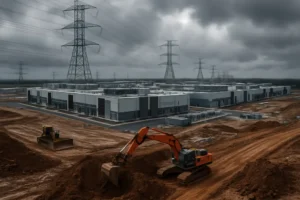
When most people interact with artificial intelligence, it feels almost invisible. You type a question, and within seconds, an answer appears. But behind that simplicity lies something far more complex. As I’ve explored how modern systems like ChatGPT operate, one thing becomes clear: the real story isn’t just the software it’s the AI data center infrastructure powering it.
These facilities are not your typical server rooms. They are massive, energy-intensive environments engineered specifically to handle the enormous computational demands of machine learning. Understanding what happens inside them offers a clearer picture of where AI is heading and what it truly costs to keep it running.
What Is an AI Data Center?
At a basic level, an AI data center is a specialized facility designed to store, process, and manage data for artificial intelligence systems. But unlike traditional data centers, these are optimized for high-performance computing tasks such as training and running large AI models.
What makes them different is scale and purpose. Instead of simply hosting websites or storing files, AI-focused facilities are built to process vast datasets and execute trillions of calculations per second. This is what allows systems like ChatGPT to generate human-like responses in real time.
The key distinction lies in how resources are used. Traditional servers handle predictable workloads. AI servers, on the other hand, deal with highly intensive, parallel computations that require significantly more power and specialized hardware.
The Hardware Behind Modern AI
When I look inside an AI data center, the first thing that stands out is the dominance of GPUs (Graphics Processing Units). These chips have become the backbone of AI because they are designed to handle parallel processing far more efficiently than traditional CPUs.
Companies like NVIDIA have positioned themselves at the center of this transformation, producing GPUs capable of training and running large-scale models. These chips work in clusters, often numbering in the thousands, connected through high-speed networks that allow them to operate as a unified system.
Beyond GPUs, there are also:
- High-speed networking systems that move data between servers
- Specialized AI accelerators designed for specific workloads
- Massive storage arrays to handle training datasets
Together, these components form a highly coordinated environment where speed and efficiency are critical.
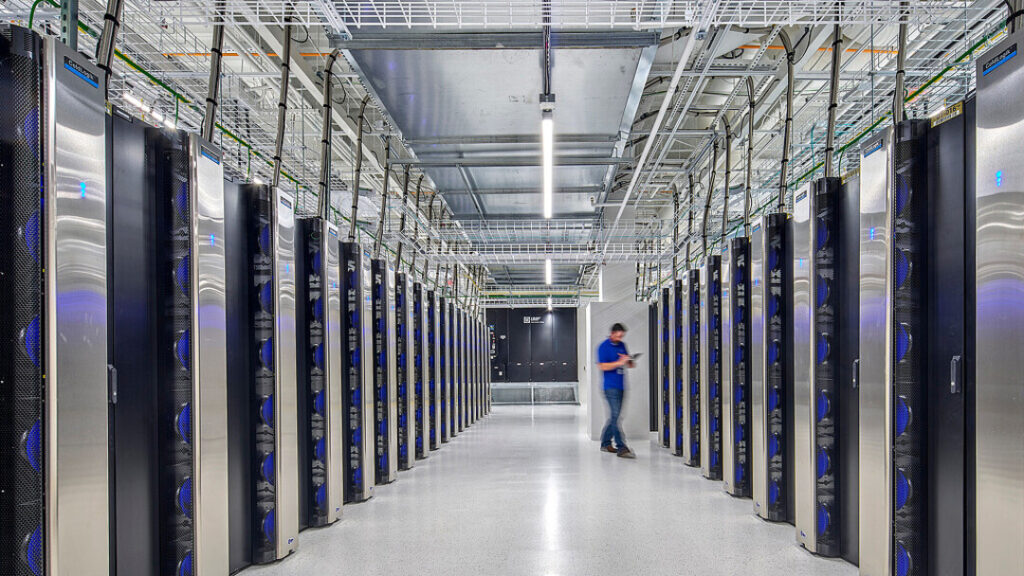
Power Consumption: The Hidden Cost of AI
One of the most striking realities I’ve come across is just how much energy an AI data center consumes. Training large AI models can require enormous amounts of electricity, often comparable to small towns.
This is not just a technical challenge it’s becoming a global conversation. As AI adoption grows, so does the strain on power grids. Data centers are increasingly being built near energy sources, including renewable power, to manage demand more effectively.
The issue isn’t just total energy usage. It’s also about consistency and reliability. AI workloads require uninterrupted power, meaning these facilities must be equipped with backup systems and redundancy measures to avoid downtime.
Cooling Systems: Keeping the Machines Alive
With that level of power consumption comes heat lots of it. One of the less visible but equally important aspects of an AI data center is its cooling infrastructure.
Traditional air cooling is no longer enough for many modern AI workloads. Instead, operators are turning to liquid cooling systems, which can absorb heat more efficiently and maintain stable operating temperatures.
This shift is critical because overheating can reduce performance, damage hardware, and increase operational costs. In many ways, cooling technology is becoming just as important as computing power in the evolution of AI infrastructure.
How Data Moves Through the System
Another aspect that often gets overlooked is how data flows within an AI data center. The speed at which information moves between servers can directly impact performance.
High-speed networking technologies allow thousands of GPUs to communicate simultaneously, enabling complex tasks like model training to happen faster. Without this level of connectivity, even the most powerful hardware would struggle to keep up with modern AI demands.
This interconnected structure is what transforms individual machines into a cohesive computing system. It’s not just about raw power it’s about coordination.
Why Scale Matters More Than Ever
The scale of today’s AI infrastructure is unlike anything we’ve seen before. Modern AI data center facilities are often described as “hyperscale,” meaning they operate on a massive level to support global demand.
What I find particularly interesting is how this scale directly influences AI capabilities. Larger data centers allow for bigger models, faster training, and more advanced applications. But they also introduce new challenges, from energy consumption to environmental impact. This balance between growth and sustainability is becoming one of the defining issues in the AI industry.
Key Components of an AI Data Center
To better understand the structure, here’s a simplified breakdown:
| Component | Function |
|---|---|
| GPUs / AI Accelerators | Perform complex AI computations |
| Networking Systems | Enable fast communication between servers |
| Storage Systems | Store massive datasets for training and inference |
| Power Infrastructure | Supply consistent electricity to operations |
| Cooling Systems | Prevent overheating and maintain efficiency |
Each of these elements plays a critical role in ensuring that AI systems operate smoothly and efficiently.
The Bigger Picture: Why It All Matters
What becomes clear after examining an AI data center is that artificial intelligence is no longer just a software story. It is deeply tied to physical infrastructure hardware, energy, and engineering. For those looking to explore more technical background, this overview of AI data center architecture from NVIDIA provides additional insight into how these systems are designed and optimized.
As AI continues to evolve, the demand for more powerful and efficient data centers will only increase. This raises important questions about sustainability, accessibility, and the long-term impact of rapid technological growth.
Conclusion
Looking inside an AI data center reveals a side of artificial intelligence that most users never see. It is a world of high-performance hardware, massive energy consumption, and intricate engineering designed to deliver instant results.
What stands out most is how essential this infrastructure has become. Without it, modern AI systems like ChatGPT simply wouldn’t exist. The speed, accuracy, and capabilities we now take for granted are all made possible by these powerful, carefully managed environments.
As AI continues to expand into every aspect of daily life, understanding what powers it is no longer optional it’s essential. Because behind every intelligent response is a network of machines working tirelessly to make it happen.