Artificial intelligence is advancing at a remarkable pace, and at the heart of this technological revolution lies one critical component: graphics processing units (GPUs). These powerful chips enable the massive computations required to train and run modern AI models.
In this Nvidia vs AMD AI GPUs analysis, I explore how two of the world’s largest semiconductor companies are competing to dominate the rapidly expanding AI hardware market. The competition between these companies is more than just a rivalry; it represents the foundation of the modern AI ecosystem.
Companies building large AI models whether for generative AI, autonomous systems, or scientific research require enormous computing power. GPUs provide the parallel processing capabilities needed to handle billions of calculations simultaneously. As demand for artificial intelligence grows, the competition between Nvidia and AMD has intensified dramatically.
Why GPUs Are Essential for Artificial Intelligence
Before comparing these two companies, it’s important to understand why GPUs are so crucial for AI development.
Traditional central processing units (CPUs) are excellent at handling sequential tasks, but AI training requires massive parallel computation. Neural networks rely on thousands or even millions of calculations occurring simultaneously. GPUs are specifically designed to handle this type of workload.
Modern AI models such as large language models and advanced machine-learning systems require clusters of thousands of GPUs working together inside specialized data centers. Without these processors, the rapid growth of artificial intelligence simply would not be possible.
This demand has created one of the most competitive technology markets in the world, placing Nvidia and AMD at the center of the AI hardware race.
Nvidia’s Dominance in the AI GPU Market
For years, Nvidia has held a commanding lead in the AI GPU market. Its hardware powers many of the world’s most advanced artificial intelligence systems.
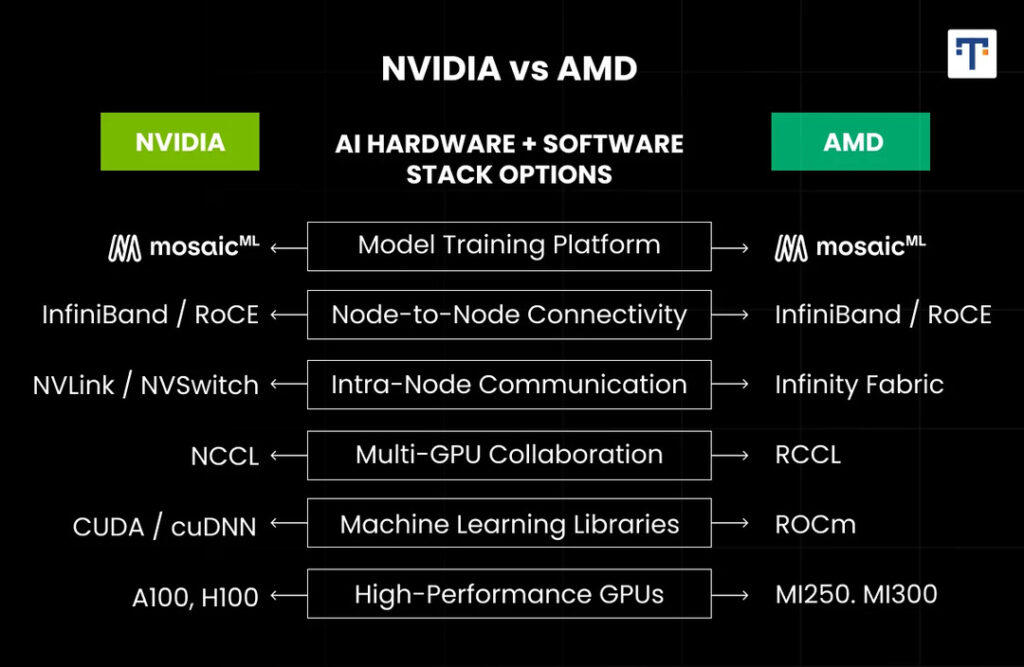
One of the primary reasons for Nvidia’s success is its highly developed software ecosystem. The company’s CUDA platform allows developers to easily program GPUs for complex workloads. Over time, CUDA has become a widely adopted standard for AI development, creating a strong advantage for Nvidia hardware.
Nvidia’s flagship AI processors including the H100 and newer AI accelerators are designed specifically for large-scale machine learning. These GPUs deliver enormous computational power and are widely used by major cloud providers and AI research organizations.
In addition to raw performance, Nvidia has invested heavily in building a complete AI infrastructure stack, including networking technology, software frameworks, and supercomputing solutions. This integrated approach has helped solidify its position as the dominant player in the industry.
AMD’s Growing Challenge in AI Computing
While Nvidia has historically led the market, Advanced Micro Devices commonly known as AMD is rapidly emerging as a serious competitor.
In recent years, AMD has introduced a series of high-performance data center GPUs designed specifically for AI workloads. The company’s MI series accelerators are increasingly being adopted by cloud providers and enterprise AI platforms.
AMD’s strategy focuses on open computing standards and competitive pricing, which can appeal to companies seeking alternatives to Nvidia’s ecosystem. The company has also made significant improvements in its software frameworks to better support machine-learning workloads.
Another advantage AMD brings to the table is its strong expertise in both CPUs and GPUs. By integrating these technologies more closely within data-center platforms, AMD aims to deliver highly efficient computing solutions for AI training and inference.
As more organizations look to diversify their hardware supply chains, AMD’s presence in the AI GPU market continues to grow.
Performance, Architecture, and Innovation
When evaluating Nvidia vs AMD AI GPUs, performance comparisons often focus on several key factors: computing power, memory bandwidth, energy efficiency, and scalability.
Nvidia’s GPUs have traditionally excelled in large-scale AI training environments, particularly because of their optimized software stack and specialized hardware features such as Tensor Cores. These components accelerate the matrix calculations required for deep learning.
AMD, however, has made significant progress in recent generations of AI hardware. Its latest GPUs emphasize high memory capacity and strong compute throughput, which can be particularly valuable for large models requiring extensive data processing.
Another critical factor is scalability. AI systems often rely on clusters containing thousands of GPUs connected through high-speed networking. Both companies are investing heavily in technologies that allow their hardware to scale efficiently across massive data-center deployments.
This ongoing innovation is pushing the entire industry forward, leading to faster and more powerful AI computing platforms.
The Expanding AI Data Center Market
The rivalry between Nvidia and AMD is closely tied to the rapid growth of AI-focused data centers.
Major technology companies including cloud providers and AI startups are building enormous computing facilities designed specifically for machine learning workloads. These facilities require massive quantities of GPUs, often numbering in the tens of thousands.
As a result, demand for AI processors has surged dramatically. Analysts expect the global AI hardware market to grow rapidly over the next decade as organizations continue investing in artificial intelligence capabilities.
For official technical insights into AI hardware and accelerated computing, the Nvidia vs AMD AI GPUs ecosystem can be explored through Nvidia’s data center AI resources, which outline how GPUs are used in large-scale AI environments.
This explosive growth means that both Nvidia and AMD have enormous opportunities to expand their presence in the AI infrastructure market.
What the Future Holds for AI GPU Competition
Looking ahead, the competition between Nvidia and AMD is likely to become even more intense.
Both companies are investing billions of dollars into research and development to create next-generation AI processors capable of handling increasingly complex workloads. Innovations in chip architecture, interconnect technologies, and energy efficiency will play a critical role in determining which company gains the upper hand.
At the same time, new players are entering the AI hardware market, including specialized AI accelerator startups and major technology companies designing their own custom chips. These developments could reshape the competitive landscape in the years ahead.
Despite these emerging challenges, Nvidia and AMD remain two of the most influential forces driving the evolution of AI computing.
A Rivalry Shaping the AI Era
After examining the Nvidia vs AMD AI GPUs competition, one thing becomes clear: this rivalry is helping define the future of artificial intelligence.
Nvidia currently maintains a strong lead thanks to its established software ecosystem, advanced hardware designs, and deep integration across the AI development pipeline. However, AMD’s rapid innovation and strategic investments are creating a genuine challenge in the data-center GPU market.
As demand for AI computing continues to grow, both companies will play essential roles in powering the next generation of intelligent systems. From training massive language models to enabling scientific discoveries, GPUs have become the engines driving modern AI.
Ultimately, the competition between Nvidia and AMD is not just about market share it is about who will build the computational foundation of tomorrow’s AI-driven world.