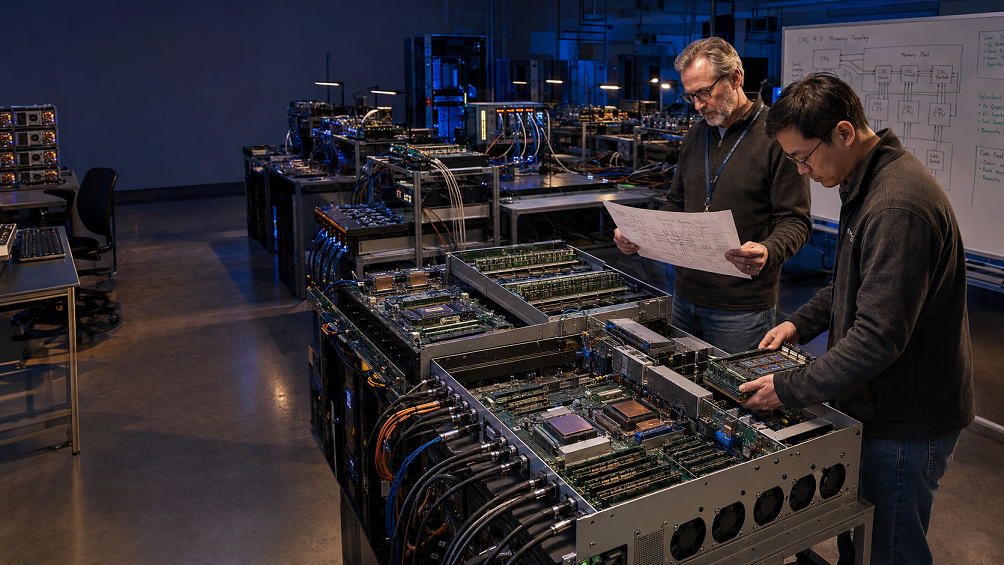
Server memory planning is moving beyond the old question of how many DIMM slots fit inside a chassis. AI inference, large databases, cache-heavy services, analytics platforms, and dense virtualization clusters can consume memory faster than operators can economically add local DRAM to every host. Compute Express Link, or CXL, is emerging as one answer. The technology lets processors, accelerators, and memory devices communicate through a coherent interconnect built on PCI Express foundations.
CXL 4.0 pushes that model further. The CXL Consortium released the specification in November 2025 with a 128 GT/s data rate, bundled-port support, longer channel options, and memory reliability, availability, and serviceability improvements. Those changes matter less as a headline specification race than as evidence that memory is becoming a resource operators can design, tier, monitor, and allocate across larger systems.
What CXL 4.0 Changes At The Link Layer
The CXL 4.0 specification release doubled the data rate from 64 GT/s in CXL 3.x to 128 GT/s. It retained backward compatibility with earlier generations and introduced bundled ports, which can combine device connections to increase available bandwidth between hosts and compatible accelerators.
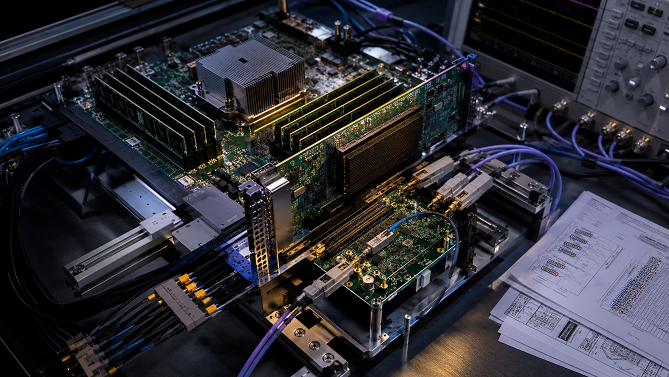
That 128 GT/s figure aligns CXL 4.0 with PCI Express 7.0 signaling. PCI-SIG states that PCIe 7.0 reaches a 128 GT/s raw bit rate and can provide up to 512 GB/s of bidirectional bandwidth across an x16 configuration. A CXL implementation is not automatically equivalent to the theoretical maximum of a generic PCIe x16 link, yet the underlying signaling generation gives server designers a larger transport envelope for memory and accelerator traffic.
The operational value sits in topology as much as link speed. Native x2 support can increase device fan-out, and CXL 4.0 permits additional retimers for longer electrical channels. Bundled ports give designers another way to scale connectivity without changing the software-facing enumeration model. The result is more freedom to build memory systems that extend beyond a CPU socket and its directly attached DIMMs.
Why Memory Tiering Matters More Than Raw Capacity
CXL memory does not erase the performance difference between local DRAM and memory reached through another device. The more useful model is tiering: keep latency-sensitive working data close to the processor, then place colder or less frequently accessed pages in a secondary CXL-attached tier.
Linux already treats CXL configuration as a coordinated interaction among firmware, ACPI tables, device drivers, NUMA policy, memory hotplug, allocation rules, and user-space policy. The official Linux CXL documentation covers memory tiers, NUMA nodes, access coordinates, memory hotplug, decoder programming, reclaim behavior, and device configuration. That software layer is a major part of any deployment plan.
This distinction changes procurement. Buying a memory-expansion card is not enough. Operators need platform firmware that exposes devices correctly, an operating system with the required CXL support, monitoring that distinguishes local and remote memory behavior, and workload placement policies that account for latency and bandwidth differences.
The workload itself determines whether the extra capacity earns its place. A cache with a large cold-data region may tolerate tiered memory much better than an application whose hottest data structures constantly jump between memory domains.
Production Evidence Is Starting To Matter
The strongest sign of CXL maturation in 2026 is not a specification document. It is production evidence.
At a CXL Consortium presentation on July 21, 2026, Meta engineers Neha Gholkar and Hasan Al Maruf described Vistara, an internally developed CXL memory system used across production workloads. Their presentation reported that 43% of the studied servers were memory-bound rather than compute-bound, creating a case for increasing usable memory without proportionally increasing processor capacity.
Meta’s reported architecture used a 1 TB server configuration with a 3:1 ratio of local memory to CXL memory. The presentation described transparent Linux memory tiering, with hot pages retained locally and colder pages demoted to the CXL tier. Production examples included development infrastructure, machine-learning parameter servers, caches, and data-warehouse workloads. Meta reported different results for each workload, reinforcing the point that CXL should be evaluated against a specific memory-access pattern rather than treated as universally faster memory.
That is a much healthier basis for server planning than assuming every memory-intensive application belongs on the same architecture.
AI And Real-Time Services Make Memory Placement More Visible
AI infrastructure makes the memory question harder. Accelerator capacity receives most of the attention, yet inference platforms still depend on host memory, model-serving caches, retrieval systems, networking, storage, and CPU-side orchestration. HW Server’s guide to 2026 AI edge server hardware shows how modern edge designs already force engineers to balance acceleration, storage, thermal limits, form factor, and local processing rather than treating the server as a CPU-only system.
The same principle applies to data services outside AI. A site continuously refreshing sports wagering odds illustrates a public-facing application built around changing datasets, multiple markets, current prices, and frequent updates. That type of service can place pressure on caches, APIs, databases, and data-distribution layers long before a visitor thinks about the underlying infrastructure.
CXL is relevant where such systems hold large datasets in memory but do not access every byte with equal frequency. It gives architects another tier between local DRAM and slower storage-oriented paths. The engineering task is determining which data belongs there.
The CXL Consortium made this AI connection explicit at Future of Memory and Storage 2026, where sessions covered memory pooling, inference, KV-cache offloading, disaggregated memory, RAG acceleration, and AI infrastructure. Those sessions show where the ecosystem is directing current engineering work, not proof that every technique is ready for universal deployment.
What Operators Should Validate Before Deployment
CXL planning should start with telemetry. Teams need to know whether servers are limited by memory capacity, memory bandwidth, CPU execution, accelerator utilization, storage, or network I/O. A host that rarely approaches its local memory ceiling may gain little from another memory tier.

Latency sensitivity needs the same scrutiny. Production traces can reveal how much of a workload remains hot, how frequently pages move between tiers, and whether tail latency changes after memory pressure increases.
Platform compatibility comes next. CPU support, firmware, motherboard routing, retimers, switches, CXL device generation, operating-system maturity, and monitoring need to be evaluated as one system. Backward compatibility in a specification does not guarantee that every feature works across every mixed-generation platform.
Reliability deserves equal attention. CXL 4.0 adds memory RAS improvements intended to improve error visibility and maintenance. For operators running dense clusters, the management question becomes larger than whether memory is reachable. They need to know how faults are reported, how degraded devices are isolated, how firmware updates are handled, and what happens to workloads during maintenance.
Why Server Memory Planning Is Becoming Architectural
CXL 4.0 does not make traditional DRAM obsolete. It changes the boundary around where server memory can live and how software can use it.
The most promising deployments will probably come from environments where memory capacity is already a measurable constraint, workloads contain meaningful hot and cold regions, and operators have enough observability to control placement. AI serving, large caches, development fleets, databases, and analytics systems are obvious candidates for testing, but each needs its own latency and throughput validation.
The larger shift is architectural. Memory is starting to look less like a fixed quantity soldered conceptually to one host and more like an infrastructure resource that can be extended, tiered, monitored, and eventually shared. CXL 4.0 gives hardware designers more bandwidth and connectivity options. Production work in 2026 is beginning to show what software teams must build around those capabilities.
For server buyers, that means the next memory decision should start with workload evidence, operating-system readiness, platform interoperability, and failure handling—not a capacity number printed on a specification sheet.