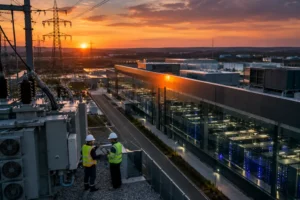
Data center construction is no longer only a question of land, fiber, power purchase agreements, and cooling equipment. By November 10, 2026, the buildout model has become a policy and engineering problem in which emissions, water reporting, grid cost allocation, and local approval processes increasingly shape whether a project can move from site control to energization.
The connectivity category is directly affected because compute campuses depend on dense fiber access, utility interconnection, resilient backup systems, and predictable operating permissions. A technically strong network design does not solve a weak permitting record, and a fast construction schedule can still fail if electricity, cooling water, air permits, or community cost impacts are not addressed early.
Why Data Center Construction Faces New Constraints
The environmental pressure is not abstract. A February 2026 Harvard assessment reported that between May 2024 and April 2025, U.S. hyperscale data centers consumed more than 2.10% of total U.S. electricity. The same analysis found that nearly 60% of that electricity was associated with fossil fuels, producing 52 million tons of CO₂ emissions, with carbon intensity about 52% higher than the U.S. average of 369 g/kWh, according to the Harvard hyperscale emissions assessment.
Load Growth Changes Site Selection
Those figures change how site selection should be evaluated. A project team may still rank sites by fiber diversity, latency to user clusters, available acreage, tax treatment, and construction labor. The more difficult filter is whether the local grid can support the requested load without shifting avoidable costs to households or other commercial customers. If a campus requires new substations, transmission upgrades, water infrastructure, or local generation, those costs become part of the project’s technical footprint rather than a secondary financing item.
What Data Center Construction Must Prove
For data center construction teams, the evidence package now needs to look closer to an infrastructure filing than a conventional commercial real estate plan. Regulators and utilities are likely to ask for projected peak demand, annual electricity consumption, backup generation design, water sourcing, expected discharge, cooling technology, construction phasing, and the method used to allocate upgrade costs. The engineering challenge is to produce numbers that remain credible across several phases of buildout, not only during the first energized hall.
Environmental Metrics Are Moving Into Permits
California has made that shift explicit. On September 21, 2026, the governor signed a package of seven data center laws requiring stronger transparency and regulatory control, including water and electricity usage reporting, payment for grid and water infrastructure, compliance with state energy procurement standards, and protections against shifting costs to ratepayers, as described by the California governor’s office.
Electricity, Water, And Cost Allocation
The California action is notable because it treats resource use and cost allocation as permitting questions, not just utility planning details. That matters for developers because a proposal can be technically feasible while still facing rejection or delay if the financing model places too much risk on the public grid or municipal water systems. For local governments, the core question is not whether compute demand is useful; it is whether the physical support systems can be built without degrading service quality, drought resilience, or rate fairness.
Carbon Accounting Needs Facility-Level Evidence
Carbon claims also need better evidence. Annual renewable procurement can be useful, but it may not describe hourly operating emissions where a facility draws power from a regional mix that changes through the day. Site reviewers may increasingly distinguish between contractual energy claims and measured operational impacts. Prior analysis of data center energy policy makes the same point from a planning perspective: sustainability language is less useful than auditable data on electricity, water, backup systems, and local infrastructure effects, as suggested by related endpoint security guidance.
Connectivity Planning Now Includes Energy Risk
Connectivity planning has traditionally focused on carrier diversity, route separation, meet-me-room capacity, latency, and physical security. Those remain necessary. The newer issue is that network availability depends on the power and cooling systems that keep optical gear, switches, storage, and servers operating. A facility with strong fiber access but uncertain grid capacity can become a stranded asset if energization dates move or if operating permits constrain backup generation.
Network Availability Depends On Utility Design
Facility engineers should evaluate network rooms, interconnection spaces, and carrier equipment against the same resource assumptions used for the rest of the campus. That means checking whether electrical redundancy, cooling redundancy, fire protection, and maintenance access remain adequate at each phase of the power ramp. If network infrastructure is expanded ahead of confirmed power capacity, the operator may carry installed but underused assets. If it is expanded too late, the compute halls may be ready before external connectivity is resilient enough for production workloads.
Security Controls Extend Beyond IT Rooms
Security planning must also account for energy systems. Power management networks, building automation, cooling controls, battery systems, and generator controls should be segmented and monitored as operational technology. Defensive controls should cover identity management, logging, patch governance, vendor remote access, and incident response paths for facilities teams. For non-specialist endpoint hygiene context, related endpoint security guidance can supplement, but not replace, formal data center security controls designed for industrial and enterprise environments.
Regulatory Designs Are Becoming Construction Inputs

The future of data center construction will likely be shaped by how early developers turn regulatory duties into design inputs. Treating reporting, metering, grid upgrades, and water strategy as late-stage compliance tasks is risky. By the time a project reaches public review, the major site decisions may already be hard to reverse, including cooling architecture, backup generation type, power routing, and water source assumptions.
| Project Area | Regulatory Signal | Engineering Response |
|---|---|---|
| Electricity | Higher scrutiny of load growth and cost shifting | Phase energization plans, substation studies, and cost allocation models |
| Water | More reporting and local supply review | Cooling selection, metering, conservation plans, and drought assumptions |
| Emissions | Closer review of power sourcing and backup generation | Hourly energy data, generator permitting files, and operating limits |
| Connectivity | Dependence on power quality and site resilience | Carrier diversity matched to electrical and cooling redundancy |
Permitting Delays Are Now Design Risks
A delay caused by an incomplete environmental record can affect procurement, equipment delivery, fiber construction, and customer commitments. The risk is not limited to rejected permits. Conditional approvals can force redesign, new mitigation measures, revised utility agreements, or changes to construction sequencing. Developers should model permitting uncertainty in the same way they model long-lead transformers, switchgear, chillers, and high-capacity network equipment.
Community Impact Claims Need Measurable Limits
Community-facing commitments should be written as measurable operating limits where possible. Vague claims about efficient cooling or clean energy are weaker than specific metering plans, reporting intervals, water consumption thresholds, backup generator operating limits, and documented responsibility for infrastructure upgrades. Regulators are becoming less willing to accept statements of intent without a mechanism to verify performance after the facility is operating.
Data Center Construction Governance Checklist
For data center construction sponsors, the practical response is to build a governance file that engineering, legal, utility, sustainability, and security teams can all use. The file should be updated as the project moves from site screening to design, permitting, procurement, construction, commissioning, and operations.
- Document projected peak demand, annual energy use, and phasing assumptions.
- Identify water sources, cooling approach, discharge controls, and drought assumptions.
- Separate contractual energy procurement claims from measured facility operating data.
- Map grid and water infrastructure upgrades to the party responsible for payment.
- Include backup generation permits, operating limits, and emissions documentation.
- Align carrier diversity plans with power, cooling, and physical security redundancy.
- Segment and monitor facility control systems as operational technology assets.
A Practical Approval File
The approval file should be specific enough that an outside reviewer can understand how the campus will operate on a high-load day, during maintenance, and during a utility disturbance. It should also show how later phases will change the load profile. A first phase that looks acceptable on its own may create a different local impact once the full campus is built, so staged reporting is more credible than a single static estimate.
What Remains Uncertain
The policy direction is clear, but implementation will vary by state, utility territory, water basin, and local politics. Some rules may tighten reporting and cost recovery without stopping projects. Others may slow or reshape projects that cannot document resource impacts. The strongest technical position is cautious and evidence-led: design for measured energy and water performance, disclose assumptions early, protect facility control systems, and treat environmental compliance as part of the core connectivity architecture rather than a filing attached after design decisions are complete.