AI agent governance is becoming the difference between useful automation and unmanaged digital authority. As enterprises move from chatbots to agents that can touch files, APIs, calendars, tickets, code, and business workflows, the security question is no longer whether an AI answer is accurate it is whether the agent should have been allowed to act at all.
That is why companies need governance before deployment, not after a pilot spreads through the business. The same risks behind enterprise AI agents become more serious when agents gain tool access, inherit user permissions, and operate across systems that were built for people, not autonomous software.
AI Agent Governance Starts Before the First Workflow
The biggest mistake is treating AI governance as a policy document that appears after agents are already in production. By then, the organization may already have shadow agents, unclear ownership, unmanaged prompts, excessive permissions, and incomplete audit trails.
Agent governance has to begin at the design stage. Every agent should have a named business purpose, an owner, a defined operating boundary, and a clear list of allowed systems. If the company cannot explain what the agent is supposed to do, it should not connect that agent to sensitive data or production tools.
This is where purpose limits risk. A finance agent should not browse engineering repositories. A support agent should not approve vendor payments. A coding agent should not make production changes without review.
Governance is not about slowing innovation. It is about preventing vague automation from becoming invisible authority.
Identity Is the New Control Point
Human users already have identities, roles, permissions, and activity logs. AI agents need the same discipline, but with tighter boundaries.
An enterprise agent should not simply borrow a user’s full access and roam across the organization. That creates a dangerous shortcut where the agent can touch everything the user can touch, even when the task only requires a small subset of permissions.
Microsoft’s Agent 365 control plane reflects where the market is heading: agents need visibility, identity, management, and security controls at scale. That matters because enterprises will not be managing one or two agents. They may eventually manage hundreds across departments, devices, apps, and workflows.
The practical rule is simple. Each agent needs a distinct identity, a clear owner, and access scoped to the job. If an action would require approval from a human employee, the agent should not bypass that approval just because it is faster.
Tool Permissions Need a Smaller Blast Radius
The power of an AI agent comes from tool use. The danger comes from tool use too.
Once an agent can call APIs, query databases, update records, send messages, or trigger automations, every connector becomes part of the risk surface. A bad prompt, poisoned document, misunderstood command, or compromised workflow can produce real business consequences.
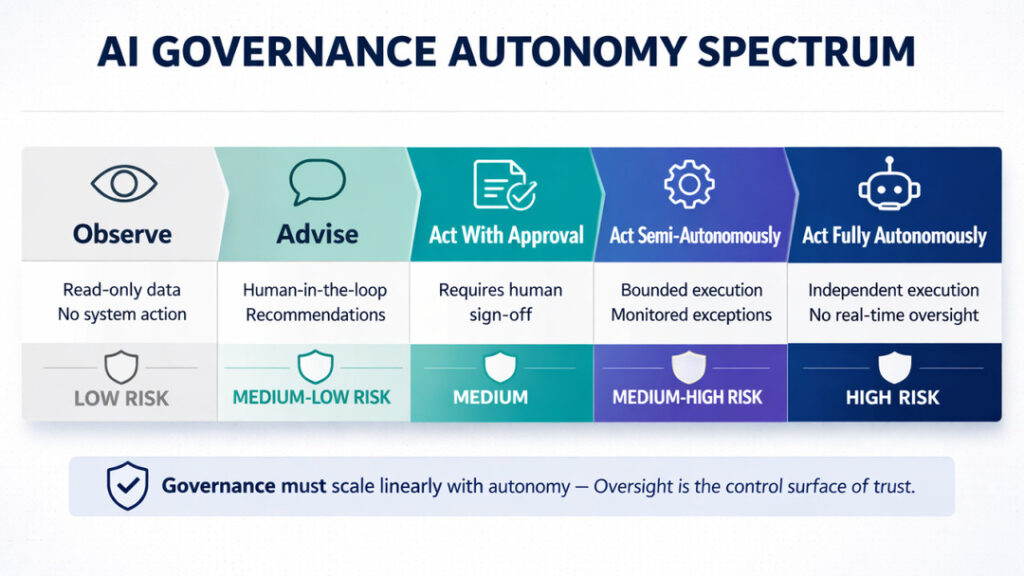
That is why tool permissions should be separated into layers: read-only access, draft-only access, low-risk actions, and high-risk actions that require approval. Agents should not receive write access by default.
A useful governance table can keep teams honest before deployment:
| Governance Area | Question to Answer Before Launch | Risk If Ignored |
|---|---|---|
| Data access | What can the agent read? | Sensitive data exposure |
| Tool permissions | What can the agent change or trigger? | Unauthorized actions |
| Human approval | Which tasks need review? | Risky automation without oversight |
| Audit logging | What activity is recorded? | Poor incident investigation |
| Ownership | Who is accountable for the agent? | No clear response path |
| Retirement plan | When should access be removed? | Stale agents with live permissions |
The table shows why AI agent governance belongs with security architecture, not just product experimentation.
Audit Logs Must Explain the Decision Path
Traditional logs often show that something happened. Agent logs need to show why it happened.
If an agent updates a ticket, sends a file, runs a query, or calls an API, security teams need more than a timestamp. They need the user request, the context the agent retrieved, the tool it selected, the approval step, and the final action.
That does not mean storing sensitive conversations carelessly. It means designing traceability that supports compliance, incident response, and internal accountability.
This is where auditability builds trust. Employees and executives are more likely to accept agentic systems when they know actions can be reviewed, explained, and corrected.
A black-box agent may look impressive in a demo. It becomes a liability in production.
Compliance Cannot Be Bolted On Later
AI agents create compliance questions because they operate across data boundaries. A single workflow may involve personal data, confidential records, intellectual property, regulated documents, or customer communications.
That makes governance especially important for industries with strict retention, privacy, or audit requirements. Companies need policies for what agents can process, what they can store, how long context is retained, and which systems are excluded.
CISA’s agentic AI security guidance puts the same basic issue in security terms: agentic systems need careful adoption, lifecycle controls, and risk management before they are trusted with consequential work.
The key is to connect AI governance with existing compliance systems. Agents should follow the organization’s data classification rules, identity rules, approval rules, and retention rules. They should not create a parallel process that security and legal teams cannot see.
Compliance needs design, not cleanup.
The Next Pressure Point Is Shadow Agents
The next enterprise governance problem will be agents that appear outside official channels. Employees will use AI tools because they are useful. Teams will connect assistants to documents, SaaS tools, and workflows because the productivity gain is obvious.
If security teams respond only by blocking everything, users may move faster in the shadows. If they allow everything, the company loses control.
The better path is approved agent deployment with visible rules. Give teams safe options. Provide clear permission templates. Require owners. Monitor tool connections. Review high-risk workflows. Retire agents when projects end.
AI agent governance matters because agents are not ordinary software features. They can reason, retrieve, connect, and act across the enterprise. Companies that govern them before deployment can capture the productivity upside without surrendering control. Companies that wait may discover too late that the hardest part of agentic AI was never the model it was deciding who gave the agent permission to act.
FAQ
What is AI agent governance?
AI agent governance is the set of rules, controls, owners, permissions, and audit processes that define how AI agents can access data, use tools, and act inside enterprise systems.
Why should governance happen before deployment?
Governance should happen before deployment because agents can spread quickly across workflows. Waiting until after launch can leave companies with excessive permissions, unclear accountability, and weak audit trails.
What is the biggest risk with enterprise AI agents?
The biggest risk is uncontrolled authority. If an agent can access sensitive data or trigger business actions without proper limits, a small mistake can become a serious security or compliance problem.