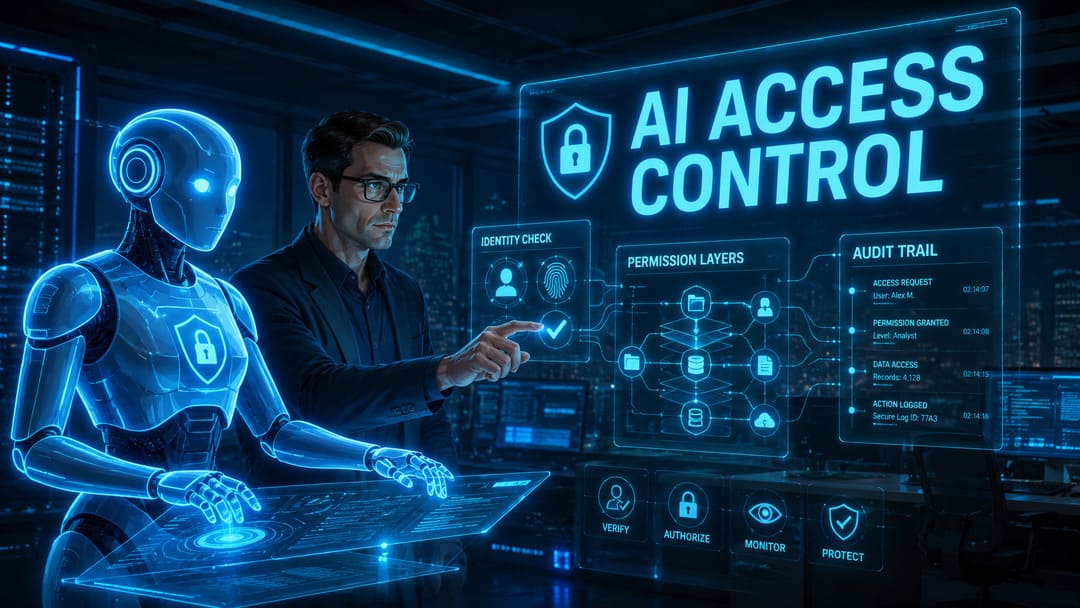
AI agent security risks are becoming harder to contain because agents do not simply answer questions anymore. They connect to files, tools, APIs, calendars, code repositories, ticketing systems, cloud platforms, and business workflows, which means a bad instruction can move from a chat window into real enterprise action.
That is the real shift security teams need to face. The same pressure behind AI hacking tools is now moving inside companies through agents that can retrieve data, call tools, summarize sensitive records, and execute multi-step tasks with less human friction.
AI Agent Security Risks Start With Access
A chatbot is risky when it gives a bad answer. An agent is risky when it can act on that answer.
That difference changes enterprise security. Once an AI system can open files, query databases, create tickets, call APIs, send messages, or trigger automation, it becomes part of the access-control layer. The model is no longer just generating text. It is operating inside the company’s workflow.
This is why access becomes the attack surface. If an agent inherits a user’s permissions without tight boundaries, it may touch more data than the task requires. If it connects to too many tools, a small prompt mistake can become a larger operational problem.
The danger is not that every agent will behave recklessly. The danger is that enterprises may deploy agents before defining exactly what each one is allowed to see, change, approve, or escalate.
Prompt Injection Becomes More Dangerous When Tools Are Connected
Prompt injection used to sound like a chatbot problem. Someone tricks the model into ignoring instructions, revealing information, or producing an unsafe response.
Agents make that weakness more serious because injected instructions can influence tool use. Microsoft’s security work on AI agent framework vulnerabilities showed how prompt injection in an agent framework could lead to remote code execution when the agent interpreted natural language, selected tools, and passed parameters into code.
That is the enterprise lesson. Agent security is not only about filtering prompts. It is about controlling what happens after the model decides to act.
A malicious instruction hidden in a document, email, webpage, ticket, or shared file could try to steer an agent toward the wrong action. If the agent has access to powerful tools, the risk moves beyond bad output into unauthorized behavior.
Prompt becomes command when the agent can execute.
Traditional Controls Do Not Map Cleanly to Agents
Enterprises already have identity systems, endpoint controls, logging tools, access policies, and security monitoring. Those still matter, but agents create awkward gaps between existing layers.
A human user understands context. A normal application follows fixed logic. An agent sits somewhere in between. It reasons probabilistically, interprets instructions, chooses tools, and may chain actions across systems.
That makes policy design harder. Should the agent inherit the user’s permissions? Should it have its own service identity? Should high-risk actions require approval? Should the agent be allowed to read external content and internal files in the same workflow?
These are not abstract architecture questions. They decide whether an agent becomes useful automation or a confused deputy that can be manipulated into misusing legitimate access.
CISA and international partners have already published guidance on the secure adoption of agentic AI, emphasizing that these systems need layered controls, governance, and risk management across their lifecycle.
The Riskiest Agent Connections Are Easy to Underestimate
The riskiest agents are not always the most advanced ones. They are often the ones connected to boring but powerful business systems.
A support agent with access to customer records can expose private data. A finance agent connected to invoices can create payment risk. A coding agent with repository access can introduce insecure changes. A cloud operations agent can modify infrastructure if its permissions are too broad.
| Agent Connection | Enterprise Value | Security Risk |
|---|---|---|
| File systems | Faster search and summarization | Sensitive data exposure |
| Email and messaging | Better follow-ups and routing | Prompt injection through content |
| APIs and SaaS tools | Workflow automation | Unauthorized actions |
| Code repositories | Developer productivity | Insecure or unreviewed changes |
| Cloud consoles | Faster operations | High-impact misconfiguration |
The table shows why agent security cannot be handled as one generic AI policy. Every connector changes the risk.
Governance Has to Move Before Deployment
Many companies will be tempted to pilot agents quickly because the productivity case is obvious. That is where mistakes begin.
Agent governance needs to start before the first broad deployment. Security teams should define approved use cases, permission boundaries, logging requirements, escalation paths, data-retention rules, and human-review points.
The safest approach is not to block every agent. It is to narrow the blast radius. Give agents specific roles. Limit tool access. Separate read-only tasks from write-capable actions. Require approval for sensitive changes. Keep audit trails that show what the agent saw, decided, and did.
This is where least privilege matters more than excitement. An agent should not get broad access just because the user has it. It should get the minimum access needed for the task.
The Next Pressure Point Is Agent Monitoring
The next enterprise security gap will be monitoring. Companies cannot govern agents properly if they cannot see what agents are doing.
Traditional logs may show an API call or file access event, but they may not explain why the agent took that action. Security teams need visibility into prompts, retrieved context, tool choices, approvals, outputs, and downstream actions.
That does not mean storing every sensitive conversation forever. It means creating enough traceability to investigate mistakes, detect abuse, and prove that high-risk actions were controlled.
The next wave of AI agent security risks will not come only from smarter attackers. It will come from companies giving agents more authority than their monitoring systems can explain. Enterprises that treat agents like ordinary software will miss the point. Agents are becoming active participants in business workflows, and they need security controls designed for systems that can reason, connect, and act.
FAQ’s
What makes AI agents riskier than chatbots?
AI agents can connect to tools, files, APIs, and workflows. That means a bad prompt or manipulated instruction can lead to real actions, not just an inaccurate or unsafe answer.
Should enterprises block AI agents completely?
Blocking every agent may slow useful automation. A better approach is controlled deployment with limited permissions, approved use cases, human review for sensitive actions, and strong monitoring.
What is the first step in reducing AI agent security risks?
Start with access control. Define what each agent can read, change, approve, and trigger before connecting it to business systems or sensitive enterprise data.