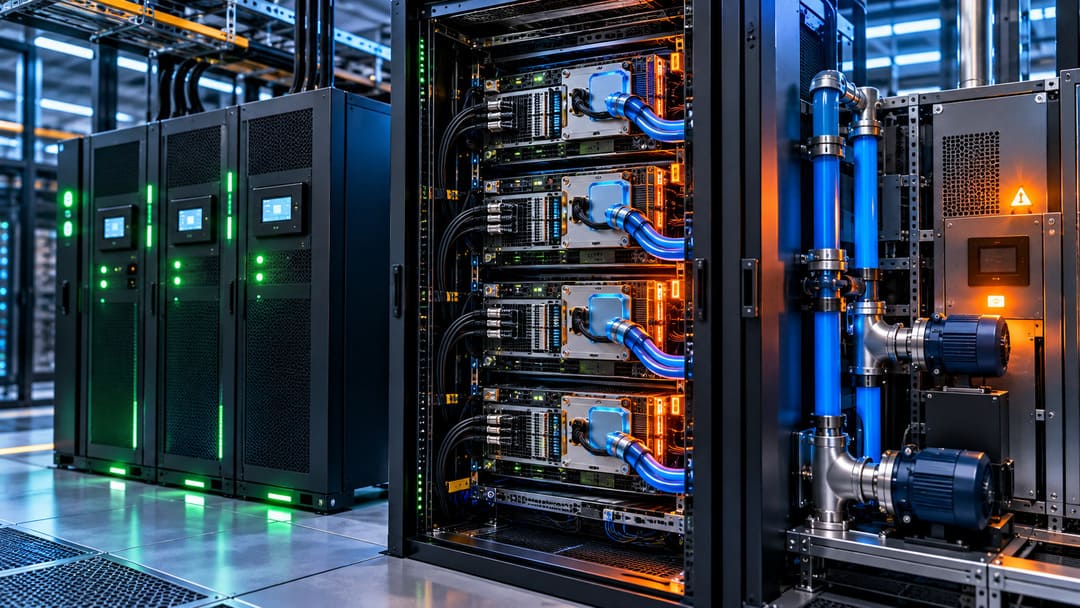
A UPS can keep an AI server rack energized through a utility outage while the rack’s cooling becomes unavailable. Servers may stay powered as generators start, but air handlers, chilled-water pumps and coolant distribution units (CDUs) may be on different electrical paths or need time to restart. For liquid-cooled accelerators, lost coolant flow can become the limiting factor long before the backup power runs out.
This is a system-design issue, not simply a bad UPS. Schneider Electric’s guidance on data-center UPS design explains that sites commonly protect IT loads with UPS power while some cooling equipment depends on generator-backed circuits. After a power event, restoring full cooling can take longer than transferring electrical supply. Schneider Electric Blog
Power and Cooling Have Three Different Clocks
Electrical ride-through is the time the UPS can support its connected load before another source takes over or an orderly shutdown is needed. It depends on the actual watts drawn, the UPS and battery configuration, and their condition. Eaton’s UPS selection guidance advises using model-specific runtime information at the expected load; the VA rating alone is not a battery-runtime promise. Eaton
Thermal ride-through is how long IT equipment can remain within its required operating limits after cooling is partly or fully lost. This is not the same as room temperature returning to normal. The critical measurement could be server inlet temperature, GPU temperature, or coolant flow, depending on the hardware.
Cooling recovery ends only when the equipment delivering heat removal is actually functioning again. A generator may be producing acceptable power while a chiller completes its restart sequence, a pump restarts, or a CDU is still restoring its required flow and temperature.
A design must meet all three conditions. The smallest safe margin, not the longest battery rating, determines whether an outage can be ridden through without interrupting workloads.
When a Five-Minute UPS Is Not Enough
Imagine a hypothetical AI row with a UPS rated to carry its measured IT load for five minutes. After a utility outage, the generator accepts the electrical load at 30 seconds. The IT systems never lose input power.
Now assume the CDU circulation pumps are not on UPS power. They stop during the outage, and full coolant flow is not restored until two minutes after the original interruption. That leaves the accelerators without normal coolant circulation for approximately 120 seconds, even though the generator has been supplying electricity for much of that time.
If the installed servers’ validated allowable cooling interruption were only 30 seconds, the recovery would exceed that limit by 90 seconds. The times here are invented solely to demonstrate the comparison; they are not measurements or generic safety limits for any GPU, pump or CDU. The actual allowable interval must come from qualified engineering review, vendor specifications and appropriate site testing.
A green UPS indicator therefore cannot prove that the AI workload is protected. Likewise, a healthy generator status does not establish that the full cooling chain has recovered.
Liquid Cooling Makes the Coordination More Critical
Air-cooled rooms have some thermal mass in their air, structural materials and cooling equipment. Direct-to-chip systems concentrate heat removal in a circulating fluid path. The amount of time a particular cold-plate system can safely tolerate a loss of flow varies, and should never be assumed from a conventional air-cooled room’s history.
ASHRAE’s data-center handbook treats IT power and cooling as interdependent services. It discusses maintaining critical circulation with small UPS-backed pumps and using stored chilled water or other thermal capacity when appropriate. The correct design depends on both the liquid loop and the residual air-cooling needs. ASHRAE Handbook Online
Backing up a pump is also not identical to plugging a server into an unused UPS outlet. Vertiv’s discussion of CDU power protection identifies motor starts, variable-frequency drives and power quality as issues that need to be addressed when selecting a UPS for cooling equipment. Its specific product claims should be evaluated against the planned equipment, rather than treated as universal performance guarantees. Vertiv
Verify the Entire Recovery Sequence
Before approving a dense rack or a cooling retrofit, the facility and IT teams should document five things:
- The actual electrical paths: which UPS and generator circuits feed IT loads, CDU controllers, pumps, air handlers and the supporting monitoring system, including any shared breaker or transfer device.
- The supported operating loads: UPS output ratings, battery runtime at realistic peak demand, pump starting behavior, redundancy and the protection requirements for mechanical loads.
- The thermal interruption limit: the equipment-specific time to throttling or protective shutdown at the intended workload and inlet or coolant conditions, with the evidence and assumptions recorded.
- The real recovery timeline: how long generators, transfer switches, cooling controls, pumps, chillers and valves take to deliver acceptable cooling again, not merely how quickly the first generator starts.
- The response if that timeline fails: alarms on flow, temperature and power; documented load shedding or graceful shutdown; and controlled commissioning under qualified supervision. Do not test a live production rack by casually disconnecting its power or cooling.
The electrical dependency is related to, but distinct from, the issue covered in HW Server’s A/B rack power failover guide: two supply paths may appear lightly loaded until one must carry the entire demand. Existing facilities face an additional challenge because inherited distribution and plant restart behavior may constrain upgrades, as described in the site’s data center retrofit assessment.
The acceptance criterion for resilient AI infrastructure is not simply “the servers stayed on.” It is that the protected electrical path and the required cooling path both remained within their documented operating limits through the disturbance and recovery. Any system without that evidence has an untested gap, regardless of how much battery runtime is displayed.