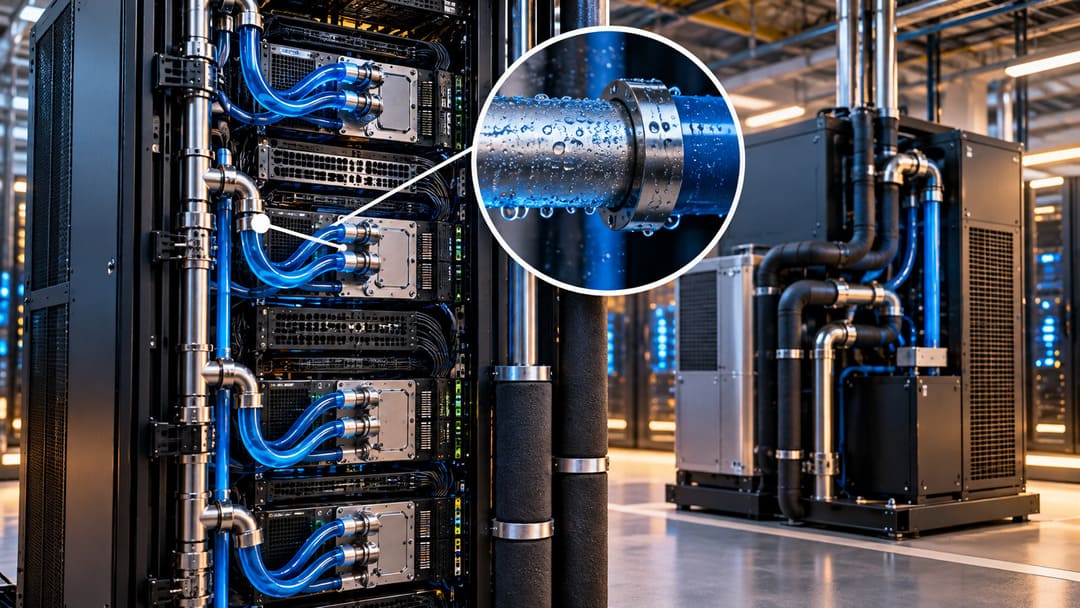
A liquid-cooled AI rack can develop moisture without a coolant leak. If an exposed hose, fitting or manifold becomes colder than the dew point of the surrounding air, water vapor can condense on its surface. That creates a different failure risk from a broken seal: the cooling circuit may remain intact while moisture forms outside it.
Direct-to-chip cooling moves heat from powerful processors into a circulating liquid. This helps facilities manage dense computing hardware, but it also creates a new operating boundary. Keeping chips within their approved temperatures is only half the job. Operators must also prevent accessible cold surfaces from falling into a range where room humidity becomes liquid water.
Warmer supply liquid may make condensation less likely and can reduce the amount of mechanical chilling required in some designs. But increasing the temperature too far can exceed a particular server’s approved thermal envelope. HW Server’s earlier analysis of warmer AI data center cooling addresses that efficiency tradeoff; the operational issue here is how to maintain a safe range when humidity and workloads change.
Dew Point, Not Just Room Temperature, Sets the Moisture Limit
Dew point is the temperature at which air reaches saturation as it cools. When a surface is below the local air’s dew point, moisture can collect on it. ASHRAE’s guidance on insulating liquid-cooling equipment describes insulation as a way to prevent condensation where cooler surfaces operate below ambient dew point.
Consider a hypothetical rack area with an 18°C air dew point. An uninsulated fitting at 16°C is below that threshold and can collect condensation; a fitting at 22°C is above it under the same air conditions. These illustrative temperatures are not prescribed server settings. The allowable coolant range and safety margin come from the equipment and facility design.
A dry-looking rack is not proof that the controls are adequate. Room humidity can change with ventilation, door opening, seasonal weather or a failed humidity-control component. A sensor far from the affected equipment may miss the conditions at a cold fitting or pipe penetration.
Warmer Liquid Helps, but the Server Still Has Limits
The move toward warm-water direct cooling is one reason dew-point management deserves attention. In its ThinkSystem SC777 V4 Neptune product guide, Lenovo describes a direct-water-cooled AI server designed for water inlet temperatures up to 45°C, with the lower boundary constrained by the dew point. That is a product-specific operating description, not permission to apply 45°C or any other setpoint to every accelerator platform.
A coolant distribution unit (CDU) may transfer heat between the server-side loop and facility water while controlling supply temperature and flow. The minimum allowable temperature must account for the coldest exposed surface, not just the temperature reported by one sensor at the CDU.
A Cold-Plate Humidity Test Is Not a Whole-Rack Guarantee
The Open Compute Project cold-plate test specification includes humidity exposure alongside leakage, pressure, thermal and reliability tests. That is valuable evidence about the component under specified test conditions. The document also limits its scope to design and prototype qualification; it does not certify every installed pipe, seal, CDU controller or room-level humidity response.
This distinction matters during procurement. Passing a cold-plate test is different from demonstrating that the assembled rack avoids condensation during a real moisture excursion, sensor failure or change of coolant setpoint. Equipment qualification and site commissioning answer different questions, and both are needed.
Commission the Humidity and Cooling Controls Together
A robust design connects facility conditions to the cooling controls rather than treating humidity as a separate building-maintenance reading. Schneider Electric’s AI liquid-cooling controls reference design explicitly addresses CDU controls and their integration with building and infrastructure management systems. The exact alarm logic and response still require approval for the specific installation.
Before reducing coolant temperatures or approving a new AI pod, qualified operations teams should:
- Confirm operating limits. Establish the approved supply-temperature range for every connected server, cold plate, CDU and coolant circuit, including the required margin above local dew point.
- Measure actual conditions. Monitor temperature and humidity at relevant rack locations, and assess the coldest exposed hoses, couplings and manifolds rather than relying only on a room average.
- Test control responses. Verify how the system reacts to rising dew point, failed sensors, lost facility-water control and high chip temperatures, using an approved non-damaging commissioning procedure.
- Protect exposed surfaces. Check insulation, vapor seals, leak detection and maintenance access where the design requires them. Condensation monitoring and coolant-leak alarms solve different problems.
- Document safe operation. Record operating trends, alarms and fallback actions so technicians know which fault needs investigation before a setpoint is changed.
These checks are especially important in older rooms. HW Server’s data center retrofit assessment explains how inherited mechanical systems and partial monitoring complicate dense-compute upgrades. Adding a CDU does not automatically close those facility gaps.
The useful rule is to evaluate the cooling system from both ends: prove that the coolant can remove enough heat from the processors, and prove that exposed surfaces remain protected from the moisture conditions around the rack. A safe temperature setpoint must satisfy both requirements.