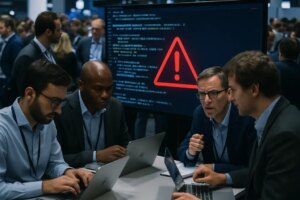
AI Hacking Tools have turned artificial intelligence policy from a debate about chatbots into a debate about national cyber exposure. The concern is no longer just whether models write convincing text; it is whether powerful systems can identify software vulnerabilities, help automate exploitation, and force governments to rethink how advanced AI should be reviewed before it reaches sensitive users.
Why AI Hacking Tools Are Forcing A Policy Reset
For much of the AI boom, public attention centered on productivity, creative disruption, search, education, and workplace automation. Those issues still matter, but the sharper security question is arriving fast: what happens when an AI model performs like an elite vulnerability hunter at machine speed?
That is the core anxiety behind the latest White House rethink. AI tools built for coding, security analysis, and technical reasoning can help defenders find flaws faster. They can also give attackers better reconnaissance, cleaner exploit paths, and more confidence when probing unfamiliar systems. The same capability can harden infrastructure or weaken it, depending on who uses it and how much access they receive.
I see this as the moment when AI safety becomes less abstract. It is no longer only about bias, misinformation, or speculative existential danger. It is about production networks, unpatched systems, federal procurement, cloud platforms, and the software dependencies that keep banks, hospitals, utilities, and government services running. That is why the policy conversation has acquired new urgency.
The latest alarm around AI Hacking Tools suggests that Washington is being pulled toward a harder question: should the most capable models face security review before deployment, especially when they can uncover vulnerabilities that human teams might miss for years?
The New Threat Is Not A Chatbot
The familiar image of AI risk is still a chat window producing a bad answer. That framing is too small. The more consequential risk is an AI system connected to code repositories, scanning tools, cloud logs, ticket queues, package dependencies, and automated workflows. Once AI moves from answering questions to taking technical action, the security implications change.
A chatbot can mislead. An agent can operate. That difference matters.
An advanced model that understands software deeply can explain insecure code, map attack surfaces, propose exploit chains, draft scripts, summarize patches, and triage vulnerabilities. In a responsible setting, that can strengthen defense. In the wrong hands, it can compress the learning curve for attackers. The issue is not magical cybercrime. It is acceleration.
Security teams already face an overwhelming backlog. Many organizations run outdated software, unmanaged assets, forgotten internet-facing services, and weak access controls. AI does not need to invent new vulnerabilities to create damage. It can make old weaknesses easier to find and exploit. That is where the real pressure appears.

Why The White House Is Reconsidering Oversight
The reported policy reset reflects a practical reality: a deregulatory posture becomes harder to defend when advanced models begin looking like cyber capability multipliers. Political leaders can argue over innovation policy, but cyber incidents have a way of making ideology look thin.
The emerging discussion appears focused on stronger oversight for powerful AI systems that can identify software vulnerabilities and support advanced technical workflows. That may include safety testing, federal procurement conditions, model evaluation programs, or additional review mechanisms for high-risk systems. The exact policy path remains unsettled, but the direction is clear enough: cyber risk is becoming central to AI governance.
This is not the same as banning advanced AI. It is closer to asking whether some models need structured testing before they are deployed into sensitive environments. The government already treats certain technologies differently when they affect national security, financial stability, aviation, medicine, or critical infrastructure. Powerful AI is drifting into that category.
The federal role also reflects an asymmetry problem. Private companies may understand their models, but governments bear consequences when critical infrastructure is disrupted. A model release that improves one company’s market position may also affect hospitals, utilities, public agencies, and financial systems. That creates a public interest in evaluation.
This is why frontier AI national security testing is becoming more than a policy phrase. It points toward a future where the most powerful systems are tested not only for consumer safety, but for cyber capabilities that could alter the balance between attackers and defenders.
Automated Vulnerability Discovery Changes The Timeline
Cybersecurity has always been a race between discovery, disclosure, patching, and exploitation. AI threatens to change the speed of every stage. If models can scan code, identify likely weaknesses, and suggest exploit paths faster than human teams, the patch window narrows.
That changes how organizations should think about vulnerability management. A flaw that once required rare expertise to identify may become easier to surface. A misconfiguration that sat unnoticed may become visible to automated systems. A legacy bug buried deep in old software may become searchable in a new way. Defenders can use that capability, but so can adversaries.
The danger is not only technical. It is operational. Many organizations are slow at patching because of downtime concerns, dependency conflicts, staffing limits, change-control procedures, and unclear asset inventories. AI does not remove those bottlenecks. It intensifies the cost of leaving them unresolved.
This creates a harsh reality for security leaders. If attackers become faster and defenders remain bureaucratically slow, risk expands. The answer is not panic. It is discipline: better asset management, faster prioritization, stronger segmentation, clearer ownership, and more realistic incident planning.
The organizations most exposed are not necessarily those with the most advanced technology. They are often those with poor visibility. You cannot defend what you cannot see. AI-powered discovery will punish that blindness.
The Dual-Use Problem Is The Center Of The Debate
AI cybersecurity tools are difficult to regulate because their value and danger often come from the same function. A model that finds vulnerabilities can save a company from breach. The same model can help an attacker locate weak points. A system that writes exploit-like proof-of-concept code can help validate a patch. It can also help weaponize a flaw.
That dual-use nature makes simplistic policy ineffective. If rules are too loose, dangerous capability spreads without enough safeguards. If rules are too restrictive, defenders may lose access to tools they need. The hard part is separating legitimate defensive intent from negligent or malicious deployment.
Access control will be central. Not every user should receive the same model capability, tool access, or operational permissions. A vetted security team working inside a controlled enterprise environment is different from an anonymous user asking for exploit guidance. Policy needs to reflect that difference.
Model providers will also need stronger internal controls. That includes usage monitoring, abuse detection, safety tuning, red-team testing, customer verification, and careful handling of high-risk requests. None of these measures is perfect. Together, they create friction against misuse.
The public debate often asks whether AI is good or bad for security. The better question is: who gets capability, under what conditions, with what accountability?
What Enterprises Should Do Now
Businesses should not wait for Washington to settle the entire question. AI-enabled cyber risk is already becoming part of enterprise security planning. Waiting for perfect rules is a weak strategy.
The first step is to inventory where AI tools are already used. Developers may be using coding assistants. Security teams may be testing automated triage tools. Vendors may be embedding AI into monitoring platforms. Employees may be pasting logs or code into external systems. Each use case creates a different profile.
The second step is to classify access. An AI assistant that drafts documentation is not the same as an AI agent that can inspect repositories, execute commands, or modify infrastructure. Tool permissions should be narrow, logged, and reviewable. High-impact actions should require human approval.
The third step is to strengthen vulnerability operations. If AI makes weaknesses easier to find, patching discipline becomes more valuable. Companies should prioritize known exploited vulnerabilities, internet-facing systems, identity infrastructure, remote access tools, and widely used third-party components.
The fourth step is to connect cyber governance with broader technology dependency. AI security is tied to chips, cloud capacity, software supply chains, model providers, and geopolitical exposure. Leaders building a more complete view can place cyber decisions beside AI infrastructure and supply-chain risk rather than treating them as separate problems.
The fifth step is to test assumptions. Tabletop exercises should include AI-assisted attacks, faster vulnerability discovery, synthetic phishing, automated reconnaissance, and compromised AI tools. If a response plan only works against yesterday’s attacker, it is not ready.
Why Federal Procurement Could Become A Control Point
One of the most practical ways government can influence AI security is through procurement. Federal agencies buy software, cloud services, security tools, and AI systems. If procurement rules require model evaluation, logging, vulnerability disclosure, access controls, or secure deployment standards, vendors will adapt.
This approach can avoid some of the problems of broad regulation. Instead of trying to control every AI system in the economy, the government can set requirements for systems used in public-sector environments. Those requirements often spill into the private sector because vendors prefer common standards.
Procurement also forces specificity. A general speech about AI safety can remain vague. A contract requirement has to define what must be tested, documented, logged, or reported. That kind of detail is where real governance begins.
The most credible path will likely combine model testing, secure deployment practices, incident reporting, and vendor transparency. No single measure solves the problem. A layered approach has a better chance.
The Innovation Argument Is Real, But Incomplete
Some AI developers and investors will argue that oversight slows innovation. That concern is not empty. Heavy regulation can make it harder for smaller companies to compete, delay useful tools, and push development into less transparent environments. A clumsy approval system could damage the very security improvements it aims to protect.
Yet the opposite argument is also incomplete. Speed alone is not a security strategy. If powerful models are deployed without understanding their cyber capabilities, the market may move faster than the institutions responsible for public safety. That can create a backlash more damaging than early oversight would have been.
The right question is not regulation versus innovation. It is what kind of review fits the level of risk. A general-purpose writing model should not be treated like a system that can autonomously discover and exploit vulnerabilities. A narrowly deployed enterprise security model should not be treated like an unrestricted public model. Precision matters.
Good oversight should be capability-based, not fear-based. It should focus on what systems can actually do, how they are accessed, how they are monitored, and where they are deployed. That requires technical competence from regulators and honesty from companies.
The best outcome is not slower AI. It is safer acceleration.
The Defender’s Opportunity
The same tools raising alarms could also strengthen cybersecurity if deployed responsibly. AI can help overwhelmed defenders analyze alerts, explain unfamiliar code, summarize threat intelligence, prioritize patches, generate detection logic, and identify exposed assets. In a world with chronic security labor shortages, that matters.
But this opportunity depends on governance. If defenders use tools they do not understand, feed sensitive data into systems without controls, or allow agents to act without review, they may create new weaknesses. The defense advantage appears only when AI is paired with operational maturity.
That is the uncomfortable truth. AI can amplify competence. It can also amplify chaos.
Security leaders should therefore treat AI as a force multiplier, not a substitute for fundamentals. Asset inventory, patching, identity controls, backups, segmentation, logging, and incident response remain essential. AI can help improve those areas, but it cannot replace them.
What To Watch Next
The next few months should reveal whether the White House moves from review to action. Watch for an executive order focused on AI security, procurement language affecting federal AI use, expanded model evaluation programs, or new standards for powerful systems with cyber capabilities.
Also watch how AI companies respond. Some may embrace evaluation as a trust signal. Others may argue that government review threatens competitiveness. The divide will show which firms believe security oversight can become part of the market and which see it mainly as a constraint.
Another key signal will come from security researchers. If AI systems continue demonstrating stronger vulnerability discovery, pressure for oversight will grow. If the threat appears more limited or manageable, policy may become narrower. Either way, the technical evidence will shape the debate.
Enterprises should track insurance, compliance, and vendor requirements too. Cyber insurers may begin asking whether organizations use AI coding tools, AI agents, or AI-powered security products. Regulators may ask how model access is controlled. Customers may ask whether AI systems touch sensitive data or infrastructure. The governance burden will not stay in Washington.
The final signal is adversary behavior. If criminal or state-linked groups begin using AI to accelerate exploitation at scale, the policy conversation will harden quickly. Governments usually move faster after visible incidents. Wise organizations prepare before that point.
The Next AI Threat Is Operational
AI Hacking Tools are forcing a White House reset because they expose the gap between AI enthusiasm and cyber readiness. The danger is not that every advanced model becomes a weapon overnight. The danger is that powerful technical capability spreads into a software ecosystem already full of neglected vulnerabilities, weak controls, and slow remediation cycles.
The opportunity is just as real. If handled well, AI can help defenders find and fix weaknesses faster than attackers exploit them. It can improve triage, reduce noise, strengthen patch prioritization, and make security expertise more widely available. But that outcome depends on serious governance, controlled access, and a willingness to treat cybersecurity as a central part of AI policy.
The next phase of AI will not be judged only by how impressive models sound in a demo. It will be judged by whether they can be deployed without destabilizing the systems that society depends on. AI Hacking Tools have made that test unavoidable, and the organizations that respond early will be far better positioned than those waiting for the first automated cyber crisis to force their hand.