The most dangerous vulnerabilities in an enterprise environment are not always the ones with the highest theoretical severity. They are the ones already being exploited, moving from technical weakness to operational threat in real time. That is why I believe KEV-listed vulnerabilities deserve a place at the very top of every remediation queue today.
Security teams are drowning in exposure data. Vulnerability scanners generate sprawling backlogs, asset inventories remain incomplete, and patch programs are often judged by volume rather than by risk reduction. In that environment, prioritization becomes the entire game. The practical value of the Known Exploited Vulnerabilities model is that it cuts through ambiguity and identifies flaws that have crossed the most important threshold in cybersecurity: they are no longer hypothetical.
The Difference Between Vulnerable And Actively Exploitable
For years, vulnerability management has leaned heavily on scoring systems, exploitability assumptions, and broad severity labels. Those tools remain useful, but they are imperfect proxies for danger. A critical vulnerability with no current exploitation path may still matter, but it does not carry the same urgency as a flaw that attackers are already weaponizing against real targets.
That is the essential distinction that changes the conversation. Once a vulnerability lands on the KEV-listed vulnerabilities catalog, it signals something far more actionable than a high CVSS number. It tells defenders that exploitation is happening in the wild, which means delay is no longer a tolerable administrative choice. It becomes a business risk decision with immediate consequences.
I have seen too many organizations struggle because they treat vulnerability remediation as a compliance exercise rather than a live operational defense function. They patch what is easiest, what is oldest, or what looks best in quarterly reporting. Attackers, meanwhile, exploit what works. That mismatch is where compromise happens.
Why KEV Changes Patch Prioritization
A modern enterprise may have thousands or even tens of thousands of open findings at any given moment. No team can fix everything at once. The real challenge is deciding what must be addressed first, what can be scheduled, and what may require compensating controls until a full remediation window opens.
KEV changes that calculus by giving defenders a practical risk signal anchored in active exploitation. It does not eliminate the need for broader context such as asset value, exposure surface, or business criticality. But it sharpens the first cut in a way most security programs desperately need.
If a vulnerability affects an internet-facing system, a core identity platform, a remote access product, or a business-critical application, and it is already known to be exploited, the debate should be over. That issue belongs in the highest remediation tier. This is not simply about patch hygiene. It is about interrupting attack paths before they become incidents.
The value here is not theoretical elegance. It is operational clarity. KEV allows security leaders to direct scarce engineering effort toward the subset of vulnerabilities most likely to translate into intrusion, ransomware deployment, credential theft, or lateral movement. In a crowded patch calendar, that clarity matters.
The Cost Of Treating KEV As Just Another Data Feed
One of the most common mistakes I see is the tendency to fold KEV into the broader vulnerability backlog without changing workflow, urgency, or executive visibility. When that happens, known exploited flaws compete with every other finding for attention, and the advantage of prioritization is lost.
That is a dangerous posture. An exploited vulnerability should trigger an elevated response model. It should move faster through validation, owner assignment, and remediation tracking. It should also be visible beyond the security team. Infrastructure leaders, application owners, IT operations, and executive stakeholders should understand that these are not ordinary patch tickets. They are active defensive priorities.
Organizations that fail here often do so for familiar reasons: fragile legacy systems, fear of downtime, change management bottlenecks, limited staffing, or uncertainty around asset ownership. Those constraints are real, but attackers do not pause for internal process friction. A known exploited vulnerability on a neglected system does not become safer because the maintenance window is inconvenient.
What A Mature KEV Response Looks Like
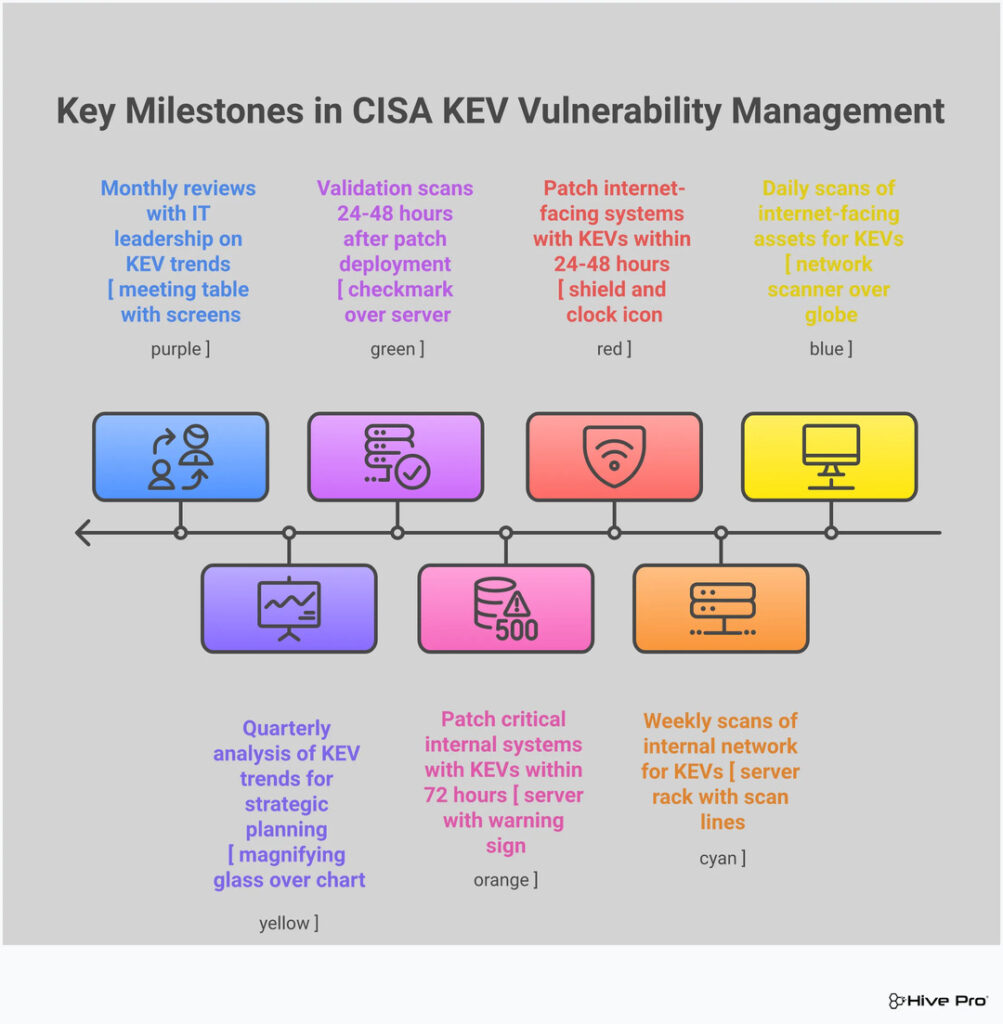
A mature program treats KEV as a standing high-priority intake stream, not as periodic threat intelligence reading. The moment a new item affects the environment, the question should not be whether it matters. The question should be where it exists, how exposed it is, and how quickly it can be contained or remediated.
That requires more than patching discipline. It requires strong asset visibility, reliable vulnerability-to-asset mapping, and clear ownership across infrastructure and application teams. It also demands the ability to act when a patch is not immediately feasible. In those cases, segmentation, access restrictions, feature disablement, virtual patching, internet isolation, and enhanced monitoring become essential stopgaps rather than optional extras.
The strongest teams also resist the false comfort of closure once a patch is deployed. Known exploited vulnerabilities deserve follow-through. I want to see validation that the fix reached all affected systems, checks for signs of pre-remediation compromise, and confirmation that temporary mitigations have been removed or formalized appropriately. Attackers often move quickly once a flaw becomes public, and a late patch does not always erase the need for forensic review.
Why This Matters To Leadership Right Now
KEV should not be viewed as a technical list for specialists alone. It is a management instrument. It gives leadership a defensible way to align remediation resources with real-world threat activity, which is exactly what boards and executives increasingly expect from cyber risk programs.
In practical terms, treating KEV-listed vulnerabilities as top-tier remediation items improves decision quality. It reduces wasted effort on lower-value patching, strengthens incident prevention, and provides a measurable standard for urgency. It also helps security leaders explain why one system must be fixed tonight while another can wait for the next cycle.
That is especially important in an era when ransomware crews, extortion groups, and opportunistic intruders routinely exploit recently disclosed weaknesses before many organizations have even completed internal triage. The window between disclosure and weaponization has narrowed. The margin for indecision has narrowed with it.
The Remediation Standard That Matters Most
The cybersecurity industry often talks about prioritization, but not all prioritization models are equally useful under pressure. In my view, KEV provides one of the clearest and most actionable standards available because it is rooted in demonstrated adversary behavior rather than abstract possibility.
That is why this matters right now. Every security program is making choices under constraint, and those choices determine whether a vulnerability remains a dashboard statistic or becomes tomorrow’s incident report. When a flaw is already being exploited, urgency is no longer subjective. KEV-listed vulnerabilities are the clearest signal most organizations will get that remediation cannot wait.