


The OpenAI Singapore lab is not just another office opening; it is a signal that the AI race is becoming more regional, operational, and politically strategic. OpenAI’s decision to place its first Applied AI Lab outside the United States in Singapore tells us that frontier AI companies are no longer competing only through model releases. They are competing through deployment hubs, talent pipelines, government partnerships, and trust in local institutions.
The OpenAI Singapore Lab Shows The AI Race Is Spreading Out
The OpenAI Singapore lab matters because it changes the geography of AI competition. For much of the public, the AI race still feels centered on San Francisco, Seattle, Washington, and a handful of chip and cloud corridors. Singapore’s role in this story shows a different pattern: major AI companies are looking for places where policy, enterprise demand, technical talent, and regional access line up.
That does not mean the United States is losing its central role. It means the next phase of AI will be less about one country hosting the entire conversation and more about a distributed network of applied deployment centers. The key phrase here is “applied.” OpenAI is not simply planting a flag. It is building a place where AI systems can be adapted to real business, public-sector, and regional use cases.
That is why this is a global AI power map story, not only a company expansion story.
Why Singapore Became The Logical Test Bed
Singapore is a natural fit because it has spent years positioning itself as a serious technology, finance, logistics, and governance hub. It also sits in a region where AI adoption will not look exactly like adoption in the United States or Europe. Southeast Asia has different languages, business structures, regulatory needs, infrastructure gaps, and public-service priorities.
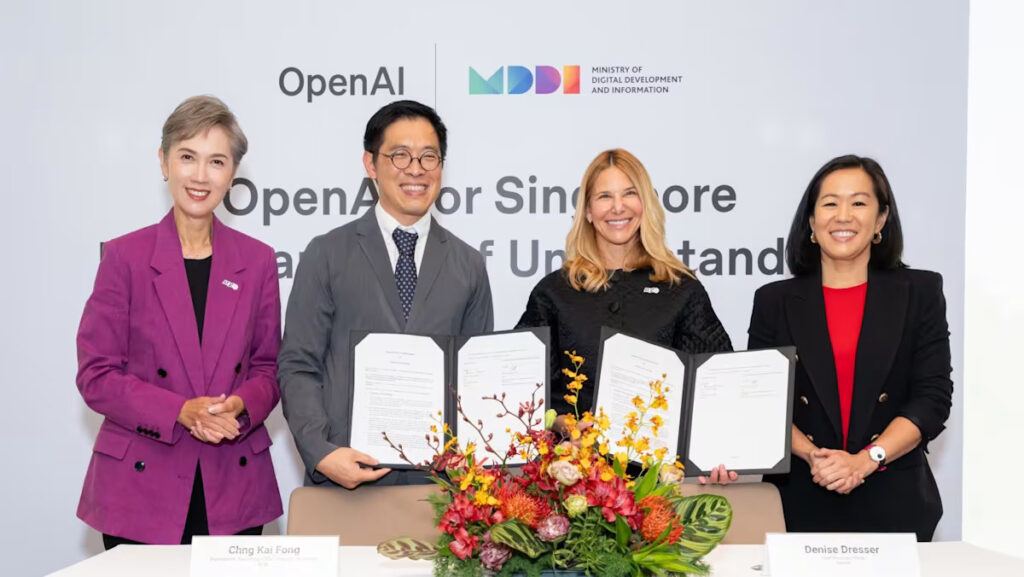
OpenAI’s own OpenAI for Singapore initiative frames the move around partnership with Singapore’s Ministry of Digital Development and Information, a commitment of more than S$300 million, and support for Singapore’s national AI strategy. The initiative includes frontier AI deployment, local talent development, and wider access for businesses and citizens.
That combination is important. It suggests that OpenAI wants more than market entry. It wants a regional operating model where AI is tested against practical problems: public services, finance, healthcare, digital infrastructure, small-business operations, and workforce development.
From AI Demos To Deployment Pressure
The most important shift here is from AI as a demonstration product to AI as an implementation challenge. Demos are easy to understand. A chatbot answers a question. A tool writes a draft. A model summarizes a file. But applied AI is messier because it has to survive contact with data quality, compliance, customer expectations, workflow design, and human accountability.
That is where Singapore could become a useful proving ground. A country with strong institutions and a compact market can move faster than larger jurisdictions while still demanding a high level of governance. For OpenAI, that creates a chance to show that frontier AI can move from impressive software into structured adoption.
The real test is deployment over demos. If the lab helps organizations solve concrete problems without creating confusion, compliance failures, or public distrust, the Singapore model may become more influential than the announcement itself.
| Comparison Point | U.S.-Centered AI Race | Singapore Applied AI Hub |
|---|---|---|
| Main emphasis | Frontier model development and platform scale | Real-world deployment and regional adaptation |
| Strategic value | Research leadership, capital, cloud infrastructure | Trust, governance, enterprise access, Asia-Pacific reach |
| Main challenge | Safety, competition, regulation, infrastructure demand | Talent depth, localization, sector-specific adoption |
| Reader takeaway | AI leadership still starts with capability | AI influence increasingly depends on practical adoption |
The table shows the larger story: AI power is no longer measured only by who builds the most capable model. It is also measured by who can make that model useful, trusted, and deployable in different markets.
The Talent Fight Is Becoming More Local
Every major AI expansion is also a talent story. OpenAI’s Singapore plan includes more than 200 Singapore-based technical roles over the next few years, with the lab positioned around forward-deployed engineering. That phrase matters because it describes a role sitting between frontier research and customer implementation.
These are not simply sales jobs. Forward-deployed engineers help translate advanced AI capabilities into real operational systems. They need technical judgment, product sense, customer understanding, and the ability to work inside complicated institutional environments.
That creates talent pipeline pressure for Singapore and the wider region. If the lab succeeds, it could help train a new class of AI deployment specialists who understand both frontier tools and local business realities. If talent supply cannot keep up, the expansion could expose a familiar bottleneck: demand for AI transformation rising faster than the workforce needed to deliver it responsibly.
The Regulatory Angle May Be Just As Important
Singapore’s AI positioning is not only about attracting companies. It is also about becoming a credible venue for responsible adoption. The country has been discussing ideas such as AI product labeling, testing frameworks, and clearer signals around appropriate use. That matters because companies want markets where they can innovate without operating in regulatory fog.
This is where regulation-ready AI adoption becomes a competitive advantage. Governments do not need to smother AI development to shape it. They can create clearer expectations around evaluation, transparency, sector readiness, and user protection. For a company like OpenAI, that kind of environment may be valuable because it reduces uncertainty while giving the firm a place to demonstrate responsible deployment.
There is also a legal parallel worth noting. As AI tools move into formal systems, institutions have to decide how much machine assistance they can absorb before accountability breaks down. That concern is already visible in debates around AI legal tools and courtroom readiness, where the promise of access sits beside the risk of bad filings, false confidence, and procedural confusion.
The Signal To Watch Is Whether Singapore Becomes A Template
The next question is whether this becomes a one-off expansion or a repeatable model. If OpenAI can use Singapore to build applied expertise, deepen public-sector relationships, support small businesses, and create trusted enterprise deployments, other countries will study the playbook closely.
For readers, the most important signal is not the size of the investment alone. It is whether the lab produces visible use cases that feel credible outside the announcement cycle. Watch for sector-specific partnerships, local talent programs, small-business adoption efforts, and public-service applications that show AI creating measurable value without weakening trust.
The risk is that global AI expansion turns into a race for influence without enough attention to governance. The opportunity is that countries like Singapore can push the industry toward a more disciplined model where governance becomes strategy, not an afterthought.
The OpenAI Singapore lab is a marker of where the AI race is heading next. The United States will remain central to frontier model development, but applied AI influence will increasingly belong to places that can combine talent, trust, regulation, and real-world adoption. For Singapore, the move strengthens its claim as an Asia-Pacific AI hub. For OpenAI, it is a test of whether global expansion can produce more than headlines. For everyone watching the industry, the bigger lesson is clear: the AI race is no longer just about who builds the smartest system, but who can make it work responsibly in the real world.



