AI agent hardware is no longer a far-off prototype idea. Microsoft’s Project Solara points to a workplace future where AI agents do not just live inside laptops, cloud dashboards, or chat windows — they sit on desks, hang from badges, listen to meetings, authenticate workers, and connect physical spaces to enterprise software.
That is why this matters beyond another Microsoft product reveal. The same hardware pressure behind Windows laptops becoming Nvidia’s new AI battleground is now moving into smaller, always-present workplace devices that could make AI feel less like software and more like infrastructure.
Microsoft Is Treating Agents Like a Hardware Category
Project Solara is interesting because it does not treat AI agents as another app feature. It treats them as a reason to rethink the device itself.
Microsoft has described Solara as a chip-to-cloud platform for agent-first devices. That language matters. A normal device is built around apps, screens, menus, and user commands. An agent-first device is built around context, identity, sensors, and task flow.
That is a meaningful break from the PC model. The PC waits for the user to open software. A Solara-style device is designed to bring agents into the moment: at a desk, in a meeting, on a retail floor, inside a hospital, or across a mobile workplace.
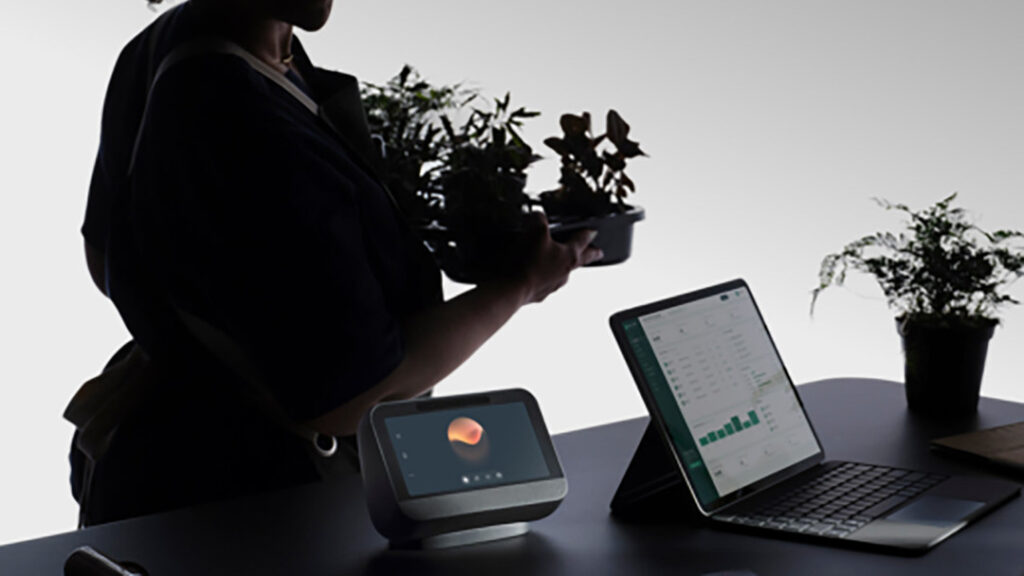
The early concepts show Microsoft thinking beyond traditional computers. A desk device could sit beside a workstation and surface agent-driven assistance. A wearable badge could bring AI into mobile work, with microphones, a camera, wireless connectivity, and biometric access.
That is not just a new gadget category. The device becomes the interface, and the agent becomes the software layer behind it.
Why AI Agent Hardware Changes Security
AI agent hardware creates a different risk profile than AI software running on a laptop.
A laptop is already part of enterprise device management. IT teams understand its operating system, patching model, permissions, endpoint security, and lifecycle. A badge-like AI device or desk companion introduces a more sensitive mix of sensors, identity, and workplace presence.
The security question is not only whether the device can be hacked. The bigger issue is what the device is allowed to observe, remember, transmit, and trigger.
A wearable that can capture hallway conversations is not just a productivity tool. It is a mobile recording point. A desk device that uses face authentication is not just convenient. It becomes part of the identity layer. A device connected to enterprise agents is not just a screen. It becomes a gateway into corporate workflows.
That makes governance harder. Companies will need clear policies for recording consent, transcript handling, data retention, identity verification, employee monitoring, and device access.
Microsoft’s Project Solara platform framing leans on enterprise manageability, security, privacy controls, biometric authentication, and agent access. That is the right direction, but the fact that those controls are necessary shows how sensitive this category could become.
The core tradeoff is simple: ambient AI creates exposure. The more naturally an agent fits into the workplace, the more carefully that workplace has to define its boundaries.
The Badge Is the Most Sensitive Form Factor
The wearable badge concept is the clearest sign that AI hardware is moving into uncomfortable territory.
Access badges already carry workplace identity. They unlock doors, confirm employment status, and move with workers through offices, stores, hospitals, warehouses, and campuses. Adding AI agent access turns the badge from a passive credential into an active computing device.
That could be genuinely useful. A nurse could capture a note without returning to a workstation. A retail manager could get task updates while walking the floor. A technician could document a field issue without juggling a phone. A knowledge worker could record a quick discussion and generate follow-up items.
But each benefit carries a matching concern. Who controls the recording? Where does the transcript go? Can the worker disable it? Does the organization monitor usage? Can guests, patients, customers, or coworkers tell when capture is happening?
These questions decide whether AI agent hardware feels like a helpful tool or a surveillance accessory. The badge is powerful because it follows the user. That is also why it is risky. Mobility raises stakes when identity, microphones, cameras, and enterprise agents sit inside one small device.
Desk Devices Could Become the New Enterprise Endpoint
The desk concept may look less provocative than the wearable badge, but it could matter more for enterprise IT.
A desk-based AI device sits in the same physical zone as the worker’s monitor, phone, keyboard, and meeting tools. It can act as a companion to the PC, a lightweight access point to agents, or a specialized client for cloud workflows.
That makes it part of endpoint strategy. Companies will have to manage it like they manage laptops, phones, conference-room systems, and shared devices. If the device is tied to calendars, messages, documents, or agents, it cannot be treated as a smart speaker with a business logo.
This is where endpoint management becomes central. Tools such as Microsoft Intune already help organizations manage and secure devices and apps. AI agent hardware will test whether those frameworks can stretch into devices that are not quite PCs, not quite phones, and not quite traditional IoT hardware.
The challenge will be consistency. A company may eventually manage laptops, tablets, desk agents, badge agents, room devices, and cloud PCs together. Each device may have different sensors, permissions, update cycles, and risk levels.
That creates a new operational question: how many AI access points can an enterprise support before manageability becomes the bottleneck?
The Real Battle Is Not Apps Versus Agents
The easiest way to describe Solara is “AI agents replacing apps,” but that is too simple.
Apps will not disappear. Enterprises still need structured software, databases, workflows, dashboards, and interfaces. What changes is how workers reach those systems. Instead of opening five tools to finish a task, an employee may ask an agent to coordinate across them.
That makes the agent a control layer. The device becomes the place where that control layer appears.
This is why Microsoft’s move matters strategically. If agents become the main way workers interact with digital systems, the company that controls the agent hardware layer gains influence over identity, context, workflow routing, user experience, and enterprise governance.
That is not a small prize. It is the same kind of platform leverage created by operating systems, browsers, mobile app stores, and cloud dashboards in earlier computing eras.
The difference is that this platform may not live on one screen. It could live across a laptop, a desk companion, a badge, a meeting-room display, a headset, and a cloud workspace.
Enterprises Should Watch the Pilot Phase Closely
The most important signals will come from real workplace testing, not polished concept videos.
The first signal is user comfort. If workers feel AI agent devices make tasks easier without making them feel watched, adoption becomes possible. If the devices create anxiety around recording, biometric access, or management oversight, resistance will grow quickly.
The second signal is administrative clarity. IT teams need enrollment, permissions, updates, audit logs, privacy controls, and retirement procedures that fit existing security practices. A device category that creates too many exceptions will struggle, even if the hardware is clever.
The third signal is workflow value. AI agent hardware has to solve problems that phones and laptops do not already solve well. Capturing in-person work, surfacing urgent context, reducing administrative friction, and helping mobile workers may be strong use cases. Repackaging a chatbot in a new shell will not be enough.
AI agent hardware is exciting because it pulls artificial intelligence closer to the actual work people do. It is risky for the same reason. Microsoft’s Project Solara may still be early, but it makes one thing clear: the next AI platform fight will not stay inside the laptop. It will move into the physical workplace, where hardware design, employee trust, endpoint security, and governance will decide whether AI agents become useful colleagues or devices people quietly learn to avoid.