


Here’s a manufacturing reality check that hits harder than a Monday morning alarm: 94% of manufacturers see the value in edge computing, but only 10% have actual strategies. It’s like everyone knows they need to exercise, but most just watch videos on their couch.
Our factory floors are generating data faster than a TikTok trend goes viral. Robots, sensors, and AI-powered gear create an endless stream of information that needs immediate processing. Sending everything to the cloud? That’s like trying to run a NASCAR pit crew with dial-up internet.
Industrial edge servers are becoming the secret weapon for manufacturers who actually want to compete. They process data right where it’s born – on the shop floor. This isn’t just about convenience. It’s about survival in an industry where milliseconds can mean millions.
The factory is transforming into the new data center. Let’s break down what this seismic shift means for the future of making things in America.
Data-Powered Automation
Imagine if your assembly line could make decisions as fast as a day trader in a market crash. Welcome to the era of data-powered automation. Here, edge computing turns factories into smart systems that learn and adapt quickly.
Edge computing works right where data is created – at the source. This cuts out the slow cloud trips. It’s like giving your factory a brain of its own.
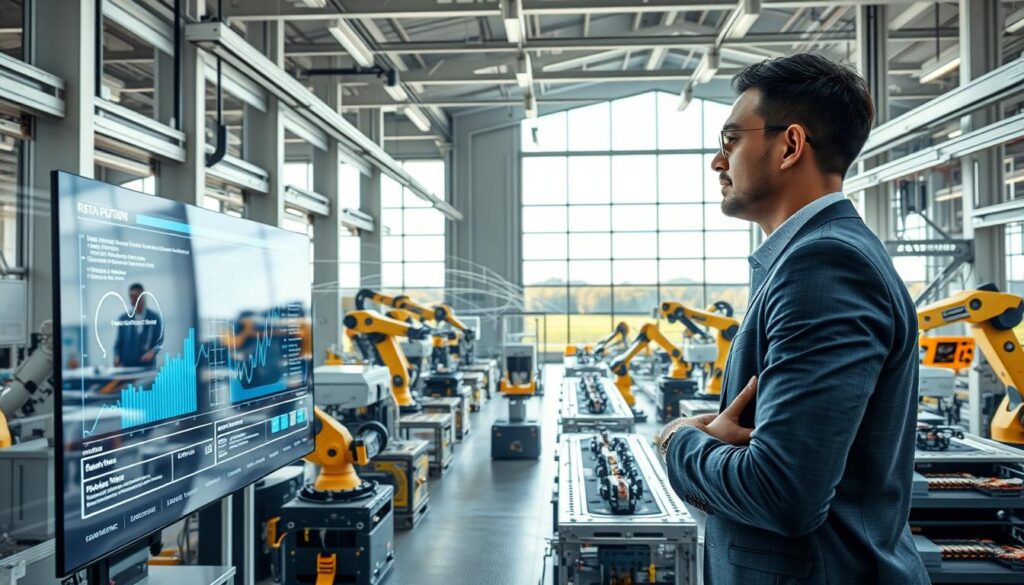
These systems don’t just follow orders. They predict, adjust, and optimize on their own. They can see when maintenance is needed before it’s too late. They also adjust production and energy use in real-time.
Let’s look at a real smart factory case study. An auto maker used edge devices on their line. They saw a 30% drop in downtime, 22% fewer quality issues, and 15% less energy cost. That’s a big leap forward.
The power of edge computing in manufacturing is its ability to keep going even when the cloud is down. It’s like having a team of superheroes who work better without their capes.
This isn’t old-school automation. It’s about making factories that learn from every action. They build knowledge faster than any Wall Street firm can.
Seeing these systems in action is truly magical. They’re not just replacing people – they’re making them smarter. They give operators superpowers to see things we can’t.
Predictive Maintenance
Remember when maintenance meant waiting for things to break? That’s old news. Today, industrial edge servers predict failures before they happen.
These systems check vibration patterns, thermal signs, and data with amazing accuracy. They can forecast when a bearing will fail in 83 hours. This gives you time to plan maintenance during off-peak hours.
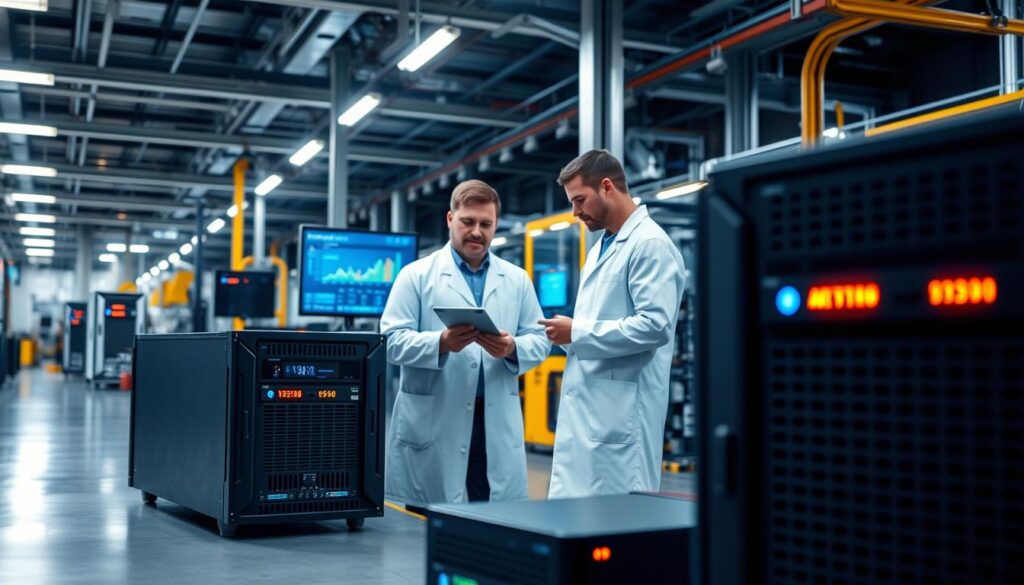
The magic comes from AI-driven analytics at the edge. Systems watch equipment in real-time. They predict failures before they happen. This turns maintenance from a cost into a strategic advantage.
Companies using edge AI-driven predictive maintenance see huge benefits. They cut downtime by up to 30%. That’s a game-changer.
Let’s compare predictive maintenance to old methods:
| Maintenance Type | Downtime Reduction | Cost Impact | Strategic Value |
|---|---|---|---|
| Reactive (Fix after break) | 0% | High emergency costs | None |
| Preventive (Scheduled) | 10-15% | Moderate planned costs | Low |
| Predictive (Edge AI) | 25-30% | Optimized spending | High strategic advantage |
The Dell AI Factory with NVIDIA is at the forefront of this tech. It lets manufacturers predict maintenance needs with precision. They can tackle equipment failures before they slow production.
This isn’t just about saving money. It’s about making manufacturing smarter and more resilient. Industrial edge servers turn maintenance into a science based on data.
Quality Control Use Cases
Remember when quality control meant humans searching for defects? Those days are over. Now, smart factories use edge computing for quality control. It’s like having super vision, but without the cape or music.
I looked at a smart factory case study that amazed me. Automated systems are now catching defects 20-25% better. That’s a huge leap forward.
These systems are amazing. They find defects that humans can’t see, checking thousands of items every hour. They spot tiny flaws, color issues, and size problems that would shock even the most precise experts.
The real magic is in real-time. Sensors on production lines catch problems right away. This means no bad products make it out. It’s like having a perfect quality inspector who never gets tired.
| Traditional QC | Edge-Powered QC | Improvement |
|---|---|---|
| Human visual inspection | AI computer vision | 25% better detection |
| Sampling-based checking | 100% real-time monitoring | Zero defects shipped |
| Reactive corrections | Instantaneous adjustments | 70% less waste |
| Static inspection criteria | Continuous learning system | Daily accuracy improvements |
These systems don’t just find problems – they get better at it. Each defect helps the AI improve. It’s like having a team that gets smarter every day without extra training.
The results are huge. Companies see near-perfect quality and cut costs by up to 40%. As shown in this analysis of smart factories, edge computing and AI are changing manufacturing. Quality is now built into every product.
This isn’t just about finding defects. It’s about making systems that prevent them. The future of quality in manufacturing is about perfection, built right into the process.
Implementation Tips
Ever watched a Hollywood blockbuster where the brilliant plan falls apart during execution? Edge computing implementations can feel like that – minus the dramatic soundtrack and attractive cast. Here’s how to avoid turning your smart factory dreams into a B-movie disaster.
First rule: start small but think big. Don’t try to boil the ocean on day one. Choose one pain point – maybe predictive maintenance or quality control – and build from there. This approach lets you learn, adapt, and scale without betting the entire factory on untested concepts.
The right industrial edge servers are your foundation. These aren’t your average data center hardware. They need to withstand factory conditions while delivering real-time processing power. Think of them as the special forces of computing – rugged, reliable, and mission-critical.
Now let’s address the corporate Cold War: IT vs OT. These departments often speak different languages and have competing priorities. The solution? Create a joint task force with clear objectives. When IT’s security concerns meet OT’s operational needs, magic happens. This convergence eliminates data silos and creates a unified architecture.
Security isn’t an afterthought – it’s your bedrock. Implement proven security solutions that protect everything from edge devices to cloud applications. Think defense in depth, not just a firewall at the perimeter.
Here’s your implementation checklist:
- Begin with proven technologies, not bleeding-edge experiments
- Establish clear metrics for success before deployment
- Choose scalable industrial edge servers that grow with your needs
- Develop a phased rollout plan with regular review points
- Create cross-functional teams that include both IT and OT staff
Remember what separates successful implementations from failed experiments: patience and measurable progress. The companies winning at edge started with focused use cases and scaled intelligently. They treated it as a marathon, not a sprint.
For deeper insights on preparing your organization, explore these seven essential strategies for edge computing. The journey might seem daunting, but the payoff – increased efficiency, reduced downtime, and smarter operations – makes every careful step worthwhile.
Your factory floor shouldn’t resemble a sci-fi movie set gone wrong. With the right approach, your edge implementation will look more like a well-orchestrated symphony than a garage band rehearsal.
Measured ROI
Let’s dive into the numbers that even your CFO will love. A 136% ROI over three years is real, not just a dream. It happens when edge computing meets the real world of manufacturing. Early adopters are seeing returns that make Wall Street jealous.
The edge computing market is booming, growing from $18.3 billion to a projected $112 billion by 2031. This isn’t just a trend; it’s a major shift in how smart money invests in industrial tech.
Every smart factory case study shows the same thing: the real ROI isn’t just in saving time or energy. It’s in the competitive edge you get from predictive maintenance and quality control. This would make Henry Ford incredibly happy.
Your data holds secrets about product design, plant performance, and customer preferences. These secrets could revolutionize your operations. The question is, can you afford to be behind with yesterday’s technology?
Look at any smart factory case study and you’ll see the same pattern. Companies are turning data into dollars while their competitors are still counting pennies. The edge isn’t coming; it’s already here, and it’s already paying for itself.



