
A widespread Cloudflare outage temporarily took down Uber Eats, Bet365, Steam and other major platforms, highlighting how dependent modern apps are on shared infrastructure.
A significant Cloudflare outage on Friday sent shockwaves across the internet, temporarily knocking out dozens of high-traffic platforms and reminding users just how fragile modern digital infrastructure can be.
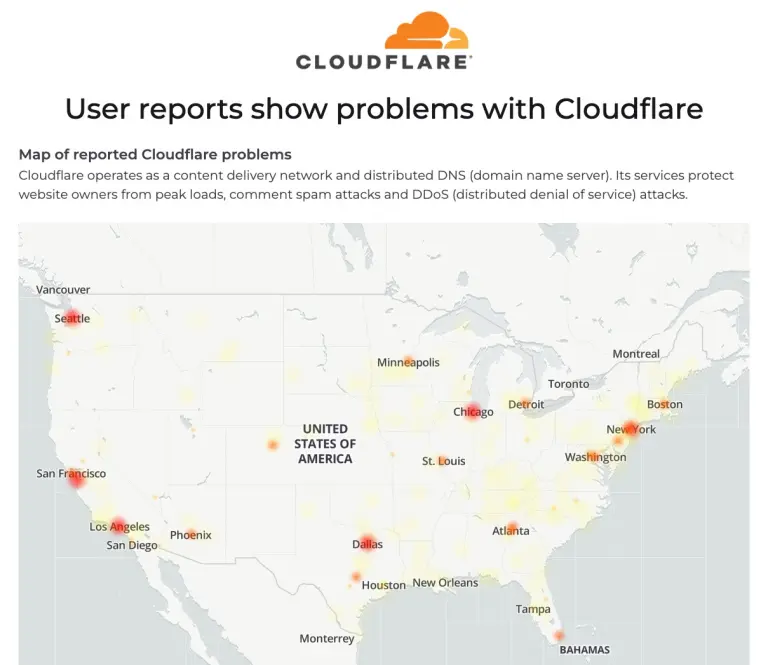
Among the services impacted were Uber Eats, online betting platform Bet365, gaming giant Steam, and even elements of Counter-Strike’s online ecosystem. For hours, users reported login failures, stalled transactions, and complete service disruptions.
According to outage tracking service Downdetector, Uber Eats generated thousands of complaints during the peak of the disruption, with customers reporting frozen checkout screens, inability to cancel orders, and limited access to customer support.
For sports bettors, the timing was especially frustrating. Bet365 — one of the largest sportsbooks operating legally in multiple U.S. states — also experienced a surge of user reports as wagers failed to process and account access stalled. Social media quickly filled with a mix of humor and irritation, with some users joking about being “saved” from placing losing bets, while others fumed over missed opportunities.
Cloudflare, headquartered in San Francisco, acts as a critical layer of the modern web. The company provides content delivery network (CDN) services, cybersecurity protection, DNS routing, and performance optimization for millions of websites and applications worldwide. When Cloudflare experiences instability, the ripple effects can be enormous — even for companies with otherwise robust internal systems.
In a statement, Cloudflare said it had identified and mitigated the underlying issue and was working to fully restore services to impacted customers. The company emphasized that teams were actively monitoring systems to return operations to normal levels.
But the broader story goes beyond a single outage.
A Single Point of Failure in a “Decentralized” Internet
The modern internet is often described as decentralized. In practice, however, much of its performance and security relies on a small group of infrastructure providers. Cloudflare sits at the center of that ecosystem, protecting and accelerating traffic for businesses ranging from food delivery apps to online casinos.
When a provider like Cloudflare goes down, it’s not just a website glitch — it’s a systemic event.
For sports betting platforms in particular, uptime is critical. Odds shift in seconds. Live betting markets depend on millisecond-level performance. A few minutes of downtime during a major game can translate into substantial missed revenue and frustrated customers.
That’s why many bettors diversify across multiple platforms. While major brands like Bet365 dominate market share, some players prefer alternative sportsbooks with independent infrastructure strategies. For example, users looking to explore other options often compare platforms such as BetOnline Sportsbook.
Having multiple verified sportsbooks can act as a hedge — not just against odds differences, but against technical disruptions like Friday’s outage.
The Growing Cost of Infrastructure Dependence
Cloudflare’s quick response helped prevent what could have been a much longer outage. Still, the incident underscores a larger trend: as more industries move online — food delivery, gaming, finance, sports betting — they increasingly rely on shared backend infrastructure.
This concentration creates efficiency and speed. It also creates risk.
In recent years, similar outages involving major cloud providers have disrupted airline bookings, financial transactions, streaming services, and ecommerce platforms. Each event serves as a reminder that redundancy isn’t optional — it’s essential.
For users, these outages feel random and inconvenient. For businesses, they are existential threats to revenue and reputation.
What Happens Next?
Cloudflare has indicated that systems are stabilizing and that availability is being restored. Most affected services were returning to normal operations by late afternoon.
But the real takeaway may be philosophical rather than technical.
The internet’s invisible plumbing — DNS routing, CDN acceleration, DDoS protection — rarely makes headlines. Yet it is arguably more important than the apps themselves. Friday’s disruption was a glimpse into how interconnected and interdependent the digital economy has become.
For everyday users, it meant delayed meals and missed bets.
For the tech industry, it was another warning: resilience must scale as fast as the platforms it supports.
Because when the backbone stumbles, the entire body feels it.