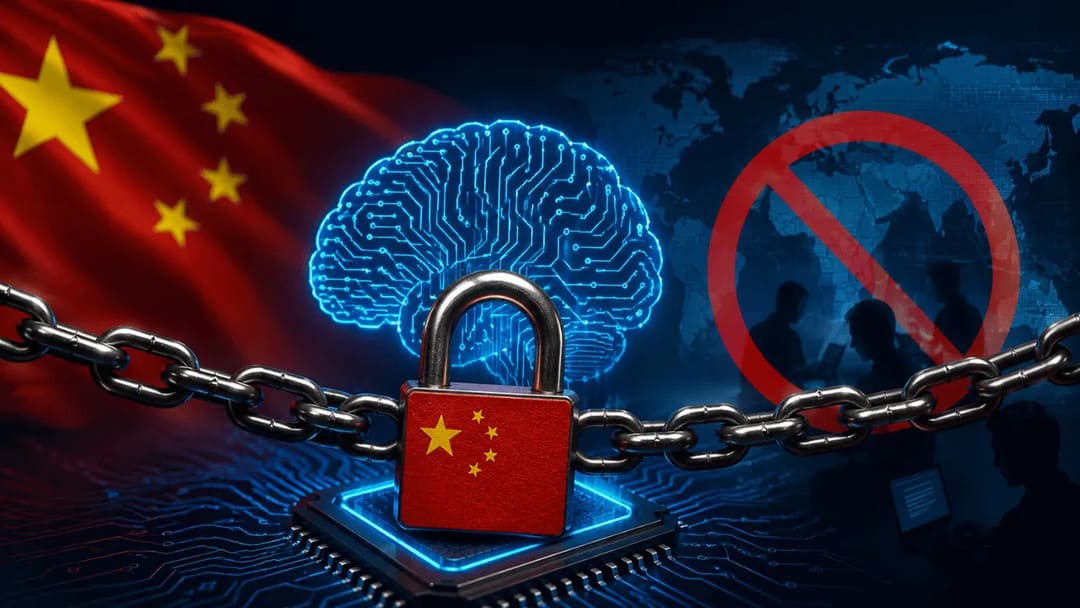
Chinese AI access is becoming a serious enterprise risk because cheap, capable models are useful only if access remains predictable. Companies shifting workloads toward Chinese AI systems may be solving today’s cost problem while creating tomorrow’s dependency problem.
That is why the latest “silicon curtain” debate matters. It belongs in the same strategic lane as AI sovereignty risk: model access, chip supply, export controls, and national policy are now part of enterprise infrastructure planning.
Chinese AI Access Is Becoming a Control Question
China is reportedly weighing restrictions on overseas access to sought-after domestic AI models as Beijing considers how to protect strategic technology. The discussion comes as DeepSeek and other Chinese AI players have drawn global interest from companies looking for lower-cost alternatives to American frontier models.
The obvious appeal is price and performance. If a Chinese model can handle coding, customer support, translation, summarization, or internal workflow tasks at lower cost, enterprises will consider it. In a market where AI compute remains expensive, cheaper capability is hard to ignore.
But access is not only a technical issue. It is a policy issue. If a government treats model weights, APIs, training methods, or inference capacity as strategic infrastructure, overseas users may face future limits.
A model can be open today and restricted tomorrow. That is the core risk behind possible model restrictions.
Open-Source Does Not Remove Geopolitical Dependency
Open-source AI often sounds like an escape from vendor lock-in. In practice, it can still depend on developers, chips, hosting providers, update channels, licenses, fine-tuning data, and national rules.
If a company builds a product around a Chinese model, it may still rely on documentation, future releases, ecosystem tools, safety patches, and compatibility updates. If policy changes affect those layers, the business impact can be real.
That is especially true for hosted versions of models. An API is not sovereignty. It is a service relationship. Even downloadable weights do not remove every dependency if the model ecosystem evolves quickly.
The smarter question is not whether Chinese models are usable. Many are. The question is how much operational risk a company accepts when a model sits inside a geopolitical system it does not control.
The pressure point is dependency hidden as openness.
What Enterprises Should Compare Before Switching
| Decision Area | Short-Term Appeal | Long-Term Risk |
|---|---|---|
| Model cost | Lower inference or deployment expense | Price advantage may depend on access rules |
| Performance | Strong enough for many business tasks | Capability may vary by domain and language |
| Hosting | APIs can be easy to adopt | Service access may change suddenly |
| Open weights | More deployment flexibility | Updates and ecosystem support still matter |
| Governance | Faster experimentation | Compliance, censorship, and audit risks |
The table shows why Chinese AI access should be evaluated like cloud, chip, or security-vendor dependency. Cost is one variable, not the whole strategy.
The Enterprise Answer Is Multi-Model Resilience
Companies do not need to reject Chinese AI systems outright. They need to avoid making any single model ecosystem a silent point of failure.
That means building multi-model routing, keeping abstraction layers between applications and model providers, testing alternatives, and documenting which workloads depend on which model. Sensitive workflows may need stricter rules than low-risk internal tools.
A company might use a Chinese model for translation, a U.S. model for advanced reasoning, a European model for regulated data, and an open-weight local model for private search. The point is not political symmetry. It is resilience.
Enterprises learned this lesson with cloud concentration. AI now needs the same discipline.
The safest architecture is portable by design.

DeepSeek’s Chip Ambition Raises the Stakes
DeepSeek’s reported work on its own AI chip underscores the deeper strategy. If Chinese AI companies reduce reliance on Nvidia hardware, they also reduce vulnerability to U.S. export controls and foreign supply pressure.
That would strengthen China’s domestic AI stack. It could also make Chinese models more resilient, cheaper, and strategically useful. But it may also increase Beijing’s desire to control access.
Research on DeepSeek has already shown why the model ecosystem matters beyond raw performance. A technical review of DeepSeek described its low-cost, high-performance model development and engineering shifts in the broader AI landscape through DeepSeek’s model evolution.
The combination of model efficiency and chip independence could make Chinese AI more attractive internationally. It could also make it more politically sensitive.
The Next Signal Is Whether Access Rules Become Formal
The next signal is whether China turns discussion into official policy. Formal restrictions would change procurement conversations quickly, especially for firms using Chinese models in products sold outside China.
The second signal is whether DeepSeek or other Chinese firms announce clearer chip roadmaps. Domestic hardware would make the Chinese AI stack more independent, but also more strategically valuable.
The third signal is how U.S. and European regulators respond. If Chinese AI access is treated as a security issue, companies may face pressure from both sides.
The fourth signal is enterprise behavior. If large firms diversify model providers more aggressively, the market will move toward multi-model architecture as a default.
Chinese AI access will remain attractive because cost pressure is real. But the next week and beyond will test whether companies understand the difference between cheap capability and dependable infrastructure.
The strongest AI strategy is not chasing the lowest-cost model. It is building systems that keep working when vendors, governments, chips, and access rules change.