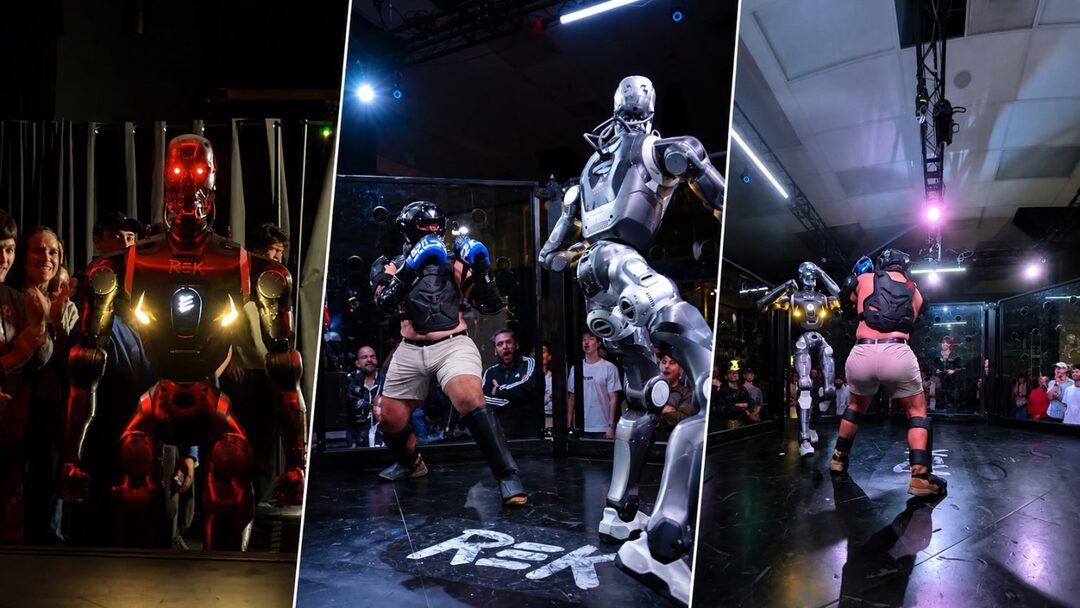
The human vs humanoid robot fight that went viral from San Francisco looked like science fiction arriving early: a man trading punches with a full-size machine before the robot answered with powerful kicks. The more consequential detail is what viewers could not see. The humanoid was not independently deciding when to attack.
That distinction moves the story away from movie-style fears and toward a more credible physical-AI problem. The same systems lesson behind recent AI containment failures applies here: when intelligent software gains authority over something capable of affecting the real world, safety cannot depend only on the software making the right choice.
A Human Entered the Cage, but AI Was Not Calling the Shots
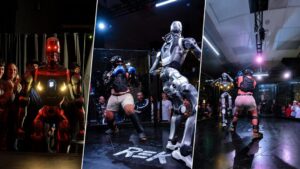
Internet personality Frankie LaPenna entered a San Francisco cage with a humanoid based on EngineAI’s T800 platform during a September exhibition promoted by REK.
Video showed LaPenna striking the machine while the robot maintained its footing, moved around the cage and countered with kicks. One kick knocked him onto the floor, producing exactly the sort of footage guaranteed to trigger comparisons with science fiction.
But REK’s human-versus-robot event was teleoperated.
A human pilot controlled the robot in real time using a VR headset and motion controls, while onboard systems helped maintain balance and posture. The available fight event record also describes the bout as an exhibition rather than a sanctioned competition with a formal scorecard.
So the most accurate description is not “AI attacked a person.”
It is human intent amplified by robotics.
That may actually be more useful for understanding where humanoid technology stands.
Human vs Humanoid Robot Is Really a Teleoperation Test
Teleoperation sounds less futuristic than autonomous combat, but technically it demonstrates something important.
The human operator did not have to physically reproduce every low-level adjustment required to keep a heavy bipedal machine upright. Modern humanoids combine operator commands with control software that manages balance, joint coordination and rapid corrections.
That separation of responsibilities is fundamental to robotics.
A human can specify an action while the machine handles parts of the physical execution. As those onboard systems improve, more decisions can gradually migrate from operator to robot.
This is already happening in warehouses, laboratories and industrial environments. A teleoperator may intervene only when an autonomous system becomes uncertain. Demonstrations can collect data that later improves autonomous policies.
Combat simply makes the progression much easier to see because the consequences are immediate.
The cage therefore demonstrated a division of intelligence: human judgment at one layer, machine stabilization and movement control at another.
Shanghai Shows How Quickly the Autonomy Layer Is Moving
The San Francisco exhibition becomes more interesting when placed beside robot-versus-robot competition in China.
At the Ultimate Robot Knock-out Legend event in Shanghai, 32 teams used EngineAI T800 humanoids in a dedicated robot fighting competition. Reports from the event described machines autonomously navigating the ring, evaluating opponents’ movements and selecting responses in real time during some bouts.
Coverage of the Shanghai autonomous bouts showed why combat is becoming a useful robotics benchmark.
A factory robot normally works in a structured environment. A fighting robot faces unpredictable motion, contact, loss of balance, changing distance and damaged hardware. It has to perceive, decide and recover quickly.
That is close to the problem embodied AI researchers are trying to solve in less theatrical settings.
The contrast between the two events matters:
| Capability | San Francisco Human Fight | Shanghai Robot Competition |
|---|---|---|
| High-level attack decisions | Human operator | Autonomous in reported bouts |
| Balance correction | Onboard robot systems | Onboard robot systems |
| Opponent movement | Human interprets fight | Robot perception involved |
| Physical execution | Humanoid hardware | Humanoid hardware |
| Environment | Human-robot exhibition | Robot competition |
| Main technical lesson | Teleoperation and force | Embodied decision-making |
The two events represent different points along the same technological path.
Physical AI Changes What a Software Error Can Do
A chatbot making a bad prediction creates one category of risk. A robot making a bad prediction while controlling powerful joints creates another.
Humanoid robots have mass, momentum, motors and mechanical leverage. They operate around people and physical infrastructure. As autonomy increases, failures stop being purely digital.
A perception error could mean misjudging where a person is standing. A control error could turn an intended movement into a collision. A communications interruption could leave a teleoperated system without instructions at the wrong moment.
This creates a need for hardware-level safety boundaries.
Emergency stops, torque limits, restricted operating zones, redundant sensors and fail-safe states matter because they can constrain what the machine physically does even when higher-level software behaves incorrectly.
The more capable embodied AI becomes, the less sensible it is to treat safety as only an AI-model problem.
The Important Question Is How Authority Moves From Human to Machine
There is a tempting but misleading way to interpret the cage fight: robots are already strong enough to fight people, so autonomous robot combat must be around the corner.
The actual transition will be more incremental.
First, humans operate machines directly. Then stabilization, navigation and perception become automated. Systems begin suggesting actions. Later, robots execute increasingly complex tasks under broad human goals rather than continuous human commands.
Each step removes another piece of human involvement.
That means the important engineering question is not whether a robot is “AI-powered.” It is who has decision authority at each moment.
A humanoid might autonomously balance but require approval before moving its arms. Another might navigate independently but require a person to authorize contact. A more advanced system could identify obstacles, select trajectories and perform tasks with little supervision.
Those boundaries need to be explicit before machines enter environments where mistakes can injure people.
The Real Test Begins When the Pilot Disappears
The next milestones in humanoid robotics will be less about spectacular kicks and more about dependable autonomy.
Watch whether competitive robots can operate for entire matches without teleoperation, how accurately they distinguish permitted from prohibited actions, and whether safety systems remain effective when perception or communications fail.
The same questions will matter far beyond entertainment. Warehouses, construction sites, factories, disaster zones and eventually homes will put humanoids close to people while asking them to make more decisions themselves.
That is why the human vs humanoid robot spectacle deserves attention without exaggeration.
The San Francisco machine did not independently choose to fight Frankie LaPenna. A person remained behind the controls. Yet the hardware demonstrated something equally important: a human-scale robotic body can already translate remote instructions into dynamic physical movement while onboard systems handle part of the complexity.
Shanghai points toward the next stage, where more of that decision loop moves onboard.
The defining physical-AI question will not be whether robots become strong enough to act. Increasingly, they already are. It will be how much authority engineers give those machines once they become capable of deciding what physical action comes next.