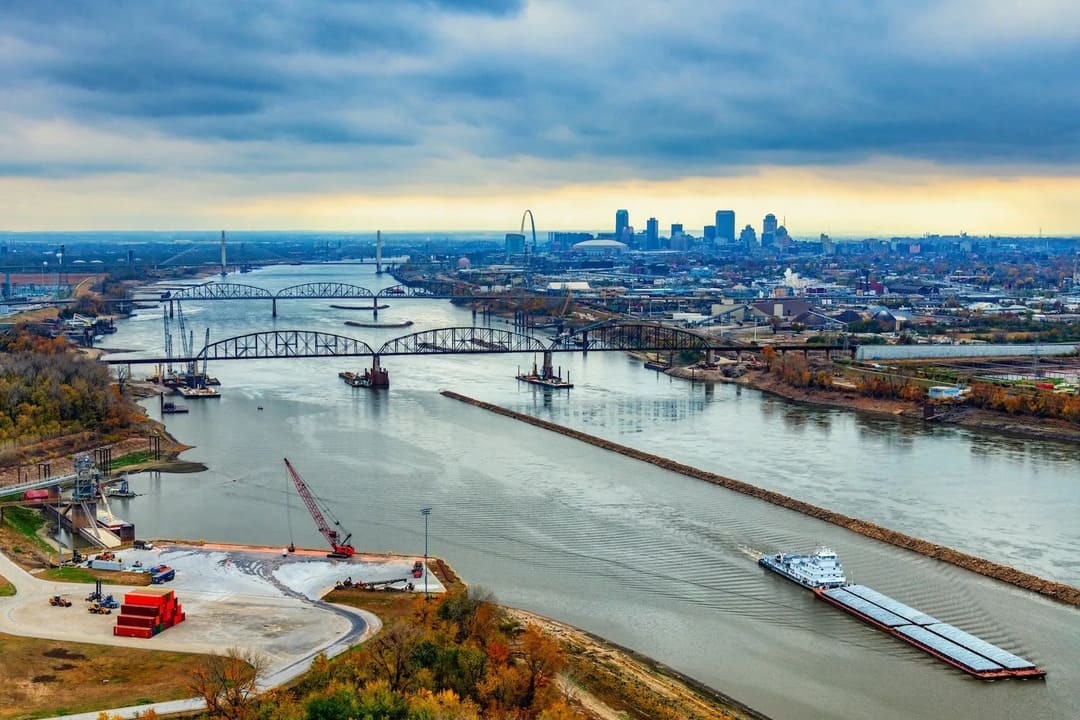
AI data center water use is becoming the next physical constraint in America’s compute buildout. Along the Mississippi River, local leaders are moving toward coordinated water protections as communities weighing AI infrastructure realize that a favorable grid connection means less if water becomes politically or physically difficult to secure.
That shift follows the same pattern already visible in data center water disputes: AI arrives as a digital investment, but communities experience it through pipes, wells, utility agreements, cooling systems and resource competition. Along the Mississippi, the emerging question is whether water permission could eventually matter as much as electrical capacity.
AI Data Center Water Use Is Becoming a Siting Constraint
Mayors representing Mississippi River communities across 10 states are building a more coordinated approach to data center development. The Mississippi River Cities & Towns Initiative said in September that more than three-quarters of its member cities had been approached about hosting some form of AI infrastructure.
That level of interest changes the stakes.
A single data center does not determine the future of a major river system, and water consumption varies dramatically depending on cooling architecture, climate, workload, facility size and whether operators use potable, reclaimed or closed-loop systems.
But clusters of hyperscale campuses create cumulative questions that individual city permitting processes may not be equipped to answer.
The coalition’s latest river compact push is therefore less about blocking AI development than creating stronger rules before projects accumulate faster than regional water policy can adapt.
The Mississippi River is not simply another utility source. It supports municipalities, agriculture, industry, transportation and ecosystems across a vast economic corridor.
The First Move Is Not Actually a Data Center Water Ban
The policy discussion needs an important distinction.
Mississippi River leaders are not proposing a blanket prohibition on cooling water for AI campuses. Their immediate legislative model comes from Missouri’s 2025 Water Preservation Act, which requires permits for most water withdrawn in Missouri and exported outside the state, subject to specific exemptions including certain uses within 30 miles of the border.
Lawmakers in Mississippi, Louisiana and Minnesota have committed to pursuing similar measures.
That means the current strategy is not a data-center ban. It is an attempt to establish stronger state control over water leaving the region and then build momentum toward a broader interstate framework.
For data center developers, that distinction matters. A facility consuming water where it is withdrawn is different from a project transporting water across state or basin boundaries.
Yet the political direction is still significant. Once states start treating water quantity as a strategic resource requiring coordinated protection, industrial users should expect closer examination of withdrawals, cooling technologies, disclosure and long-term supply planning.
AI infrastructure is entering that conversation at exactly the moment its physical footprint is expanding.
The Great Lakes Model Shows What a Compact Could Become
Mississippi River leaders have pointed toward the Great Lakes as a possible model for long-term cooperation.
The Great Lakes-St. Lawrence River Basin Water Resources Compact became state and federal law in 2008 after ratification by eight states and congressional consent. It established coordinated rules for managing basin water, generally prohibited new diversions outside the basin with limited exceptions, and created conservation and reporting frameworks.
The Great Lakes water framework shows how dramatically an interstate agreement can change the status of water. Instead of every major withdrawal being viewed only as a local development question, states operate within shared principles designed to protect the larger basin.
A Mississippi River Compact remains an ambition rather than enacted law. Creating one would require substantial political agreement across states with different industries, water laws, economic priorities and upstream-downstream interests.
The comparison nevertheless explains what is changing.
| Issue | Mississippi River Push | Great Lakes Compact |
|---|---|---|
| Current status | Developing state protections and compact support | Binding interstate compact |
| Geographic scope | Mississippi River corridor states | Eight Great Lakes states |
| Core concern | Water quantity and future withdrawals | Withdrawals, diversions and conservation |
| Data center role | Emerging driver of local concern | New large-user issue within existing framework |
| Regulatory maturity | Still developing | Operating since 2008 |
| Strategic goal | Coordinated regional protection | Established basin-wide management |
The Mississippi River does not yet have the same legal structure. But the political logic is beginning to look familiar: regional water governance may become preferable to city-by-city decisions when industrial demand scales across an entire watershed.
Water Changes the Economics of Where AI Gets Built
AI developers have spent the last several years searching for power.
That search pushed projects toward regions with available generation, transmission capacity, favorable regulation and enough land for campuses measured in hundreds of megawatts or even gigawatts.
Water adds another filter.
A location can offer inexpensive electricity and still become unattractive if cooling requires resources the community is unwilling to allocate. A technically viable site can become politically difficult if residents cannot see how much water will be consumed, whether drinking water is involved, or what happens during drought.
Developers have options. Closed-loop cooling can reduce ongoing withdrawals. Air cooling can reduce water dependency but may come with energy or performance tradeoffs in certain climates. Reclaimed wastewater can protect potable supplies. Hybrid systems can shift between modes depending on weather and operating conditions.
Those engineering choices are increasingly becoming siting choices.
The cheapest cooling architecture on paper may not be the cheapest after permitting delays, public opposition or new conservation requirements are included.
The Next Fight Will Be Over Disclosure Before Consumption
One of the clearest themes emerging from Mississippi River communities is the demand for more information before projects are approved.
Local governments need credible estimates for peak water use, normal operating demand, construction consumption, drought conditions and future expansion phases. They also need to know whether developers expect public utilities to finance new pipes, treatment capacity or pumping infrastructure.
That makes resource transparency an infrastructure requirement rather than a public-relations exercise.
The pressure will increase if multiple campuses target the same watershed. A city may comfortably accommodate one facility while a regional cluster creates a very different cumulative demand profile.
That is where interstate coordination becomes more relevant. Rivers ignore municipal and state boundaries. A withdrawal decision upstream can matter to communities that had no role in approving the project.
The next signals will be the proposed laws in Mississippi, Louisiana and Minnesota, whether additional river states join them, and whether the compact effort advances from political coordination toward a formal interstate process.
Water Is Becoming Part of the Compute Map
The AI infrastructure race is usually drawn as a map of GPUs, substations, transmission lines and fiber routes. The Mississippi River debate adds another layer.
AI data center water use will increasingly influence which communities welcome hyperscale projects, which cooling designs get approved and what developers must disclose before construction begins.
That does not mean AI data centers will drain the Mississippi River or that every large facility is inherently water-intensive. Those claims flatten a much more complicated engineering and policy problem.
The stronger lesson is that digital infrastructure can no longer assume local natural resources are simply available because a project can afford them.
Power became a strategic constraint first. Land followed. Water is moving into the same category.
If Mississippi River states eventually build a coordinated compact, AI companies will face a new reality when selecting sites: compute capacity will depend not only on where servers can be powered, but on where communities are willing to allocate the physical resources that keep those servers running.