Subsea cable telecom careers rarely receive the attention given to wireless engineering, cloud computing, or AI infrastructure. Google’s newest network expansion shows why that may change: three new undersea systems will require specialized expertise across optical networking, landing stations, marine operations, route planning, maintenance, and resilience.
Google announced Alisios, Canoa, and OlaLuz on August 11, 2026, as part of a broader Americas Connect initiative. The projects reinforce a point already visible in the changing geography of AI infrastructure: high-performance computing still depends on physical routes capable of moving enormous volumes of data reliably between regions.
Google’s New Cable Map Is Really a Workforce Map
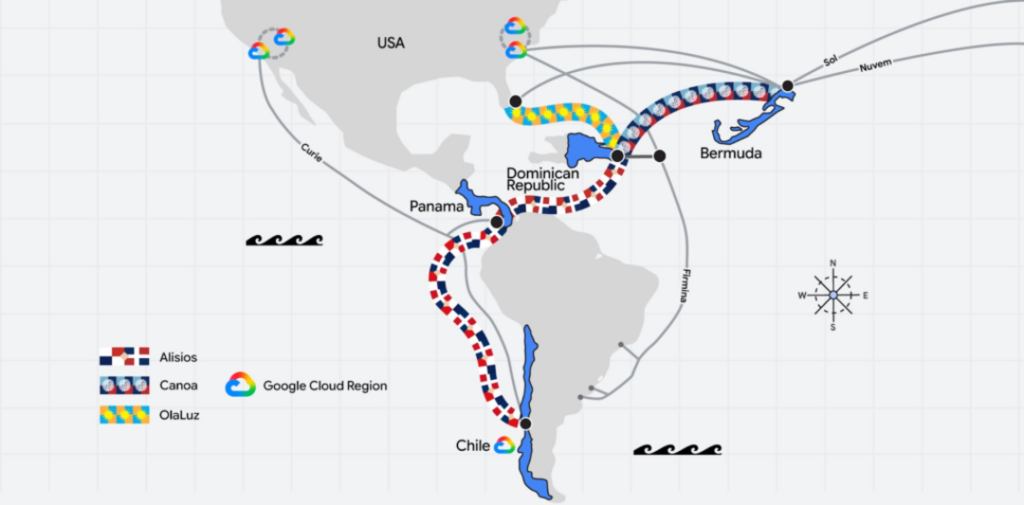
The three systems create distinct connections around a central point in the Dominican Republic. Alisios is planned to connect the Dominican Republic, Panama, and Chile. Canoa will run between the Dominican Republic and Bermuda, while OlaLuz will provide a direct route between the Dominican Republic and Florida. Google is also adding a Dominican Republic branch to its existing Firmina system.
Together, the projects form part of Google’s new Americas Connect cable plan, which is designed around multiple routes linking cloud regions across the Americas and Europe.
A cable announcement can make this infrastructure sound almost automatic: select two landing points, place fiber on the seabed, and switch it on. The real process involves years of engineering, permitting, marine surveys, equipment deployment, optical design, landing-station construction, testing, network integration, and eventually continuous operations.
That makes specialist infrastructure talent part of the expansion story.
Subsea Cable Telecom Careers Stretch Far Beyond Cable Ships
The most visible jobs in subsea infrastructure are associated with specialized vessels that install and repair cables. Those marine crews are essential, but they represent only one part of a much larger technical ecosystem.
Optical transport engineers work on the systems that move signals across extreme distances. Network planners determine how new capacity connects with terrestrial fiber, cloud facilities, internet exchanges, and existing submarine systems. Landing-station technicians maintain the equipment where the wet segment of a cable meets terrestrial networks.
Marine route specialists evaluate seabed conditions, hazards, water depth, existing infrastructure, and possible installation paths. Operations teams then need to monitor the system after commissioning and coordinate repairs when damage or equipment failure affects service.
The industry itself is attempting to broaden its talent pipeline. The SubOptic Foundation now promotes subsea education pathways covering digital infrastructure, submarine cable engineering, project management, economics, regulation, environmental considerations, operations, and maintenance.
For telecom professionals, that range is significant. Subsea work is multidisciplinary, not a career available only to people with maritime backgrounds.
Landing Stations Turn Geography Into Technical Work
A submarine cable does not become useful simply because it reaches land. Its landing station must connect the undersea system to terrestrial fiber networks and onward to data centers, cloud regions, carrier facilities, and other interconnection points.
Google’s network design illustrates that relationship clearly. Americas Connect is intended to create multiple paths between Chile, Panama, the Caribbean, the U.S. East Coast, the U.S. West Coast, Bermuda, and European infrastructure. Different routes are intended to improve reach while reducing dependence on a single path.
That architecture creates work for engineers who understand both optical transmission and network topology. A cable route may span an ocean, but performance and resilience can still depend on what happens inside a landing station or along the terrestrial fiber route immediately beyond it.
Professionals with experience in DWDM, optical testing, fiber characterization, network monitoring, power systems, structured maintenance, or carrier interconnection may therefore find parts of their existing skill set surprisingly transferable.
The opportunity is less about abandoning conventional telecom knowledge and more about applying familiar skills offshore.
AI and Cloud Traffic Raise the Reliability Stakes
Subsea cable investment is becoming closely linked with cloud infrastructure because geographic separation matters less when reliable high-capacity connections can move workloads and data efficiently between regions.
AI adds another reason to care about those links. Training clusters, cloud services, storage platforms, inference systems, and users may exist in different countries or on different continents. The infrastructure connecting those locations becomes part of the practical AI stack even though it sits far below the application layer.
Reliability also changes the type of expertise operators need. The International Telecommunication Union has identified physical damage, repair delays, geographic concentration, and dependence on limited numbers of systems as important resilience challenges for submarine communications infrastructure.
Building additional routes can reduce some concentration risk, but redundancy has to be engineered rather than assumed. Route diversity must be real at the seabed, landing point, terrestrial backhaul, and network levels.
That creates a role for people who can think beyond raw bandwidth and understand failure domains.
The Skills That Will Matter as Americas Connect Expands
Google has not publicly provided capacity figures or operational dates for Alisios, Canoa, and OlaLuz in its initial announcement. That leaves several important project milestones ahead, including engineering, deployment, landing infrastructure, integration, and commissioning.
For professionals interested in this niche, optical networking remains an obvious foundation. Knowledge of fiber transmission, DWDM systems, attenuation, amplification, testing, and fault isolation can translate directly into submarine-network environments.
Project and infrastructure skills matter too. Cable systems cross jurisdictions and involve marine surveys, environmental processes, landing permits, equipment suppliers, construction teams, terrestrial carriers, and international network operators. Engineers who understand technology while coordinating complex infrastructure projects can become especially valuable.
Cybersecurity and resilience skills are also becoming harder to separate from network engineering. Landing stations and network-management systems form part of critical communications infrastructure, so access control, monitoring, physical security, redundancy, incident response, and continuity planning all matter.
Perhaps the strongest advantage is cross-domain knowledge. Someone who understands optical networks but can also discuss cloud architecture, data centers, routing, infrastructure resilience, or marine operations can bridge teams that traditionally work in separate specialties.
Subsea Cable Telecom Careers Are Becoming Harder to Ignore
Google’s latest cable expansion does not guarantee a sudden wave of specific jobs in every country along the route. It does show that the physical internet continues to expand even as technology conversations concentrate increasingly on software and AI.
That makes subsea cable telecom careers worth a closer look for network engineers, fiber specialists, infrastructure planners, technicians, and early-career professionals deciding where to specialize. The work sits at the intersection of terrestrial networking, optical engineering, cloud infrastructure, marine operations, and international connectivity.
AI may be driving unprecedented demand for compute, but compute has little value when data cannot move reliably between users, facilities, and regions. The people designing, installing, operating, and protecting those routes are becoming part of the infrastructure story behind the AI boom.
Frequently asked questions
What careers are available in the subsea cable industry?
Roles include optical transport engineering, landing-station operations, marine route planning, cable installation and repair, network design, project management, fiber testing, infrastructure security, regulatory work, and network resilience planning.
Do you need maritime experience to work with submarine cables?
Not necessarily. Many roles are land-based and draw on telecom, optical networking, data center, project-management, cybersecurity, engineering, or regulatory experience. Marine expertise becomes more important for installation, survey, and offshore operations positions.
What networking skills are useful for subsea cable careers?
Fiber optics, DWDM, optical testing, fault isolation, routing, network monitoring, terrestrial backhaul, redundancy planning, and infrastructure troubleshooting are particularly relevant. Broader cloud and data center knowledge can also strengthen a candidate’s profile.
Why are cloud companies investing in submarine cables?
Submarine systems provide high-capacity international routes connecting users, cloud regions, data centers, and other digital infrastructure. Multiple geographically diverse routes can also improve resilience when another connection experiences disruption.
Will AI increase demand for subsea cable specialists?
AI growth can increase the importance of high-capacity connectivity between data centers, cloud regions, and users. That does not guarantee particular job numbers, but it strengthens the strategic importance of the infrastructure subsea specialists operate.